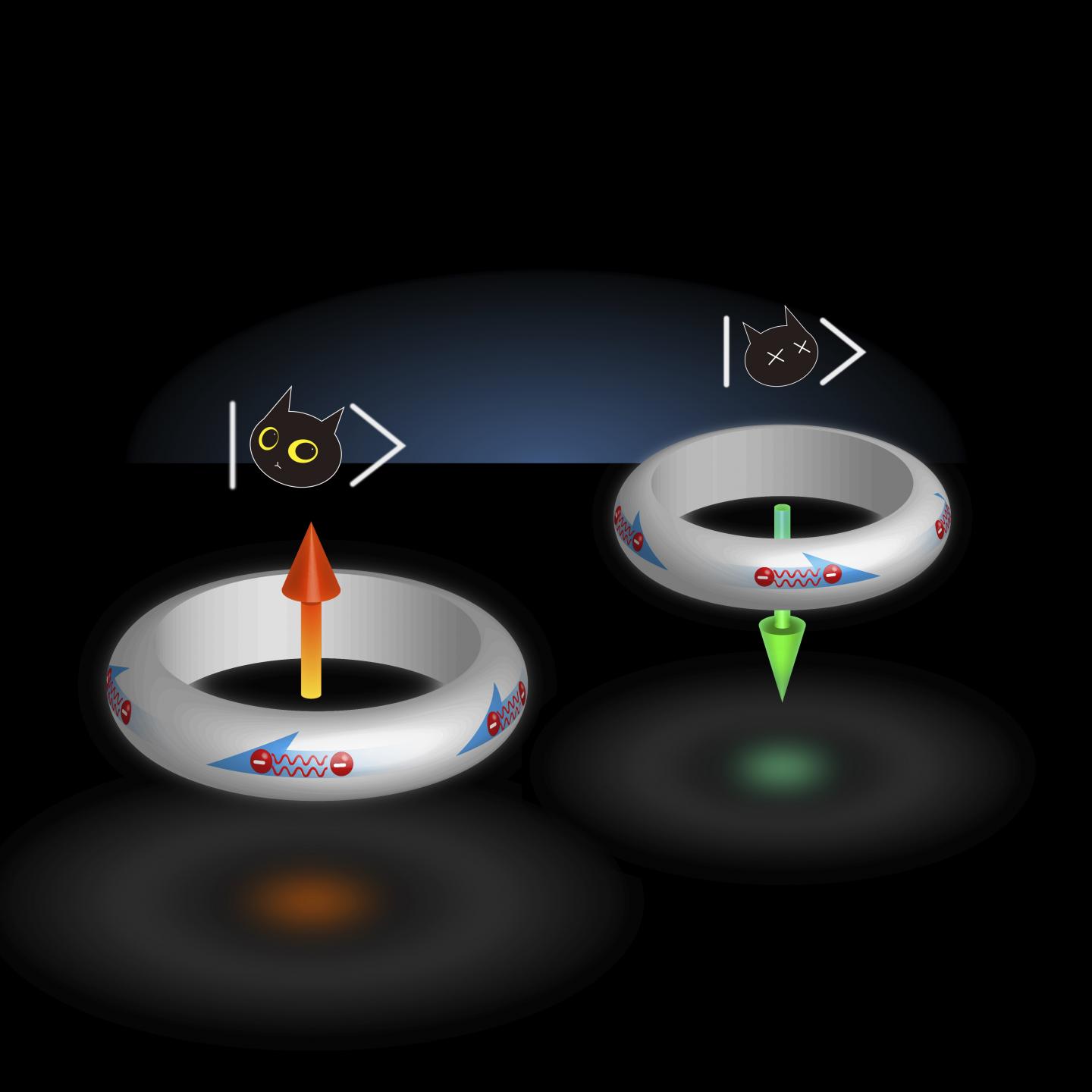
Credit: Yufan Li
Quantum computers with the ability to perform complex calculations, encrypt data more securely and more quickly predict the spread of viruses, may be within closer reach thanks to a new discovery by Johns Hopkins researchers.
“We’ve found that a certain superconducting material contains special properties that could be the building blocks for technology of the future,” says Yufan Li, a postdoctoral fellow in the Department of Physics & Astronomy at The Johns Hopkins University and the paper’s first author.
The findings will be published October 11 in Science.
Today’s computers use bits, represented by an electrical voltage or current pulse, to store information. Bits exist in two states, either “0” or “1.” Quantum computers, based on the laws of quantum mechanics, use quantum bits, or qubits, which do not only use two states, but a superposition of two states.
This ability to use such qubits makes quantum computers much more powerful than existing computers when solving certain types of problems, such as those relating to artificial intelligence, drug development, cryptography, financial modeling and weather forcasting.
A famous example of qubit is Schrodinger’s cat, a hypothetical cat that may be simultaneously dead and alive.
“A more realistic, tangible implementation of qubit can be a ring made of superconducting material, known as flux qubit, where two states with clockwise- and counterclockwise-flowing electric currents may exist simultaneously,” says Chia-Ling Chien, Professor of Physics at The Johns Hopkins University and another author on the paper. In order to exist between two states, qubits using traditional superconductors require a very precise external magnetic field be applied on each qubit, thus making them difficult to operate in a practical manner.
In the new study, Li and colleagues found that a ring of β-Bi2Pd already naturally exists between two states in the absence of an external magnetic field. Current can inherently circulate both clockwise and counterclockwise, simultaneously, through a ring of β-Bi2Pd.
Adds Li: “A ring of β-Bi2Pd already exists in the ideal state and doesn’t require any additional modifications to work. This could be a game changer.”
The next step, says Li, is to look for Majorana fermions within β-Bi2Pd; Majorana fermions are particles that are also anti-particles of themselves and are needed for the next level of disruption-resistant quantum computers: topological quantum computers.
Majorana fermions depend on a special type of superconducting material–a so-called spin-triplet superconductor with two electrons in each pair aligning their spins in a parallel fashion–that has thus far been elusive to scientists. Now, through a series of experiments, Li and colleagues found that thin films of β-Bi2Pd have the special properties necessary for the future of quantum computing.
Scientists have yet to discover the intrinsic spin-triplet superconductor needed to advance quantum computing forward, but Li is hopeful that the discovery of β-Bi2Pd’s special properties, will lead to finding Majorana fermions in the material next.
“Ultimately, the goal is to find and then manipulate Majorana fermions, which is key to achieving fault-tolerant quantum computing for truly unleashing the power of quantum mechanics,” says Li.
###
Other authors on this paper include Xiaoying Xu of Johns Hopkins University; and M.-H. Lee and M.-W. Chu of National Taiwan University.
The U.S. Department of Energy, Basic Energy Science (DESC0009390) provided funding for this work.
Media Contact
Chanapa Tantibanchachai
[email protected]
928-458-9656