Device could save on PPE and restore more time for patient care
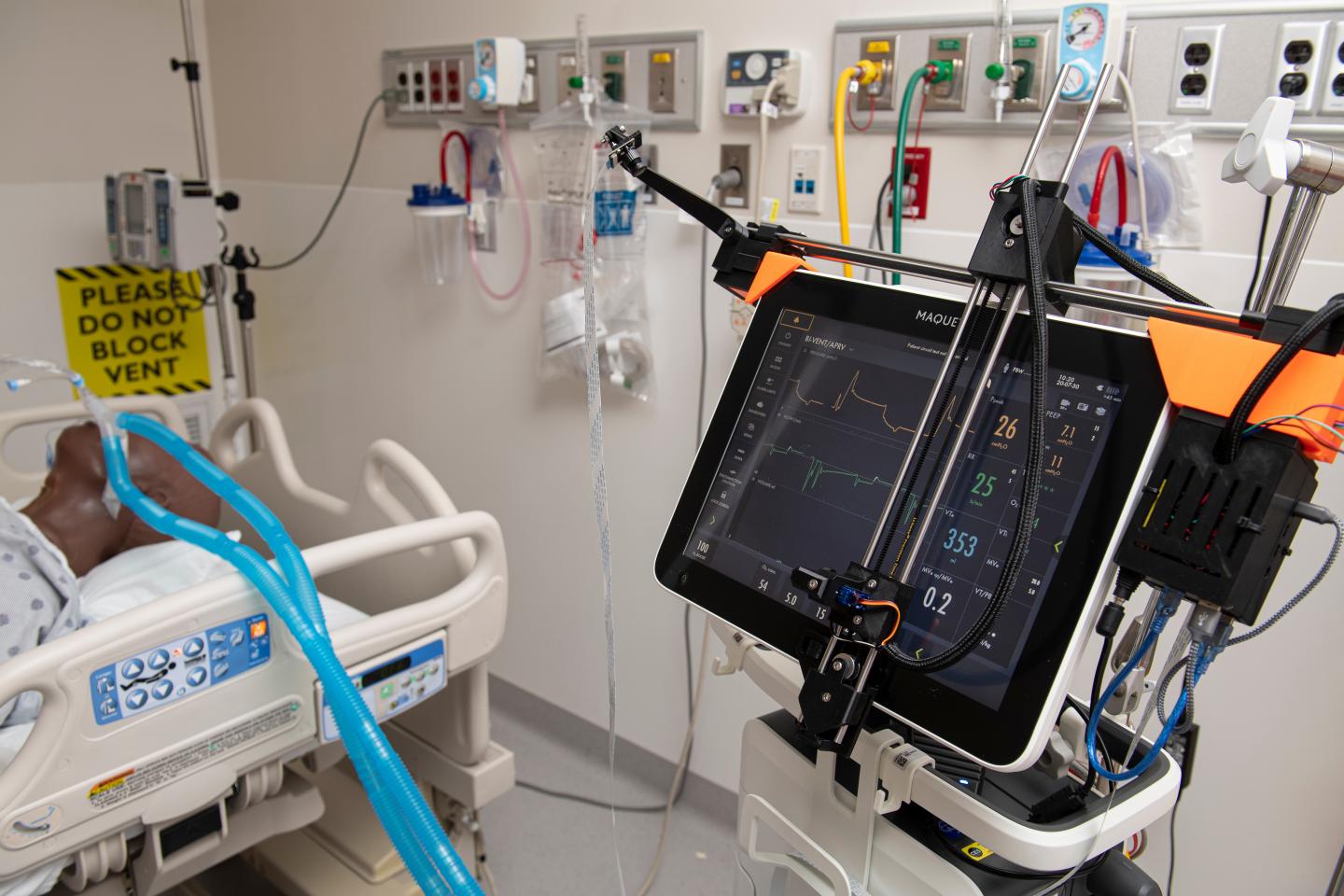
Credit: Will Kirk, Johns Hopkins University
A new robotic system allows medical staff to remotely operate ventilators and other bedside machines from outside intensive care rooms of patients suffering from infectious diseases.
The system, developed by a team of Johns Hopkins University and Medicine researchers, is still being tested, but initial trials have demonstrated how it could be deployed to help hospitals preserve protective gear, limit staff exposure to COVID-19 and provide more time for clinical work.
The invention’s rapid development since March is the result of a collaboration between robotics researchers from the Whiting School of Engineering and respiratory clinical staff from Johns Hopkins Medicine, working together to tackle one of the most vexing treatment issues to arise during the pandemic.
“When the crisis began to get very severe we started to think about what we could do to help,” said robotics professor Russell Taylor, who specializes in computer-integrated interventional medicine and supervised the effort. “One of the needs that came through very clearly was the challenge of providing care to patients on ventilators in intensive care units.”
Sajid H. Manzoor, director of adult respiratory therapy at Johns Hopkins Hospital, saw those challenges first-hand. “Two of the toughest challenges we faced at the peak of COVID-19 were staffing and PPE,” Manzoor said.
The need was identified early in the pandemic during brainstorming sessions with robotics researchers and medical staff from Johns Hopkins and the University of Maryland. Those in attendance identified several bottlenecks to delivering care that might benefit from robotic solutions, including testing patients, disinfecting and cleaning, and operating ICU ventilators.
The pandemic spurred a massive surge of highly infectious, intensive care patients requiring ventilators, infusion pumps and other support equipment. Treating them requires hospital personnel to change protective gear every time they enter rooms, even for minor adjustments to machines.
The process burns through limited supplies of personal protective equipment and wastes the precious time of medical staff. In addition, personnel are stretched thin because security procedures require that an additional person assist with the changing of gowns, gloves, masks and other gear.
“This remote-control system will be a force multiplier for our frontline clinicians,” said Jonathan Cope, a respiratory therapist who assisted with the project. “Being able to save time to deliver more care to more patients will pay huge dividends when we face massive patient surges during pandemics.”
The system could help hospitals handle all types of infectious diseases.
During one brainstorming session in March, researchers and clinicians from Hopkins and UM seized on the remote control idea floated by University of Maryland Shock Trauma Center’s Sarah Murthi.
UM computer science graduate student Misha Khrenov – working under computer science professor Axel Krieger, who joined Hopkins in July – and Johns Hopkins LCSR research scientist Balázs P. Vágvölgyi built the working prototype.
The robotic device is affixed to the ventilator’s touch screen with a horizontal bar secured across the top edge. The bar serves as a stationary track for the back-and-forth movement of two connected vertical bars that extend the full height of the screen. As the vertical bars sweep across the screen, a stylus they carry moves up and down according to its commands, similar to how an Etch A Sketch moves its drawing tool along an X-Y axis. A camera connected to the top bar sends an image of the screen to the operator’s tablet outside the room.
During a recent test at the Johns Hopkins Hospital Biocontainment Unit, Cope used the tablet to change oxygen percentage and volume delivered by a ventilator attached to a mannequin in an adjoining room.
“Whether it’s for Covid or the next pandemic, there is always going to be a need for this,” he said. “It will definitely end up in the ICU environment in the coming years.”
###
Reporters interested in the project can contact Doug Donovan at 443-462-2947.
Johns Hopkins University news releases are available online, as is information for reporters. To arrange a video or audio interview with a Johns Hopkins expert, contact a media representative listed above or visit our studio web page. Find more Johns Hopkins stories on the Hub.
Media Contact
Doug Donovan
[email protected]