For decades, scientists have marveled at nitrogenase, the metalloenzyme that performs one of the most consequential chemical reactions on Earth: pulling nitrogen gas out of the atmosphere and converting it into ammonia, the form of nitrogen that fuels all life. Bacterial versions of this enzyme have been studied intensively since the 1960s, their structures solved and their catalytic cycles mapped in exquisite detail. Yet the archaeal branch of life, the domain that includes many of the planet’s most ancient microbes, has kept its nitrogenase secrets hidden. Now, a team led by Rajnandani Kashyap and Edwin Antony at Saint Louis University, together with Daniel Lessner at the University of Arkansas and colleagues, has captured the first atomic-resolution view of a nitrogenase from a methane-producing archaeon, and what they found is unlike anything seen in bacteria.
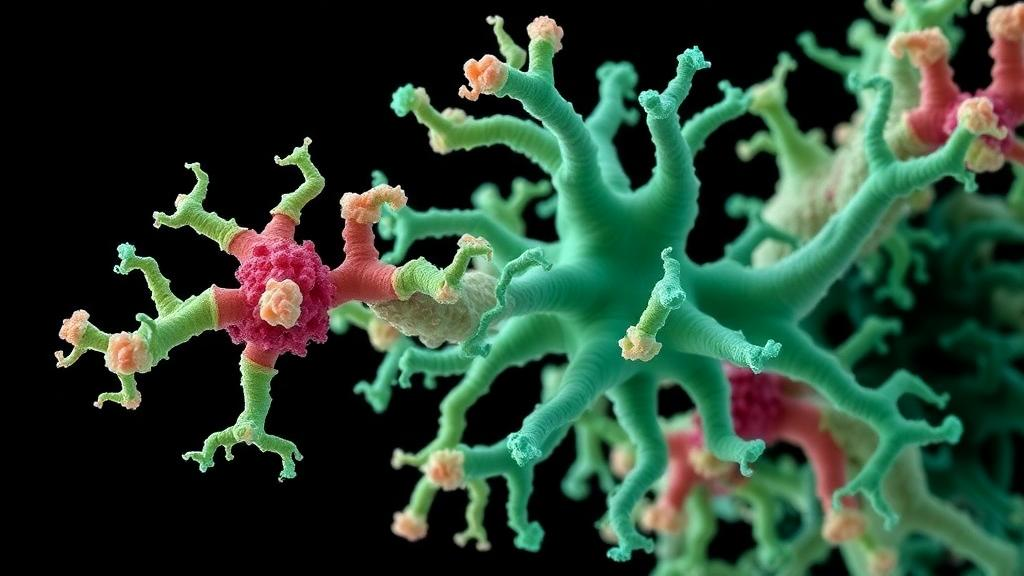
Using cryo-electron microscopy, the researchers imaged a native supercomplex purified directly from Methanosarcina acetivorans, a methanogenic archaeon that thrives in oxygen-free environments such as wetland sediments and the guts of animals. The structure, published in Nature, reveals a colossal molecular machine assembled from three copies of the catalytic NifDK heterotetramer, the component that houses the iron-molybdenum cofactor where dinitrogen is actually reduced, bridged by six copies of a heterotrimeric PII protein complex called NifI1,2. This arrangement creates a massive assembly of roughly 900 kilodaltons, a molecular behemoth that had never been observed in any nitrogenase system before.
The architectural logic of the supercomplex is as elegant as it is surprising. Each of the six NifI heterotrimers binds to a NifDK tetramer at precisely the site where NifH, the iron protein that delivers electrons to the catalytic core, would normally dock. In other words, the PII proteins act as molecular gatekeepers, physically blocking the electron donor from reaching its target. By occupying these docking sites, the NifI complexes lock the entire enzyme assembly into an inactive state, a strategy that ensures nitrogen fixation, an enormously energy-expensive process consuming sixteen ATP molecules per molecule of ammonia, does not proceed when conditions do not warrant it.
What makes this regulatory mechanism particularly remarkable is how it couples nitrogenase activity directly to the metabolic state of the cell. The cryo-EM maps revealed that the six NifI complexes within the supercomplex bind their ligands asymmetrically: some pockets hold ADP, the low-energy signal that accumulates when cellular energy reserves are depleted, while others bind 2-oxoglutarate, a central metabolite whose abundance reflects the nitrogen status of the cell. When nitrogen is plentiful and energy is scarce, the ligand pattern favors supercomplex formation and nitrogenase shutdown. When the researchers added 2-oxoglutarate and ATP to the purified supercomplex in vitro, the NifI complexes were released, and NifDK activity surged threefold, demonstrating that the same metabolites that signal nitrogen starvation and energy abundance serve as the keys that unlock the enzyme.
PII proteins are among the most widespread signal transduction proteins in nature, found across bacteria, archaea and even plant plastids, where they sense the levels of ATP, ADP and 2-oxoglutarate to coordinate nitrogen metabolism. In bacteria, PII proteins typically regulate nitrogenase through post-translational modifications such as adenylylation of the iron protein, or through direct but transient interactions. The methanogen supercomplex represents a fundamentally different strategy: rather than modifying the enzyme chemically, the cell assembles it into a higher-order structure whose very formation determines whether catalysis can occur. This oligomerization-based control mechanism had been suspected from earlier biochemical work in the related archaeon Methanococcus maripaludis, where Dodsworth and Leigh showed in 2006 that a PII-like protein binds directly to dinitrogenase in a manner reversed by 2-oxoglutarate, but the structural basis had remained elusive until now.
Obtaining the structure was a formidable technical challenge. Nitrogenase is notoriously oxygen-sensitive, its metal clusters destroyed almost instantly by exposure to air, so the team had to prepare cryo-EM grids under strictly anoxic conditions, following protocols recently developed for air-sensitive nitrogenase proteins. The researchers combined genetic tools, including a CRISPRi-dCas9 system adapted for archaea, with affinity purification of a Strep-tagged NifD subunit to pull down the native complex from M. acetivorans cell extracts. Mass photometry confirmed the existence of the enormous supercomplex species in solution, while mass spectrometry verified the presence of the homocitrate ligand on the iron-molybdenum cofactor. Multiple structural states were resolved, ranging from PII-free NifDK tetramers to partially occupied assemblies and the fully formed three-unit supercomplex, allowing the team to reconstruct the assembly pathway step by step.
The structural analysis also yielded insights into how the NifI heterotrimers achieve their regulatory grip. Comparison with the well-characterized bacterial PII protein GlnK showed that the NifI complexes retain the canonical three ligand-binding pockets of the PII family, but with distinctive occupancy patterns across the six trimers in the supercomplex. The T-loops, the signature regulatory elements of PII proteins that project from each subunit, participate in the interface with NifDK. The asymmetric binding of ADP and 2-oxoglutarate across the six NifI complexes suggests that the supercomplex can integrate graded metabolic information, with the collective occupancy state of the twelve NifI subunits determining the stability of the entire assembly and thus the fraction of nitrogenase held in the inactive pool.
The evolutionary implications are equally compelling. Methanogens occupy a special place in debates about the origin of biological nitrogen fixation, with some analyses suggesting that molybdenum-dependent nitrogenase may have first emerged in methanogenic archaea before spreading to bacteria. Evidence of nitrogen fixation in methanogens dates back to biochemical studies of Methanosarcina barkeri in the late 1980s, yet archaeal nitrogenases have remained structurally uncharacterized until this work. The discovery that archaea regulate nitrogenase through PII-driven oligomerization, a mechanism apparently absent from the bacterial playbook, hints at deep evolutionary diversity in how the nitrogen cycle’s central enzyme is controlled, and raises questions about whether similar supercomplexes exist in other archaeal lineages.
Beyond its evolutionary significance, the finding opens concrete avenues for biotechnology. Nitrogenase is the only known enzyme capable of reducing atmospheric dinitrogen at ambient temperature and pressure, in stark contrast to the industrial Haber-Bosch process, which consumes vast amounts of fossil energy. Engineers attempting to transfer nitrogen fixation into crops or to design synthetic nitrogen-fixing microbes have long been frustrated by the enzyme’s complexity and its elaborate regulation. Understanding how a PII scaffold can reversibly lock and unlock nitrogenase through simple metabolite signals offers a design principle for tunable nitrogenase systems, whether the goal is engineering controlled release of activity in synthetic consortia or protecting the enzyme during heterologous expression. The structure also complements recent work on bacterial protective proteins such as Shethna protein II, which guards nitrogenase from oxygen damage, together painting a picture of nitrogenase as an enzyme whose activity is managed at the level of large-scale assembly rather than solely through individual catalytic cycles.
As the first structure of an archaeal nitrogenase regulatory supercomplex, this work transforms a long-standing biochemical curiosity into a detailed molecular mechanism. It shows that the ancient methanogens, organisms living at the thermodynamic edge of life, evolved a solution to the nitrogenase control problem that is both structurally dramatic and metabolically precise, and it hands researchers a new structural template for exploring the regulation, evolution and engineering of the enzyme that sustains the global nitrogen cycle.
Subject of Research: Cryo-EM structure and metabolite-regulated assembly of a methanogen nitrogenase-PII protein supercomplex
Article Title: Cryo-EM structure of a methanogen nitrogenase–PII protein supercomplex
Article References: Kashyap, R., Deere, T. M., Dhamad, A., Chanderban, M., Tokmina-Lukaszewska, M., Bothner, B., Lessner, D. J., & Antony, E. (2026). Cryo-EM structure of a methanogen nitrogenase–PII protein supercomplex. Nature. https://doi.org/10.1038/s41586-026-11116-z
Image Credits: AI Generated
DOI: 10.1038/s41586-026-11116-z
Keywords: nitrogenase, cryo-EM, methanogen, PII proteins, Methanosarcina acetivorans, nitrogen fixation, NifDK, NifI, 2-oxoglutarate, metalloenzyme, archaea, enzyme regulation
News Source: Denise Maddox. (October 7, 2026). Ancient Microbe’s Nitrogenase Caught in Action by Cryo-EM Reveals a Giant Off-Switch Supercomplex. Scienmag.