• HOME
  • NEWS
  • EXPLORE
    • CAREER
      • Companies
      • Jobs
    • EVENTS
    • iGEM
      • News
      • Team
    • PHOTOS
    • VIDEO
    • WIKI
  • BLOG
  • COMMUNITY
    • FACEBOOK
    • INSTAGRAM
    • TWITTER
Friday, May 22, 2026
BIOENGINEER.ORG
No Result
View All Result
  • Login
  • HOME
  • NEWS
  • EXPLORE
    • CAREER
      • Companies
      • Jobs
        • Lecturer
        • PhD Studentship
        • Postdoc
        • Research Assistant
    • EVENTS
    • iGEM
      • News
      • Team
    • PHOTOS
    • VIDEO
    • WIKI
  • BLOG
  • COMMUNITY
    • FACEBOOK
    • INSTAGRAM
    • TWITTER
  • HOME
  • NEWS
  • EXPLORE
    • CAREER
      • Companies
      • Jobs
        • Lecturer
        • PhD Studentship
        • Postdoc
        • Research Assistant
    • EVENTS
    • iGEM
      • News
      • Team
    • PHOTOS
    • VIDEO
    • WIKI
  • BLOG
  • COMMUNITY
    • FACEBOOK
    • INSTAGRAM
    • TWITTER
No Result
View All Result
Bioengineer.org
No Result
View All Result
Home NEWS Science News Chemistry

It’s what’s inside that matters: Locking up proteins enables cancer metastasis

Bioengineer by Bioengineer
March 3, 2020
in Chemistry
Reading Time: 3 mins read
0
IMAGE
Share on FacebookShare on TwitterShare on LinkedinShare on RedditShare on Telegram

IMAGE

Credit: Department of Biochemistry,TMDU


Researchers from Tokyo Medical and Dental University (TMDU) discover a novel mechanism by which claudin-1 contributes to the progression of tongue squamous cell carcinoma

Tokyo, Japan – While it is known that most cancers try to grow and spread to the rest of the body, for many cancers it is unclear how they actually achieve taking over the host’s body. In a new study published in Cancer Science, researchers from Tokyo Medical and Dental University (TMDU) revealed a novel mechanism by which tongue squamous cell carcinoma (TSCC) exploits a protein whose task actually is to keep the tissue together.

A group of cells, also called tissue, is held together by a number of proteins that form a complex called tight junctions on the cell surface. Their function is to provide stability to the tissue as well as to prevent leakage of transported solutes and water by ensuring that molecules only pass through, and not between, the cells. One of the proteins that is part of tight junctions is claudin-1. Several studies have shown that claudin-1 plays an important role in several cancers, such as oral, gastric, liver and colon cancer.

“The amount of claudin-1 that a cancer makes has not been shown to correlate with how malignant that cancer is,” says corresponding author of the study Miki Hara-Yokoyama. “The goal of our study was to understand at the molecular level how claudin-1 is involved in cancer progression.”

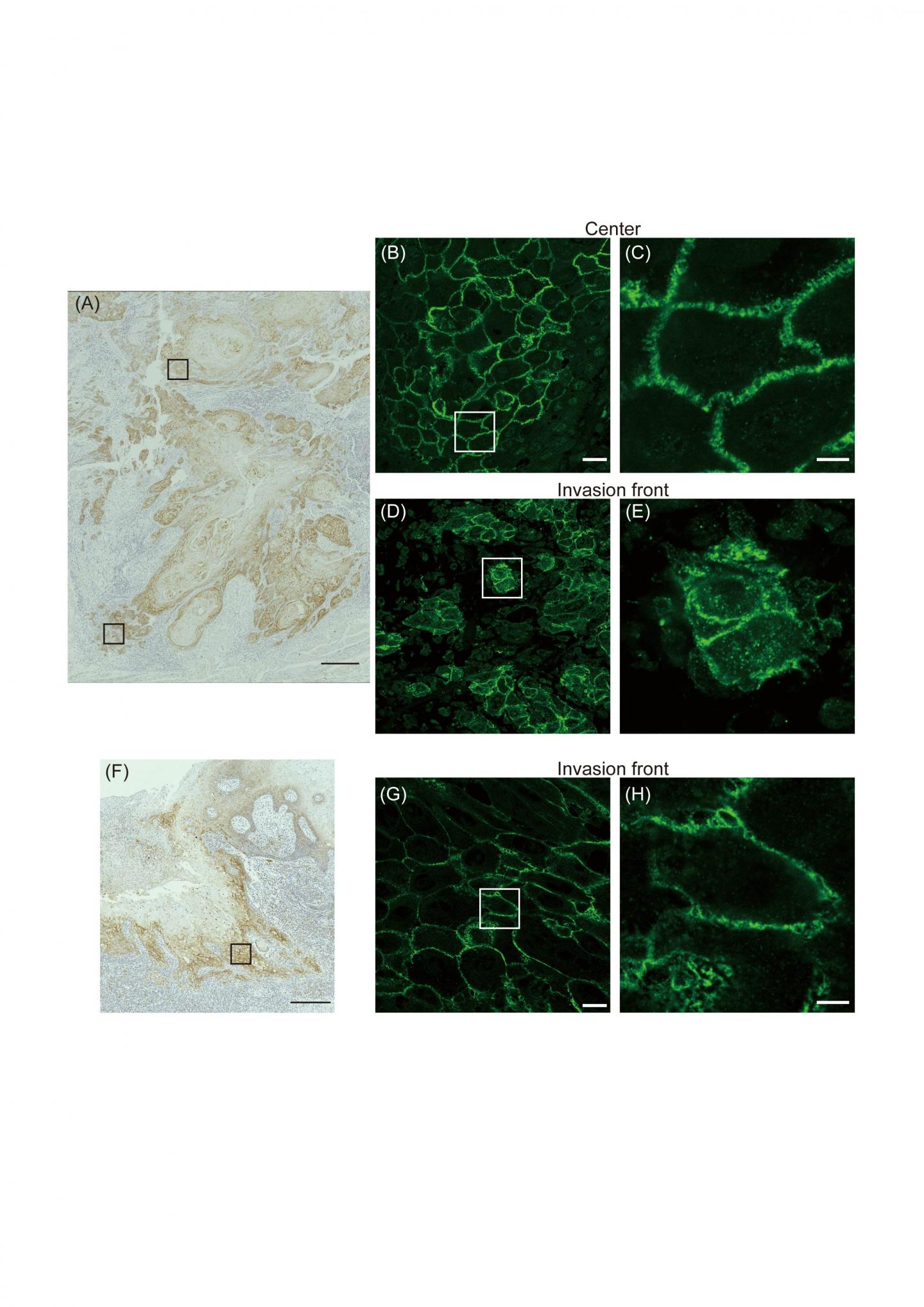
To achieve their goal, the researchers investigated specimens from patients with TSCC for the amount of claudin-1 produced by the cancer, as well as where in the cancer cell the protein is located. Given that claudin-1 is part of tight junctions, one might expect that they are naturally localized to the cell surface. It turns out it is not that simple.

“We know that localization is a key determinant of protein function. So we wanted to know if the localization of claudin-1 was connected to the progression of TSCC,” says lead author of the study Daisuke Yamamoto.

The researchers found that although the total amount of claudin-1 in TSCC cells and the invasiveness of the cancer were not associated, the amount of claudin-1 localized to the interior of the cell increased with the degree of cervical lymph node metastasis. They then isolated cells from TSCC and showed that when claudin-1 is locked within the cells or when the cells are entirely depleted of claudin-1, the cancer cells become more migratory.

“These are striking results that show how cancer cells break free from a tissue and increase their motility to invade lymph nodes and other organs of the body,” says Hara-Yokoyama. “Invasive cancers that are capable of spreading and disabling vital organ functions are often very difficult to contain. Our findings could offer a novel therapy to prevent cancers from progressing and metastasizing.”

###

The article, “Intracellular claudin-1 at the invasive front of tongue squamous cell carcinoma is associated with lymph node metastasis,” was published in Cancer Science at DOI: 10.1111/cas.14249

Media Contact
Miki YOKOYAMA
[email protected]

Original Source

http://www.tmd.ac.jp/english/press-release/20191223_1/index.html

Related Journal Article

http://dx.doi.org/10.1111/cas.14249

Tags: BiochemistryBiologyCell BiologyMolecular Biology
Share12Tweet8Share2ShareShareShare2

Related Posts

Scientists Achieve Breakthrough in Molecular ‘Sandwich’ Assembly — Chemistry

Scientists Achieve Breakthrough in Molecular ‘Sandwich’ Assembly

May 21, 2026
Advancing In Vivo and In Situ Monitoring: Science Bulletin Highlights Host-Based Antifouling Gold Nanotube Sensor for Selective Detection of Mechanically Sensitive Serotonin Release in Intestinal Mucosa — Chemistry

Advancing In Vivo and In Situ Monitoring: Science Bulletin Highlights Host-Based Antifouling Gold Nanotube Sensor for Selective Detection of Mechanically Sensitive Serotonin Release in Intestinal Mucosa

May 20, 2026

How Magnetic Orientation Could Influence the Building Blocks of Life

May 20, 2026

Breaking a 200-Year-Old Belief: Novel Surface Design Achieves Two Distinct Wetting States on One Substrate

May 20, 2026
Please login to join discussion

POPULAR NEWS

  • blank

    New Study Reveals Plants Can Detect the Sound of Rain

    733 shares
    Share 292 Tweet 183
  • ESMO 2025: mRNA COVID Vaccines Enhance Efficacy of Cancer Immunotherapy

    304 shares
    Share 122 Tweet 76
  • Research Indicates Potential Connection Between Prenatal Medication Exposure and Elevated Autism Risk

    846 shares
    Share 338 Tweet 212
  • Breastmilk Balances E. coli and Beneficial Bacteria in Infant Gut Microbiomes

    58 shares
    Share 23 Tweet 15

About

We bring you the latest biotechnology news from best research centers and universities around the world. Check our website.

Follow us

Recent News

Innovative Reusable Brick Walls Revolutionize Construction Industry

Nonlinear Atomic Tunneling Enhanced by Bright Squeezed Vacuum

Label-Free Super-Resolution Imaging of Live Cells

Subscribe to Blog via Email

Success! An email was just sent to confirm your subscription. Please find the email now and click 'Confirm' to start subscribing.

Join 82 other subscribers
  • Contact Us

Bioengineer.org © Copyright 2023 All Rights Reserved.

Welcome Back!

Login to your account below

Forgotten Password?

Retrieve your password

Please enter your username or email address to reset your password.

Log In
No Result
View All Result
  • Homepages
    • Home Page 1
    • Home Page 2
  • News
  • National
  • Business
  • Health
  • Lifestyle
  • Science

Bioengineer.org © Copyright 2023 All Rights Reserved.