• HOME
  • NEWS
  • EXPLORE
    • CAREER
      • Companies
      • Jobs
    • EVENTS
    • iGEM
      • News
      • Team
    • PHOTOS
    • VIDEO
    • WIKI
  • BLOG
  • COMMUNITY
    • FACEBOOK
    • INSTAGRAM
    • TWITTER
Thursday, July 2, 2026
BIOENGINEER.ORG
No Result
View All Result
  • Login
  • HOME
  • NEWS
  • EXPLORE
    • CAREER
      • Companies
      • Jobs
        • Lecturer
        • PhD Studentship
        • Postdoc
        • Research Assistant
    • EVENTS
    • iGEM
      • News
      • Team
    • PHOTOS
    • VIDEO
    • WIKI
  • BLOG
  • COMMUNITY
    • FACEBOOK
    • INSTAGRAM
    • TWITTER
  • HOME
  • NEWS
  • EXPLORE
    • CAREER
      • Companies
      • Jobs
        • Lecturer
        • PhD Studentship
        • Postdoc
        • Research Assistant
    • EVENTS
    • iGEM
      • News
      • Team
    • PHOTOS
    • VIDEO
    • WIKI
  • BLOG
  • COMMUNITY
    • FACEBOOK
    • INSTAGRAM
    • TWITTER
No Result
View All Result
Bioengineer.org
No Result
View All Result
Home NEWS Science News Chemistry

It’s a one-way street for sound waves in this new technology

Bioengineer by Bioengineer
April 3, 2019
in Chemistry
Reading Time: 2 mins read
0
IMAGE
Share on FacebookShare on TwitterShare on LinkedinShare on RedditShare on Telegram

IMAGE

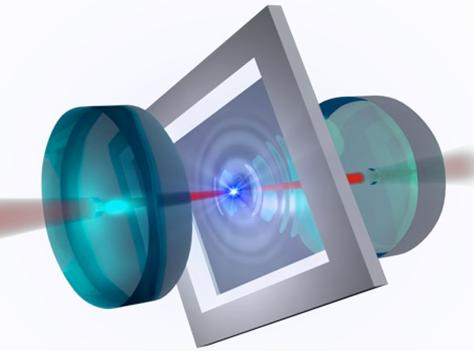
Credit: Harris Lab/Yale University

New Haven, Conn. – Imagine being able to hear people whispering in the next room, while the raucous party in your own room is inaudible to the whisperers. Yale researchers have found a way to do just that — make sound flow in one direction — within a fundamental technology found in everything from cell phones to gravitational wave detectors.

What’s more, the researchers have used the same idea to control the flow of heat in one direction. The discovery offers new possibilities for enhancing electronic devices that use acoustic resonators.

The findings, from the lab of Yale’s Jack Harris, are published in the April 4 online edition of the journal Nature.

“This is an experiment in which we make a one-way route for sound waves,” said Harris, a Yale physics professor and the study’s principal investigator. “Specifically, we have two acoustic resonators. Sound stored in the first resonator can leak into the second, but not vice versa.”

Harris said his team was able to achieve the result with a “tuning knob” — a laser setting, actually — that can weaken or strengthen a sound wave, depending on the sound wave’s direction.

Then the researchers took their experiment to a different level. Because heat consists mostly of vibrations, they applied the same ideas to the flow of heat from one object to another.

“By using our one-way sound trick, we can make heat flow from point A to point B, or from B to A, regardless of which one is colder or hotter,” Harris said. “This would be like dropping an ice cube into a glass of hot water and having the ice cubes get colder and colder while the water around them gets warmer and warmer. Then, by changing a single setting on our laser, heat is made to flow the usual way, and the ice cubes gradually warm and melt while the liquid water cools a bit. Though in our experiments it’s not ice cubes and water that are exchanging heat, but rather two acoustic resonators.”

Although some of the most basic examples of acoustic resonators are found in musical instruments or even automobile exhaust pipes, they’re also found in a variety of electronics. They are used as sensors, filters, and transducers because of their compatibility with a wide range of materials, frequencies, and fabrication processes.

###

The first author of the study is former Yale postdoctoral associate Haitan Xu. Co-authors of the study are Yale graduate student Luyao Jiang and A.A. Clerk of the University of Chicago.

The work is supported by the Air Force Office of Scientific Research, the Office of Naval Research, and the Simons Foundation.

Media Contact
Jim Shelton
[email protected]

Tags: AcousticsChemistry/Physics/Materials SciencesElectrical Engineering/ElectronicsMaterials
Share13Tweet8Share2ShareShareShare2

Related Posts

Graz University of Technology Deciphers the Structural Secrets of MOF Thin Films — Chemistry

Graz University of Technology Deciphers the Structural Secrets of MOF Thin Films

July 2, 2026
Breaking Thermodynamic Limits: Wavelength-Driven Catalysis Advances Ammonia Synthesis — Chemistry

Breaking Thermodynamic Limits: Wavelength-Driven Catalysis Advances Ammonia Synthesis

July 2, 2026

From Quantum Mechanics to AI-Powered Materials Discovery: MARVEL Marks 12 Years of Transforming Computational Science

July 2, 2026

Djire Recognized with National Award for Outstanding Contributions in Research and Teaching

July 2, 2026
Please login to join discussion

POPULAR NEWS

  • Detection of EDCs in Breast Milk and Infant Urine Up to Six Months Highlights Early Exposure Risks

    77 shares
    Share 31 Tweet 19
  • Saying Goodbye to PGY-6: Pediatric Fellowship Realities

    103 shares
    Share 41 Tweet 26
  • New Drug Candidate Developed at McMaster Shows Potential for Treating Brain Cancer

    58 shares
    Share 23 Tweet 15
  • KTU Researchers Explore Ultrasound’s Role in Enhancing Blood Flow Beyond Diagnostics

    53 shares
    Share 21 Tweet 13

About

BIOENGINEER.ORG

We bring you the latest biotechnology news from best research centers and universities around the world. Check our website.

Follow us

Recent News

Steatosis Drives Liver Metastasis Diversity in CRC

Unlocking the Mysteries of Alzheimer’s Disease

Pensoft Introduces New Peer-Reviewed Journal of Regeneration to Advance Restorative Biology Across Species

Subscribe to Blog via Email

Enter your email address to subscribe to this blog and receive notifications of new posts by email.

Join 83 other subscribers
  • Contact Us

Bioengineer.org © Copyright 2023 All Rights Reserved.

Welcome Back!

Login to your account below

Forgotten Password?

Retrieve your password

Please enter your username or email address to reset your password.

Log In
No Result
View All Result
  • Homepages
    • Home Page 1
    • Home Page 2
  • News
  • National
  • Business
  • Health
  • Lifestyle
  • Science

Bioengineer.org © Copyright 2023 All Rights Reserved.