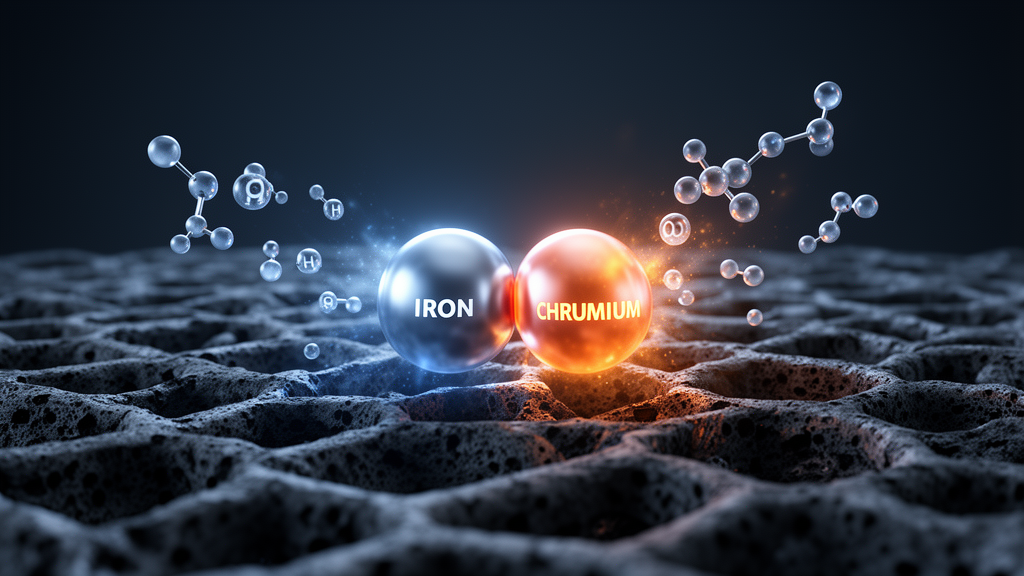
Researchers have built a catalyst in which iron and chromium atoms sit side by side as individual atoms in a nitrogen- and phosphorus-doped porous carbon, and the pairing does two things at once: it makes the iron sites more active for the oxygen reduction reaction, and it slows the degradation that iron normally triggers. The study, published in the journal Catal, reports that the neighboring Fe-Cr dual-atom configuration raises the intrinsic turnover frequency of the iron sites by a factor of 4.6 compared with iron single atoms, while cutting the half-wave potential loss in an accelerated durability test to just 21 millivolts after 30,000 potential cycles.
The oxygen reduction reaction, or ORR, is the cathodic half of fuel cells and metal-air batteries, and its sluggish multi-electron kinetics is a persistent bottleneck for energy conversion efficiency. Platinum-based catalysts remain the benchmark, but their scarcity, cost and limited long-term durability hinder widespread deployment. Iron-nitrogen-carbon catalysts, in which isolated iron atoms are anchored in FeN4 coordination, are among the most promising platinum-group-metal-free alternatives because of their high activity, maximal atomic utilization and low cost. Yet the same iron centers that drive the reaction also drive its undoing: during operation they catalyze Fenton-type reactions that generate reactive oxygen species, which attack both the active sites and the surrounding carbon framework.
According to the authors, most previous strategies for improving Fe-N-C catalysts have concentrated on activity through coordination engineering or electronic modulation, while the degradation chemistry of the iron sites has received far less attention. Neighboring heteronuclear dual-atom sites had already been shown to enhance intrinsic activity in Fe-Co, Fe-Cu and Fe-Mn systems by tuning the adsorption energetics of oxygenated intermediates, but whether such coupling could simultaneously overcome both the activity limit and the degradation susceptibility of iron single atoms remained an open question. The team chose chromium because its electronic configuration differs markedly from that of iron, allowing stronger orbital hybridization and a more profound reconstruction of the iron site’s local electronic structure than metals with similar electronic structures.
The catalyst, named FeCr/N-P-C, was made by a one-step, space-confined pyrolysis strategy. Melamine and triphenylphosphine supplied carbon, nitrogen and phosphorus, while the soft template Pluronic P123 created the porous carbon framework; iron and chromium precursors were mixed with the organic components and heated under an inert atmosphere. For comparison, the researchers prepared iron-only, chromium-only and metal-free versions using identical procedures with the corresponding metal precursors omitted. Transmission electron microscopy showed an interconnected architecture of wrinkled carbon nanosheets with abundant porosity, and no metal or metal oxide nanoparticles were discernible in high-resolution images. Inductively coupled plasma mass spectrometry measured iron and chromium loadings of approximately 1.063 and 0.164 weight percent, respectively, which together with the absence of nanoparticles suggests that most metal species are atomically dispersed.
Direct imaging and spectroscopy supported the proposed structure. Aberration-corrected HAADF-STEM revealed numerous isolated paired bright spots distributed across the carbon matrix, with a statistical average iron-chromium separation of about 0.312 nanometers. Atomic-resolution electron energy loss spectroscopy line scans confirmed that the adjacent bright atomic columns correspond to iron and chromium, and STEM-EDX mapping showed homogeneous distribution of carbon, nitrogen, phosphorus, iron and chromium. X-ray photoelectron spectroscopy confirmed the coexistence of all five elements and showed discernible binding-energy shifts in the Fe 2p and Cr 2p spectra relative to the single-metal counterparts, indicating electron redistribution between the neighboring atoms. The phosphorus 2p spectrum showed P-C and P-N bonding without detectable metal-phosphorus coordination, meaning phosphorus is incorporated into the carbon framework rather than binding the metal centers.
Synchrotron X-ray absorption spectroscopy pinned down the local coordination. The iron K-edge XANES spectrum closely resembled iron phthalocyanine and was shifted to higher energy than iron foil, indicating positively charged iron centers. Quantitative EXAFS fitting found a dominant Fe-N shell with a coordination number of 4.1 ± 0.1 at a bond distance of 2.00 Å, plus an additional Fe-Cr scattering path with a coordination number of 0.9 ± 0.3 at 3.01 Å. On the chromium side, the absorption edge approached that of Cr2O3, suggesting an average valence close to +3, and fitting revealed a Cr-N coordination number of 2.5 ± 0.2 at 2.01 Å with a weak Cr-Fe path (CN = 0.5 ± 0.2, R = 2.63 Å). Wavelet transform analysis showed intensity maxima characteristic of low-Z backscattering, with no metallic Fe-Fe or Cr-Cr features. The authors state that these results are consistent with the proposed axial N-Fe1N3-Cr1N3 configuration, in which iron is coordinated by one axial nitrogen and three in-plane nitrogen atoms while electronically coupled to the adjacent chromium.
Electrochemical testing in oxygen-saturated 0.1 M potassium hydroxide with a rotating disk electrode showed that FeCr/N-P-C delivered the best performance of the series, with an onset potential of 1.01 V and a half-wave potential of 0.845 V, shifted positively by 35 mV relative to a physical mixture of the iron and chromium catalysts, 34 mV relative to monometallic Fe/N-P-C and 105 mV relative to Cr/N-P-C, and it outperformed commercial Pt/C. At 0.80 V the dual-atom catalyst achieved a kinetic current density of 9.99 mA cm-2, higher than Fe/N-P-C (5.85 mA cm-2) and Cr/N-P-C (0.59 mA cm-2) though slightly below Pt/C (12.62 mA cm-2). Its turnover frequency of 0.534 s-1 at 0.80 V exceeded Fe/N-P-C (0.117 s-1), Cr/N-P-C (0.074 s-1) and even Pt/C (0.313 s-1). Because turnover frequency reflects the intrinsic activity of individual sites independent of loading, the roughly 4.6-fold increase over the iron single-atom catalyst indicates enhanced intrinsic activity and site utilization rather than simply more accessible sites. Koutecky-Levich analysis indicated an electron-transfer number near 4, and rotating ring-disk electrode measurements showed less than 13 percent hydrogen peroxide yield over a wide potential range from 0.2 to 0.85 V, with a Tafel slope of 92 mV dec-1, lower than all control catalysts.
Durability results were equally central to the study. After 30,000 potential cycles between 0.2 and 1.0 V, the half-wave potential shifted by only 21 mV with no obvious decay in limiting current density. In an 8-hour test, FeCr/N-P-C retained 85 percent of its initial current density, while commercial Pt/C retained 63 percent and Fe/N-P-C retained 66 percent after 6 hours. The catalyst also showed good methanol tolerance, with a half-wave potential shift of only 41 mV upon methanol introduction compared with 60 mV for Fe/N-P-C. To probe the degradation mechanism, the team used an ABTS colorimetric assay to quantify reactive oxygen species generated through Fenton reactions. Fe/N-P-C showed the strongest characteristic absorption bands at 414, 640 and 729 nanometers, indicating extensive ROS generation from hydrogen peroxide decomposition at isolated iron sites, whereas Cr/N-P-C produced negligible radical signals and FeCr/N-P-C displayed substantially lower absorbance than Fe/N-P-C despite its superior activity. Thiocyanate poisoning experiments, which block exposed metal centers, confirmed that iron sites serve as the adsorption sites for oxygen and intermediates, and that chromium introduction stabilizes the active iron sites.
In situ attenuated total reflection surface-enhanced infrared absorption spectroscopy under applied potentials in oxygen-saturated 0.1 M KOH provided mechanistic detail. Both catalysts showed a broad band near 3390 cm-1 from adsorbed hydroxyl species and interfacial water. For Fe/N-P-C, a band at about 1244 cm-1 assigned to adsorbed *OOH grew progressively more intense as potential decreased, indicating accumulation of *OOH and identifying the *OOH-to-*O transformation as a kinetically limiting step. FeCr/N-P-C showed a substantially weaker *OOH band throughout the range, implying accelerated *OOH conversion. Notably, no absorption band associated with adsorbed hydrogen peroxide, near 1405 cm-1, was detected on FeCr/N-P-C, whereas such a feature appeared for Fe/N-P-C, indicating that the dual-atom configuration suppresses peroxide accumulation and thereby reduces ROS formation and iron-induced oxidative degradation.
To test practical applicability, the researchers assembled rechargeable zinc-air batteries with FeCr/N-P-C-loaded carbon paper as the air cathode, zinc foil as the anode, and a mixed aqueous solution of 6 M KOH and 0.2 M zinc acetate as the electrolyte. The battery delivered a peak power density of 187 mW cm-2, exceeding Fe/N-P-C (173 mW cm-2), Cr/N-P-C (141 mW cm-2) and Pt/C (137 mW cm-2), and achieved a specific capacity of 542.1 mAh gZn-1 compared with 408 mAh gZn-1 for the Pt/C-based battery. In long-term cycling at 5 mA cm-2, the FeCr/N-P-C-based battery maintained stable charge-discharge voltage plateaus over 150 hours with negligible voltage decay and a round-trip efficiency of about 70.1 percent, while Pt/C delivered only 60.3 percent after just 15 hours. A flexible all-solid-state zinc-air battery using the same cathode showed a stable discharge profile during 10 hours of continuous operation. The authors present the work as establishing neighboring Fe-Cr electronic coupling as a strategy for simultaneously enhancing the intrinsic activity and durability of iron-based single-atom catalysts, while noting that the reported results are laboratory electrochemical and device-level measurements in alkaline media.
Subject of Research: Neighboring Fe-Cr dual-atom electronic coupling for enhanced oxygen reduction electrocatalysis
Article Title: Neighboring Fe-Cr electronic coupling simultaneously promotes intrinsic activity and suppresses Fe-induced degradation for oxygen reduction electrocatalysis
Article References: Guo, Y., Wei, J., Tan, X., Xiao, Y., Du, S., Cui, H., & Wang, C. (2026). Neighboring Fe-Cr electronic coupling simultaneously promotes intrinsic activity and suppresses Fe-induced degradation for oxygen reduction electrocatalysis. Catal, 2(1), Article 17. https://doi.org/10.1007/s44422-026-00031-z
Image Credits: AI Generated
DOI: 10.1007/s44422-026-00031-z
Keywords: oxygen reduction reaction, Fe-N-C catalysts, dual-atom catalysts, iron-chromium electronic coupling, electrocatalysis, fuel cells, zinc-air battery, reactive oxygen species, Fenton reaction, single-atom catalysts, durability, N,P-codoped carbon
News Source: Bethany Barker. (October 28, 2026). Iron-Chromium Atom Pairs Boost Catalyst Activity and Durability for Fuel Cells. Scienmag.