


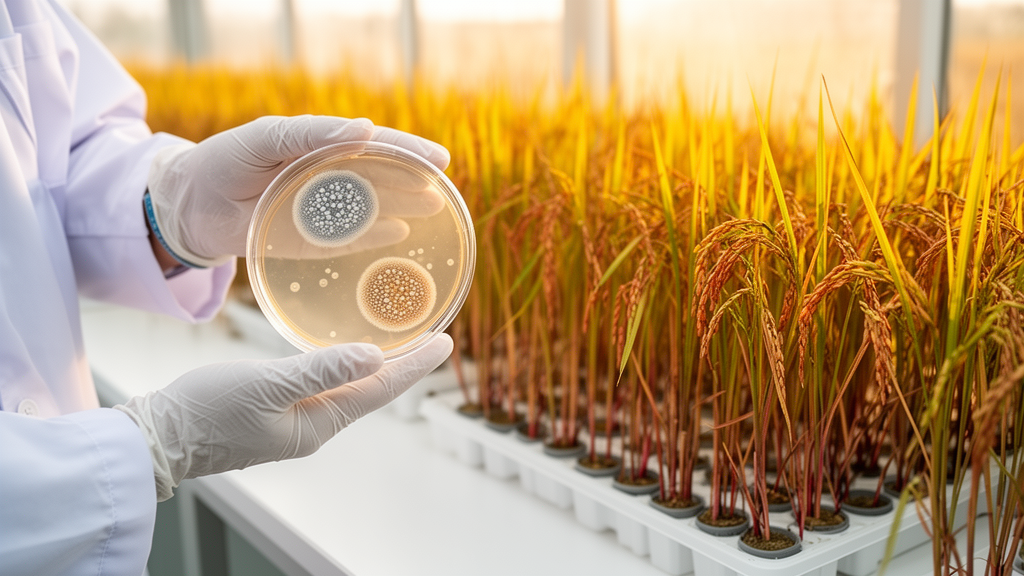
Researchers in southern Thailand have mapped the bacteria living around the roots of Sangyod rice, a deep red-violet pigmented variety from Phatthalung Province, and combined that survey with laboratory screening to nominate candidate strains for a future biofertilizer. Writing in Current Research in Biotechnology, the team led by Natthasap Moolika and Unitsa Sangket used 16S rRNA amplicon sequencing to compare rhizosphere soils from organically and chemically fertilized Sangyod paddies with water hyacinth compost, then isolated and tested bacteria for three classic plant growth-promoting traits: growth on nitrogen-free medium, phosphate solubilization, and production of the auxin indole-3-acetic acid. The work is exploratory and entirely laboratory-based; no plant has yet been treated with any of the strains.
Sangyod rice carries economic and nutritional weight in Thailand. The variety is rich in vitamins E, B1, B2, and B6, along with carbohydrates, dietary fiber, protein, minerals including calcium, phosphorus, and iron, and bioactive compounds such as gamma-aminobutyric acid and gamma-oryzanol, the latter of which has been linked in prior studies to cardiovascular benefits and reduced low-density lipoprotein cholesterol. Rising domestic and international demand has pushed some farmers toward chemical fertilizers, which raise yields in the short term but, according to the literature the authors cite, can harden soil, deplete nutrients, promote heavy metal accumulation, and contribute nitrate pollution associated with health risks such as methemoglobinemia. Plant growth-promoting rhizobacteria, or PGPR, offer an alternative: beneficial root-zone microbes that can fix atmospheric nitrogen, solubilize insoluble phosphorus, and synthesize IAA to stimulate root development.
The sampling design was deliberately local. In Tamot District, Phatthalung Province, the team collected four rhizosphere soil samples from the corners of an organic rice field and three from chemical fields, digging soil from around rice roots at roughly 20 centimeters depth. Four water hyacinth compost samples from a commercial supplier completed the set. After DNA extraction with a commercial kit, the researchers amplified the V3-V4 hypervariable region of the 16S rRNA gene using the 337F and 805R primers, producing fragments of about 468 base pairs, and sequenced the amplicons on a DNBSEQ-G400RS platform targeting approximately 40,000 reads per sample. Raw data volumes ranged from 21.51 to 21.94 megabase pairs per sample, and quality filtering retained a consistently high proportion of usable reads.
A notable methodological choice was running the taxonomic classification against four reference databases in parallel: Greengenes full-length, Greengenes V4, SILVA full-length, and SILVA V4. The results were broadly concordant. Across databases, the organically and chemically managed soils showed strikingly similar community structures, with Mycobacterium, Aquisphaera, Bradyrhizobium, and Acidothermus among the dominant identified genera, and large fractions of sequences left unassigned, rising from roughly 40 to 45 percent at genus level to 67 to 81 percent at species level. The compost was a different world entirely, dominated by thermophilic genera, chiefly Saccharomonospora, Oceanobacillus, Caldibacillus or Bacillus depending on the database, and Planifilum, a signature of the heat phases of composting.
Diversity statistics quantified the contrast. Shannon indices at the genus level ranged from 3.83 to 3.99 for organic soils and 3.94 to 4.08 for chemical soils, with Simpson values between 0.958 and 0.973 in both groups, while the compost sat markedly lower at Shannon 2.06 to 2.31. Principal coordinate analysis of Bray-Curtis dissimilarities separated the compost cleanly along the first axis, which explained 85.3 percent of the variation, and pairwise PERMANOVA with false discovery rate correction found all three group comparisons significant, though the organic-versus-chemical effect size was modest (R-squared 0.363) compared with compost comparisons above 0.9. Intriguingly, chemical soils showed slightly higher alpha diversity than organic soils, the opposite of the usual expectation; the authors attribute this anomaly to flooding during sampling that hydrologically connected the adjacent plots and likely homogenized their microbial assemblages, a confound readers should keep in mind.
The functional layer of the study came from genome-based prediction rather than direct measurement. Using BLAST searches against public NCBI genomes, the team screened detected taxa for complete nif gene clusters (nifH, nifD, nifK, nifE, nifN, nifB), which encode the nitrogenase machinery for converting atmospheric nitrogen to ammonia, and complete pqq gene clusters (pqqA through pqqE), which produce the cofactor required for phosphate-solubilizing glucose dehydrogenase. Several taxa emerged with complete nif clusters, including Roseiarcus fermentans, Bradyrhizobium hipponense, Rhodoblastus acidophilus, and Rhodopila globiformis, while Betaproteobacteria bacterium GCA_020354125.1 and Komagataeibacter saccharivorans carried complete pqq clusters. Bradyrhizobium hipponense and Rhodoblastus acidophilus harbored both, marking them as predicted dual-function candidates. K. saccharivorans, present in organic soil and compost but entirely absent from chemical plots, was highlighted as a taxon potentially suppressed by chemical fertilization.
Genomic potential, however, is not a cultured strain. Guided by the prediction that Bradyrhizobium was the most abundant dual-function taxon, the researchers isolated bacteria on both nutrient agar and yeast extract mannitol agar, the latter selective for slow-growing rhizobia. Despite this targeting, no Bradyrhizobium was recovered, plausibly because faster-growing soil bacteria outcompeted it under non-axenic conditions. The campaign instead yielded 20 isolates that passed screening on nitrogen-free Jensen’s medium, Pikovskaya’s agar with insoluble calcium phosphate, and a Salkowski colorimetric IAA assay. Sanger sequencing of the 16S rRNA gene identified them as species of Bacillus, Lysinibacillus, Burkholderia, Paraburkholderia, Priestia, and Streptomyces. Only Paraburkholderia kururiensis matched a species-level taxon in the amplicon data; Bacillus, Streptomyces, Priestia, and Burkholderia overlapped only at genus level, illustrating the resolution limits of short V3-V4 reads.
The standout performers were four strains. Lysinibacillus xylanilyticus SAN32 achieved the highest phosphate solubilization index at 3.72, with L. capsici SAN30 close behind at 3.37, both clearing the threshold generally used to classify effective phosphate solubilizers. On the IAA front, Lysinibacillus macroides SAN55 produced 130.78 plus or minus 22.44 micrograms per milliliter, and Bacillus aerius SAN29 produced 63.54 plus or minus 0.89 micrograms per milliliter, high outputs relative to previously reported Lysinibacillus strains. All isolates grew on nitrogen-free medium, a preliminary indicator of nitrogen-fixing potential that the authors stress requires direct confirmation. A co-culture compatibility assay then delivered a decisive twist: SAN55 formed inhibition zones against both Lysinibacillus phosphate specialists in every pairing orientation, ruling it out for a mixed inoculant despite its superior auxin output, while SAN29 was fully compatible with SAN32 and SAN30.
The practical upshot is a proposed pairing of Bacillus aerius SAN29, contributing IAA production, with Lysinibacillus xylanilyticus SAN32, contributing phosphate solubilization, as a functionally complementary candidate consortium. A maximum likelihood phylogenetic tree built from 16S sequences, rooted with Escherichia coli, confirmed that SAN29 and SAN32 belong to clearly distinct genera with full bootstrap support. The authors are careful about scope: the assays demonstrate in vitro traits and mutual compatibility only, not colonization, persistence, synergy, or any growth benefit in the Sangyod rhizosphere. The next step they specify is pot experimentation with Sangyod rice, measuring root development, biomass, nutrient uptake, and yield-related traits. Until such validation is done, the study stands as a well-documented pipeline, from amplicon survey through functional prediction to culture-based screening, that narrows a complex rhizosphere community down to two testable candidates for sustainable Sangyod rice production.
Subject of Research: Culture-independent and culture-based identification of plant growth-promoting rhizobacteria associated with Sangyod rice in southern Thailand
Article Title: Isolation and screening of plant growth-promoting rhizobacteria for Sangyod rice using 16S rRNA amplicon sequencing analysis
Article References: Moolika, N., Rangchai, J., Lee, D., Iewkittayakorn, J., Sathapondecha, P., & Sangket, U. (2026). Isolation and screening of plant growth-promoting rhizobacteria for Sangyod rice using 16S rRNA amplicon sequencing analysis. Current Research in Biotechnology, Article 100433. https://doi.org/10.1016/j.crbiot.2026.100433
Image Credits: AI Generated
DOI: 10.1016/j.crbiot.2026.100433
Keywords: Sangyod rice, plant growth-promoting rhizobacteria, 16S rRNA amplicon sequencing, biofertilizer, nitrogen fixation, phosphate solubilization, indole-3-acetic acid, Bradyrhizobium, Lysinibacillus, Bacillus aerius, rhizosphere microbiome, Thailand
News Source: Alan Morgan. (October 29, 2026). Rhizobacteria Screen Points to a Two-Strain Biofertilizer Candidate for Sangyod Rice. Scienmag.



