


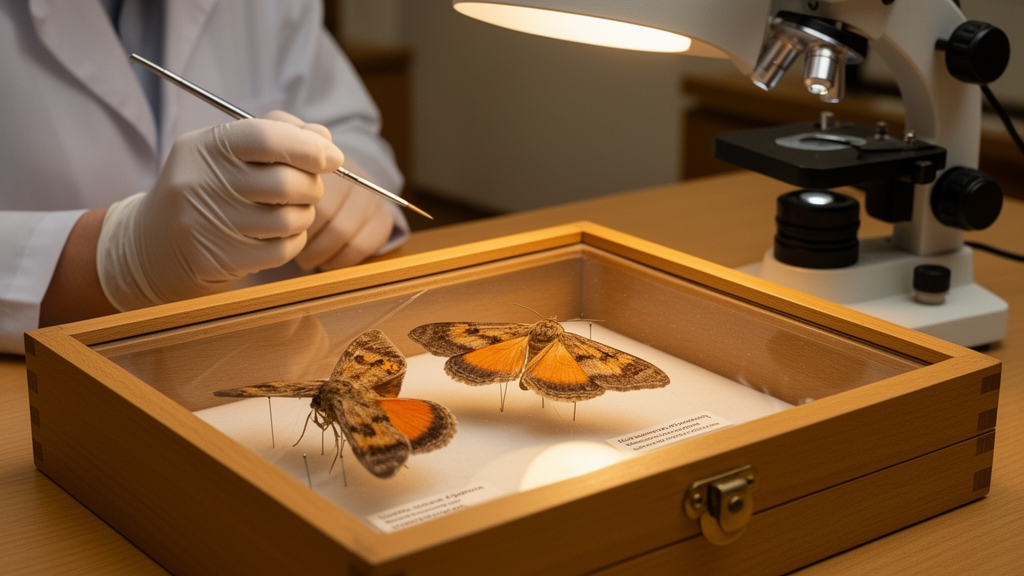
The genus Hypocala belongs to the subfamily Hypocalinae within the family Erebidae, and its larvae feed on Diospyros and other fruit trees, making several species pests of persimmon and apple. The new work, based on examination of pinned museum specimens held at the Entomological Museum of Northwest A&F University (NWAFU) in Yangling, provides updated diagnoses, descriptions and illustrations of adults and male genitalia for all four species previously recognised from China, along with female genitalia for the two species for which female material was available.
The genus was last comprehensively treated in the Fauna Sinica volume on Noctuidae by Chen in 1999, which recognised four species based on external morphology: H. subsatura Guenée, 1852, H. deflorata (Fabricius, 1794), H. rostrata (Fabricius, 1794) and H. violacea Butler, 1879. A significant shortcoming of that treatment, and of subsequent regional treatments published in 2023 and 2024, was that genitalic features were missing. The new review closes that gap by dissecting and illustrating the genitalia of the available material.
A fifth species, H. andamana Wileman, 1923, is known from Taiwan on the basis of literature records, but no specimens of this species were available for examination in the study. The authors therefore treat it as part of the Chinese fauna based solely on historical published records, including Holloway’s 2005 work and the Taiwan Biodiversity Network, and explicitly note that future collections from Taiwan and adjacent regions are needed to confirm its morphological variability and to provide a detailed re-description of its genitalia. In addition to the mainland species, the review incorporates literature records for species occurring in Taiwan, Macao and Hong Kong to give a comprehensive overview of the genus in China.
The taxonomic history of the subfamily Hypocalinae itself has been unsettled. The group has long been treated as a tribe, Hypocalini, within the Noctuidae, but Lafontaine and Schmidt in 2010 recommended elevating it to subfamily status on the basis of genital characters and mitochondrial cytochrome c oxidase subunit I (COI) sequence data that appeared to unite the group as a monophyletic assemblage. That action was subsequently supported by a molecular phylogenetic analysis of the Erebidae by Zahiri in 2012, which recovered the Hypocalinae as monophyletic and closely related to the Eulepidotinae, although with weak support for that sister relationship. Following these works, Hypocalini was officially elevated to Hypocalinae within the Erebidae. The subfamily is currently estimated to comprise about 31 species in five genera, and the placement of the genus Aon, historically shuffled among several subfamilies of both Noctuidae and Erebidae, has been stabilised by combined COI and morphological evidence uniting it with the other hypocaline genera.
Within the subfamily, Hypocala is the most widespread and economically significant lineage, with its species distributed primarily in the Old-World tropics and the greatest diversity in South and Southeast Asia. Its agricultural importance stems from the feeding habits of the larvae, which develop on Diospyros in the family Ebenaceae and on other fruit trees; several species are considered pests of persimmon and apple.
The methods behind the review combine classical morphology with standard laboratory preparation. Species were identified using external characters, including wing venation, wing pattern such as fore-wing shape, apex and colour and hind-wing colouration, and head features including the development of the proboscis, frons and labial palpi, primarily following the keys and descriptions of Chen (1999) and Holloway (2005). Male and female genitalia were dissected following standard procedures: abdomens were macerated overnight in 10% potassium hydroxide, rinsed in distilled water and examined under a stereomicroscope. The dissected genitalia were then dehydrated through a graded ethanol series of 50%, 75%, 85%, 95% and 100%, mounted on microscope slides in Canada balsam and covered with coverslips, with each slide assigned a unique preparation number. Adult specimens were photographed with a Canon digital camera, genital images were obtained with a Zeiss Stereo Discovery V20 stereomicroscope, and image adjustments were restricted to brightness, contrast and cropping.
The resulting species accounts are detailed. Hypocala subsatura, whose type locality is Sylhet in Bangladesh, has a wingspan of 38 to 42 millimetres, a reddish-brown to dark brown head and thorax, and an elongate fore-wing with dark sinuate antemedial and postmedial lines and an indistinct reniform stigma. The species is polymorphic: one form bears a large, twisted, angular dark brown patch bordered by pale grey areas on the costa and dorsum, while another is almost uniformly dark reddish-brown to greyish-brown. The hind-wing is dark brown to blackish with several separated orange-yellow longitudinal streaks and patches. In the male genitalia, the vinculum is prolonged into a remarkably long, narrowly triangular sacculus that distinctly exceeds the valva in length, and the vesica lacks distinct cornuti, showing only faint, minutely sclerotised patches. The female genitalia possess two signa in the corpus bursae, one small and rounded near the ductus entrance and a larger, elongate-ovate one on the lateral wall. Recorded host plants include apple, pear, plum, persimmon and oak. Within China the species is recorded from Inner Mongolia, Liaoning, Hebei, Shandong, Henan, Shaanxi, Gansu, Jiangsu, Zhejiang, Fujian, Taiwan, Guangdong, Hainan, Hong Kong, Macao, Yunnan and Xizang, and it also occurs in Japan, India and Bangladesh. The examined specimens came from Shaanxi, Hainan, Yunnan and Gansu, collected between 1981 and 2007.
Hypocala violacea, with a type locality in India, is larger, with an examined specimen measuring a wingspan of 50 millimetres, and shows a distinct violaceous or purplish suffusion on the reddish-brown fore-wing. Its hind-wing is predominantly dark brown with yellow markings in the basal and median areas and a relatively narrow black terminal band. The male genitalia are distinctive: the uncus is deeply divided apically into two erect lobes each bearing a lateral spur, each valva carries a long, slender, sharply pointed curved sclerotised process, and the vesica bears several elongate blade-like cornuti plus a distal group of slender needle-like cornuti, some appearing hooked. The recorded host plant is Diospyros. The single specimen examined was collected at light in Jianfengling, Hainan, in 2008. Notably, the Hainan specimen exhibits a more heavily patterned fore-wing than the typical form described from Borneo, but its male genitalia agree with Holloway’s diagnostic illustrations of the species. The authors caution that while this specimen extends the known distribution of H. violacea within China, further material is needed to confirm its establishment in Hainan. The species is otherwise recorded from Taiwan, Macao and Yunnan in China, and from India and Papua New Guinea.
Hypocala deflorata, type locality India Orientali, spans 43 to 50 millimetres and is paler, with greyish-brown to violaceous-grey fore-wings bearing distinct dark transverse lines, and a bright yellow hind-wing with a broad black terminal band whose inner margin is evenly curved. Its female genitalia differ markedly from those of H. subsatura: the ductus bursae is long, sinuous, broader, sclerotised and transversely corrugated with a heavily sclerotised cylindrical antrum, the corpus bursae is ovate, dark brown and heavily sclerotised, and no signum is apparent. The recorded host plant is persimmon. In China it is recorded from Hebei, Shandong, Shaanxi, Jiangsu, Zhejiang, Jiangxi, Fujian, Taiwan, Guangdong, Hainan, Hong Kong, Macao, Sichuan, Guizhou and Yunnan, with extralimital records stretching from Russia and Japan to Southeast Asia, Hawaii and Africa. Hypocala rostrata, the smallest examined at a wingspan of 36 millimetres, is closest to H. deflorata but can be distinguished by its light greyish-brown fore-wing with indistinct transverse lines and by a distinct tooth-like inward projection on the inner margin of the black hind-wing band. Its vesica bears a single conspicuous sharply pointed cornutus, contrasting with the more complex armature of H. violacea. Its documented host plants include four Ebenaceae species, including the persimmon Diospyros kaki, plus Pouteria and Citrus. Only one specimen, from Sichuan with collector and date information missing, was available.
To make these distinctions practical, the review includes an identification key to the Chinese species, built primarily on hind-wing colouration and fore-wing pattern. H. subsatura is separated first by its predominantly blackish-brown hind-wing with separate orange-yellow streaks and no continuous black terminal band; H. andamana by its extensively yellow hind-wing base and pale grey fore-wing with black and buff distal patches, flagged as not examined in this study; H. violacea by its dark brown hind-wing with narrow black band and reddish-brown, purple-tinged fore-wing; and finally H. deflorata and H. rostrata are separated by fore-wing line distinctness and the presence or absence of the tooth-like projection on the hind-wing band. Updated synonymies and host plant records accompany the accounts, and all examined specimens and genital preparations are deposited in the NWAFU collection, where they are publicly accessible for future study.
Subject of Research: Taxonomic review of the fruit-pest moth genus Hypocala in the Chinese fauna, based on museum specimens and genitalia morphology
Article Title: Review of the genus Hypocala Guenée ( Lepidoptera , Erebidae , Hypocalinae ) from Chinese fauna
Article References: Bashir, A., & Yang, Z. (2026). Review of the genus Hypocala Guenée (Lepidoptera, Erebidae, Hypocalinae) from Chinese fauna. Biodiversity Data Journal, 14, Article e217960. https://doi.org/10.3897/bdj.14.e217960
Image Credits: AI Generated
Keywords: Hypocala, Erebidae, Hypocalinae, taxonomy, China, Lepidoptera, genitalia, pest moths, Diospyros, persimmon, museum specimens, identification key
News Source: Drew Townsend. (October 29, 2026). Moth Genus Hypocala Reviewed Across China With New Genitalia-Based Diagnoses. Scienmag.



