

• HOME
  • NEWS
  • EXPLORE
    • CAREER
      • Companies
      • Jobs
    • EVENTS
    • iGEM
      • News
      • Team
    • PHOTOS
    • VIDEO
    • WIKI
  • BLOG
  • COMMUNITY
    • FACEBOOK
    • INSTAGRAM
    • TWITTER
Tuesday, July 7, 2026
BIOENGINEER.ORG
No Result
View All Result
  • Login
  • HOME
  • NEWS
  • EXPLORE
    • CAREER
      • Companies
      • Jobs
        • Lecturer
        • PhD Studentship
        • Postdoc
        • Research Assistant
    • EVENTS
    • iGEM
      • News
      • Team
    • PHOTOS
    • VIDEO
    • WIKI
  • BLOG
  • COMMUNITY
    • FACEBOOK
    • INSTAGRAM
    • TWITTER
  • HOME
  • NEWS
  • EXPLORE
    • CAREER
      • Companies
      • Jobs
        • Lecturer
        • PhD Studentship
        • Postdoc
        • Research Assistant
    • EVENTS
    • iGEM
      • News
      • Team
    • PHOTOS
    • VIDEO
    • WIKI
  • BLOG
  • COMMUNITY
    • FACEBOOK
    • INSTAGRAM
    • TWITTER
No Result
View All Result
Bioengineer.org
No Result
View All Result
Home NEWS Science News Biology

Ireland-Uganda partnership awarded €1 million funding to tackle sepsis in babies

Bioengineer by Bioengineer
September 28, 2023
in Biology
Reading Time: 2 mins read
0
NEOSEPSIS team
Share on FacebookShare on TwitterShare on LinkedinShare on RedditShare on Telegram

Maynooth University in Ireland in partnership with Makerere University in Uganda has been awarded €1 million under a Sustainable Development Goals (SDG) Research Challenge funded by Science Foundation Ireland and Irish Aid.
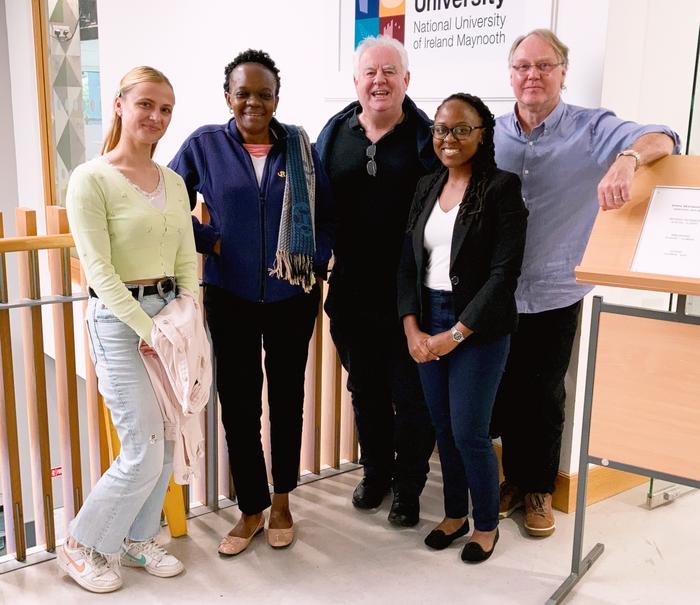
NEOSEPSIS team

Credit: Science Foundation Ireland

Maynooth University in Ireland in partnership with Makerere University in Uganda has been awarded €1 million under a Sustainable Development Goals (SDG) Research Challenge funded by Science Foundation Ireland and Irish Aid.

Maynooth University in Ireland has been awarded €1 million under the Science Foundation Ireland-Irish Aid Sustainable Development Goals (SDG) Challenge, on the recommendation of a panel of global health experts.

Prof Sean Doyle, Department of Biology and Dr Nicola Mountford, School of Business, in Maynooth University, Ireland, with partner team lead, Dr Peter Waiswa in Makerere University in Uganda, won the first SDG Challenge focusing on SDG 3: Good Health and Well-being, with a new approach to identifying sepsis in newborn babies. The team was supported by the Irish Neonatal Health Alliance as its societal impact champion.

Sepsis causes 17 neonatal deaths per day in Uganda and existing tests can be difficult to use on babies and may not provide results quickly enough. The project, Neosepsis, is developing a new low-resource sepsis test that can be conducted using a small drop of blood from a heel prick.

The SDG Challenge Programme is a partnership between SFI and Irish Aid (Department of Foreign Affairs), whose purpose is to support transformative, sustainable solutions to contribute to addressing development challenges in Irish Aid’s partner countries.

Minister for Further and Higher Education, Research, Innovation and Science, Simon Harris TD, and Minister of State for International Development and Diaspora, Sean Fleming TD, announced the winning project.

Minister Harris said: “Significant progress has been made in tackling and reducing child mortality in the past two decades, and the Neosepsis project will contribute in areas where improvements are still urgently needed. 

“The team has made rapid progress since being selected for funding only 18 months ago. This progress demonstrates that working together, we can effectively tackle the Sustainable Development Goals and make a real difference on a global scale.”

Minister Fleming said: “The winning project is an exciting collaboration between experts in Ireland and Uganda that will have a real-world impact. The project has the potential to transform sepsis testing. Seventeen children die of sepsis each day in Uganda alone.

“I congratulate the researchers on winning the Science Foundation Ireland-Irish Aid Sustainable Development Goals Challenge and hope the additional funding provided will help with this vital research.”

The Neosepsis team is adapting an existing technology for the detection of serum amyloid A (SAA), which is a proven biomarker of infection. They will use the additional funding to move towards regulatory approval in Uganda, manufacturing of the tests and further evaluation studies.

“This was a true team effort from Maynooth to Uganda,” said Prof Doyle. “In addition to our research teams, and the hundreds of families involved in initial trials, we also thank Accuplex Diagnostics Limited in Maynooth who contributed their expertise and test device prototypes.”


Share12Tweet8Share2ShareShareShare2

Related Posts

Here are a few rewritten headlines for a science magazine post, each with a slightly different tone: Intriguing & poetic: How do organs sculpt themselves? Sea stars hold the secret Direct & research-focused: Sea stars reveal the hidden rules of organ formation Metaphorical & inviting: Tiny architects beneath the waves: What sea stars teach us about building organs Short & punchy: Star-shaped clues to how our organs take shape Question-led: Could a sea star show us how organs form? Elegant & feature-style: The body’s blueprint, glimpsed in a sea star’s arm

July 6, 2026
Bacteria evolve faster with unconventional gene copies — Biology

Bacteria evolve faster with unconventional gene copies

July 6, 2026

Neighbours rewire soil feedback via root microbiome shifts

July 6, 2026

Evolution-Inspired Biosensors Revolutionize Lipid Tracking in Real Time

July 2, 2026

POPULAR NEWS

  • Detection of EDCs in Breast Milk and Infant Urine Up to Six Months Highlights Early Exposure Risks

    77 shares
    Share 31 Tweet 19
  • New Drug Candidate Developed at McMaster Shows Potential for Treating Brain Cancer

    58 shares
    Share 23 Tweet 15
  • Saying Goodbye to PGY-6: Pediatric Fellowship Realities

    103 shares
    Share 41 Tweet 26
  • KTU Researchers Explore Ultrasound’s Role in Enhancing Blood Flow Beyond Diagnostics

    53 shares
    Share 21 Tweet 13

About

We bring you the latest biotechnology news from best research centers and universities around the world. Check our website.

Follow us

Recent News

Flame retardant BDE-209 targets molecularly linked to ulcerative colitis

Ultra-high frequency particle impacts mimic rockbursts to shatter hard rock

Kidney transplant outcomes in older adults studied by German researchers

Subscribe to Blog via Email

Enter your email address to subscribe to this blog and receive notifications of new posts by email.

Join 83 other subscribers
  • Contact Us

Bioengineer.org © Copyright 2023 All Rights Reserved.

Welcome Back!

Login to your account below

Forgotten Password?

Retrieve your password

Please enter your username or email address to reset your password.

Log In
No Result
View All Result
  • Homepages
    • Home Page 1
    • Home Page 2
  • News
  • National
  • Business
  • Health
  • Lifestyle
  • Science

Bioengineer.org © Copyright 2023 All Rights Reserved.