• HOME
  • NEWS
  • EXPLORE
    • CAREER
      • Companies
      • Jobs
    • EVENTS
    • iGEM
      • News
      • Team
    • PHOTOS
    • VIDEO
    • WIKI
  • BLOG
  • COMMUNITY
    • FACEBOOK
    • INSTAGRAM
    • TWITTER
Tuesday, July 7, 2026
BIOENGINEER.ORG
No Result
View All Result
  • Login
  • HOME
  • NEWS
  • EXPLORE
    • CAREER
      • Companies
      • Jobs
        • Lecturer
        • PhD Studentship
        • Postdoc
        • Research Assistant
    • EVENTS
    • iGEM
      • News
      • Team
    • PHOTOS
    • VIDEO
    • WIKI
  • BLOG
  • COMMUNITY
    • FACEBOOK
    • INSTAGRAM
    • TWITTER
  • HOME
  • NEWS
  • EXPLORE
    • CAREER
      • Companies
      • Jobs
        • Lecturer
        • PhD Studentship
        • Postdoc
        • Research Assistant
    • EVENTS
    • iGEM
      • News
      • Team
    • PHOTOS
    • VIDEO
    • WIKI
  • BLOG
  • COMMUNITY
    • FACEBOOK
    • INSTAGRAM
    • TWITTER
No Result
View All Result
Bioengineer.org
No Result
View All Result
Home NEWS Science News Biology

IPK researchers use Cas9 gene scissors to establish new resistances of winter barley to viruses

Bioengineer by Bioengineer
November 2, 2022
in Biology
Reading Time: 3 mins read
0
Winter barley
Share on FacebookShare on TwitterShare on LinkedinShare on RedditShare on Telegram

Besides fungi and insects, viruses are also serious pathogens of crops. In the case of cereals, viruses that are transmitted to the plants via microorganisms in the soil are becoming increasingly important. For barley, these are mainly the barley yellow mosaic virus (BaYMV) and the barley mild mosaic virus (BaMMV). Both are transmitted to young seedlings of winter barley in autumn and can cause yield losses of up to 50 percent.
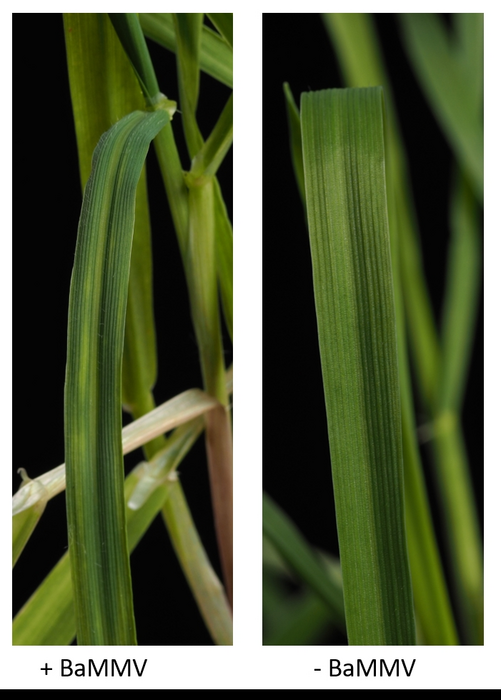
Winter barley

Credit: IPK Leibniz Institute

Besides fungi and insects, viruses are also serious pathogens of crops. In the case of cereals, viruses that are transmitted to the plants via microorganisms in the soil are becoming increasingly important. For barley, these are mainly the barley yellow mosaic virus (BaYMV) and the barley mild mosaic virus (BaMMV). Both are transmitted to young seedlings of winter barley in autumn and can cause yield losses of up to 50 percent.

Resistance breeding plays an essential role to cope with these pathogens. Although almost all current European winter barley varieties are resistant to these viruses, some virus strains have already overcome this widely used resistance through genetic adaptation, so that a broad breakthrough of the natural defences is only a matter of time. Given the tediousness of breeding measures, there is an urgent need to identify new sources of resistance and deploy them to breeding in an accelareted manner.

In search of such new resistances, a research team led by the IPK Leibniz Institute screened material from the Institute’s gene bank. In 2014, they found what they were looking for in old landraces and wild relatives of cultivated barley. “These investigations have shown that the PDIL5-1 gene, which is involved in the formation of 3-dimensional protein structures, also plays a central role in the resistance of plants to viruses,” explains Robert Hoffie from the “Plant Reproductive Biology” research group. This is a so-called susceptibility factor host-dependent viruses utilise to reproduce themselves in the plant tissue. “A decisive finding for us was that resistant gene bank material contained variants of the PDIL5-1 gene that had lost their function through mutation and hence can no longer be used by the virus ” says the IPK scientist and first author of the study.

However, crossing such resistance-mediating gene variants into the existing breeding material of European winter barley is laborious and time-consuming. “Therefore, we used the Cas9 gene scissors to switch off the PDIL5-1 gene in two susceptible barley varieties by targeted mutagenesis, thus achieving success much faster and without any additional genetic changes in the barley varieties,” says Robert Hoffie. The results were more than promising; “the targeted plants were resistant to barley mosaic virus (BaMMV) infection in the greenhouse trial and there were no negative effects on growth or yield.”

“The study exemplifies how we can take advantage of our gene bank material for plant breeding today with extremely efficient and precise biotechnological tools such as the Cas9 gene scissors,” comments Dr. Jochen Kumlehn, head of the study and head of the “Plant Reproductive Biology” research group. At the same time, the new findings also open up further perspectives of research. For example, we assume that the modification of PDIL genes may also lead to virus resistance in other plant species.


Journal

Plant Biotechnology Journal

DOI

10.1111/pbi.13948

Article Title

Novel resistance to the Bymovirus BaMMV established by targeted mutagenesis of the PDIL5-1 susceptibility gene in barley

Article Publication Date

2-Nov-2022

Share12Tweet8Share2ShareShareShare2

Related Posts

Here are a few rewritten headlines for a science magazine post, each with a slightly different tone: Intriguing & poetic: How do organs sculpt themselves? Sea stars hold the secret Direct & research-focused: Sea stars reveal the hidden rules of organ formation Metaphorical & inviting: Tiny architects beneath the waves: What sea stars teach us about building organs Short & punchy: Star-shaped clues to how our organs take shape Question-led: Could a sea star show us how organs form? Elegant & feature-style: The body’s blueprint, glimpsed in a sea star’s arm

July 6, 2026
Bacteria evolve faster with unconventional gene copies — Biology

Bacteria evolve faster with unconventional gene copies

July 6, 2026

Neighbours rewire soil feedback via root microbiome shifts

July 6, 2026

Evolution-Inspired Biosensors Revolutionize Lipid Tracking in Real Time

July 2, 2026

POPULAR NEWS

  • Detection of EDCs in Breast Milk and Infant Urine Up to Six Months Highlights Early Exposure Risks

    77 shares
    Share 31 Tweet 19
  • New Drug Candidate Developed at McMaster Shows Potential for Treating Brain Cancer

    58 shares
    Share 23 Tweet 15
  • Saying Goodbye to PGY-6: Pediatric Fellowship Realities

    103 shares
    Share 41 Tweet 26
  • KTU Researchers Explore Ultrasound’s Role in Enhancing Blood Flow Beyond Diagnostics

    53 shares
    Share 21 Tweet 13

About

We bring you the latest biotechnology news from best research centers and universities around the world. Check our website.

Follow us

Recent News

Flame retardant BDE-209 targets molecularly linked to ulcerative colitis

Ultra-high frequency particle impacts mimic rockbursts to shatter hard rock

Kidney transplant outcomes in older adults studied by German researchers

Subscribe to Blog via Email

Enter your email address to subscribe to this blog and receive notifications of new posts by email.

Join 83 other subscribers
  • Contact Us

Bioengineer.org © Copyright 2023 All Rights Reserved.

Welcome Back!

Login to your account below

Forgotten Password?

Retrieve your password

Please enter your username or email address to reset your password.

Log In
No Result
View All Result
  • Homepages
    • Home Page 1
    • Home Page 2
  • News
  • National
  • Business
  • Health
  • Lifestyle
  • Science

Bioengineer.org © Copyright 2023 All Rights Reserved.