• HOME
  • NEWS
  • EXPLORE
    • CAREER
      • Companies
      • Jobs
    • EVENTS
    • iGEM
      • News
      • Team
    • PHOTOS
    • VIDEO
    • WIKI
  • BLOG
  • COMMUNITY
    • FACEBOOK
    • INSTAGRAM
    • TWITTER
Thursday, May 14, 2026
BIOENGINEER.ORG
No Result
View All Result
  • Login
  • HOME
  • NEWS
  • EXPLORE
    • CAREER
      • Companies
      • Jobs
        • Lecturer
        • PhD Studentship
        • Postdoc
        • Research Assistant
    • EVENTS
    • iGEM
      • News
      • Team
    • PHOTOS
    • VIDEO
    • WIKI
  • BLOG
  • COMMUNITY
    • FACEBOOK
    • INSTAGRAM
    • TWITTER
  • HOME
  • NEWS
  • EXPLORE
    • CAREER
      • Companies
      • Jobs
        • Lecturer
        • PhD Studentship
        • Postdoc
        • Research Assistant
    • EVENTS
    • iGEM
      • News
      • Team
    • PHOTOS
    • VIDEO
    • WIKI
  • BLOG
  • COMMUNITY
    • FACEBOOK
    • INSTAGRAM
    • TWITTER
No Result
View All Result
Bioengineer.org
No Result
View All Result
Home NEWS Science News Chemistry

Ionophobic electrode boosts energy storage performance

Bioengineer by Bioengineer
May 27, 2021
in Chemistry
Reading Time: 2 mins read
0
IMAGE
Share on FacebookShare on TwitterShare on LinkedinShare on RedditShare on Telegram

IMAGE

Credit: IPE

Using renewable energy to replace fossil energy is now considered the best solution for greenhouse gas emission and air pollution problems. As a result, the demand for new and better energy storage technology is strong.

As part of the effort to improve this technology, a group led by Prof. ZHANG Suojiang from the Institute of Process Engineering (IPE) of the Chinese Academy of Sciences (CAS) recently found that ionophobic electrodes can boost energy storage performance.

Their study was published in the Journal of Materials Chemistry A on May 8.

Electric Double-Layer Capacitors (EDLCs) with ionic liquids (ILs)–as a new type of energy storage device–can fill the gap between the power density of batteries and the energy density of conventional capacitors. However, ILs in nanopores often exhibit sluggish diffusion dynamics, which hinder high power density.

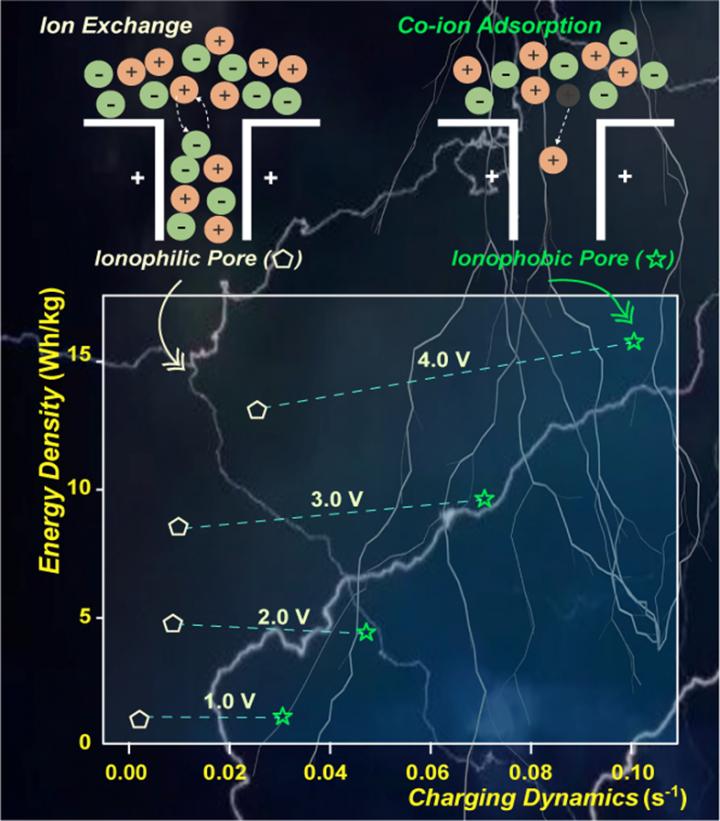
In this study, the researchers proposed a new strategy to synergistically improve the energy density and power density of EDLCs with ILs based on massive molecular dynamics simulations.

They constructed a series of EDLCs with different wettability (from ionophilic to ionophobic), using the electrolyte 1-ethyl-3-methylimidazolium tetrafluoroborate.

When comparing EDLCs with an ionophilic electrode to EDLCs with an extremely ionophobic electrode, the researchers found that the charging time for the latter decreased by ~80% while the capacitance increased by nearly 100% (at U = 4V).

For EDLCs with an ionophobic electrode, ILs cannot spontaneously enter into the porous electrode without charging. With the increase in charging voltage, both the counter ion and co-ion will start to enter the nanopore when the voltage is beyond one critical value (~2 V). At the same time, the diffusion dynamics of ions are faster than the bulk ILs due to the sparsity of ions in the pore.

“Charging the ionophobic pore is like compressing a spring. Once the spring is released, much energy will be generated,” said Prof. HE Hongyan from IPE.

This study also identified the quantitative relationship between charging time/capacitance and ionophobic property/pore geometry/electric potential. It revealed how abnormal co-ion adsorption, which does not exist in the common ionophilic electrode, enhances the overall performance of EDLCs with ILs.

The idea of introducing ionophobicity may help the rational design of IL-based high-performance supercapacitors or other energy storage applications in the future.

###

Media Contact
LI Xiangyu
[email protected]

Related Journal Article

http://dx.doi.org/10.1039/D1TA01818C

Tags: Chemistry/Physics/Materials SciencesEnergy/Fuel (non-petroleum)Materials
Share13Tweet8Share2ShareShareShare2

Related Posts

New Method Finds More Efficient Route Between Earth and Moon Than Ever Before — Chemistry

New Method Finds More Efficient Route Between Earth and Moon Than Ever Before

May 14, 2026
Unveiling the Unseen: Exploring the Boundaries of Two-Photon Vision — Chemistry

Unveiling the Unseen: Exploring the Boundaries of Two-Photon Vision

May 14, 2026

On-Chip Ferroelectric Spherulites Enable Broadband Colored Skyrmion Generation

May 14, 2026

Innovating an Affordable and Sustainable Marimba #ASA190

May 14, 2026
Please login to join discussion

POPULAR NEWS

  • Research Indicates Potential Connection Between Prenatal Medication Exposure and Elevated Autism Risk

    842 shares
    Share 337 Tweet 211
  • New Study Reveals Plants Can Detect the Sound of Rain

    729 shares
    Share 291 Tweet 182
  • Salmonella Haem Blocks Macrophages, Boosts Infection

    62 shares
    Share 25 Tweet 16
  • Breastmilk Balances E. coli and Beneficial Bacteria in Infant Gut Microbiomes

    57 shares
    Share 23 Tweet 14

About

We bring you the latest biotechnology news from best research centers and universities around the world. Check our website.

Follow us

Recent News

New Method Finds More Efficient Route Between Earth and Moon Than Ever Before

URI Master’s Student Emilio Pedroza Lopez Awarded Prestigious NSF Graduate Research Fellowship

UofL Pediatrics Researcher Discovers Novel Signaling Mechanism Linked to Anxiety and Overgrooming

Subscribe to Blog via Email

Enter your email address to subscribe to this blog and receive notifications of new posts by email.

Join 82 other subscribers
  • Contact Us

Bioengineer.org © Copyright 2023 All Rights Reserved.

Welcome Back!

Login to your account below

Forgotten Password?

Retrieve your password

Please enter your username or email address to reset your password.

Log In
No Result
View All Result
  • Homepages
    • Home Page 1
    • Home Page 2
  • News
  • National
  • Business
  • Health
  • Lifestyle
  • Science

Bioengineer.org © Copyright 2023 All Rights Reserved.