Products with sediment, such as soy milk, typically indicate on their packaging that the mixture should be shaken well before drinking. However, there are times when it is preferable not to mix everything together. Recently, a team of researchers from Pohang University of Science and Technology (POSTECH), the Korea Research Institute of Chemical Technology, and Chonnam National University has developed a technique to separate well-mixed mixtures, and this innovation is gaining attention in the academic community.
Credit: POSTECH
Products with sediment, such as soy milk, typically indicate on their packaging that the mixture should be shaken well before drinking. However, there are times when it is preferable not to mix everything together. Recently, a team of researchers from Pohang University of Science and Technology (POSTECH), the Korea Research Institute of Chemical Technology, and Chonnam National University has developed a technique to separate well-mixed mixtures, and this innovation is gaining attention in the academic community.
The research team led by Professor Jee-hoon Han from the Department of Chemical Engineering at POSTECH collaborated with Director Ji Hoon Park, Principal Researcher Soo Min Kim, and Researcher Myungho Choi from CO2 & Energy Research Center at the Korea Research Institute of Chemical Technology, and Chonnam National University Professor Jaewon Byun to create a process technology for the efficient synthesis and purification of ionic liquids. Their research was recently featured as the cover paper in the online edition of Industrial & Engineering Chemistry Research (I&EC Research), an international journal in the field of chemical engineering.
Ionic liquids are salts that remain in a liquid state at room temperature or even at relatively low temperatures due to strong electrical interactions between their ions. Unlike common salts, they possess unique properties such as nonflammability, low volatility, and thermal and chemical stability, making them valuable for various industrial applications including catalysts and electrolytes.
One of the most studied ionic liquids is [bmim][BF4], known for its high stability and low toxicity. However, the complex and expensive process of removing impurities such as lithium chloride (LiCl) during synthesis has been a significant barrier to the technology’s commercialization.
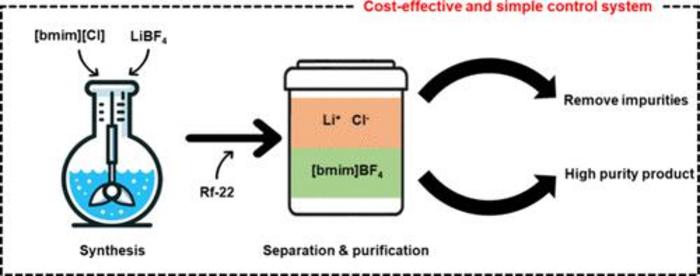
In this study, the researchers employed halocarbon refrigerants—specifically, chlorodifluoromethane (Rf-22)—to synthesize the ionic liquid [bmim][BF4] more economically and efficiently than traditional methods. By using Rf-22 as a phase separation mediator, they were able to induce a mixture containing methylimidazole to separate into two distinct layers, similar to the separation of oil and water.
The team observed phase separation by varying the ratios of [bmim][BF4], water, and halocarbon mixtures. They then applied the collected data to a ternary phase diagram model. This model visually represents the composition and phases of a mixture containing three different components and is used to predict the phase formed based on the proportions of each ingredient.
Using the ternary phase diagram modeling, the researchers successfully produced high-purity [bmim][BF4] with a purity exceeding 99%. Additionally, they were able to effectively recover and recycle the layer containing methylimidazole which did not participate in the synthesis reaction.
The team then conducted process simulations to evaluate the economic feasibility of the purification technology developed in this study. Based on a cost analysis for producing 1 ton of [bmim][BF4] per day, they determined that the minimum selling price would be about $12,000 per ton. This is more competitive than existing process technologies, demonstrating the potential for commercializing the technology.
Professor Jee-hoon Han of POSTECH stated, “We hope this research will advance the commercialization of ionic liquids and provide practical industrial solutions based on our understanding of these substances.” Principal Researcher Soo Min Kim from the Korea Research Institute of Chemical Technology expressed the significance of the research by saying, “This technique can also be applied to other solvents, enabling the synthesis of a wide range of high-purity ionic liquids.”
The research was conducted with support the Young Researcher Program of the Ministry of Science and ICT and the Basic Program of Korea Research Institute of Chemical Technology.
Journal
Industrial & Engineering Chemistry Research
DOI
10.1021/acs.iecr.4c01218
Article Title
Economically Viable Process for Synthesizing and Purifying Ionic Liquids: 1-Butyl-3-methyl Imidazolium Tetrafluoroborate