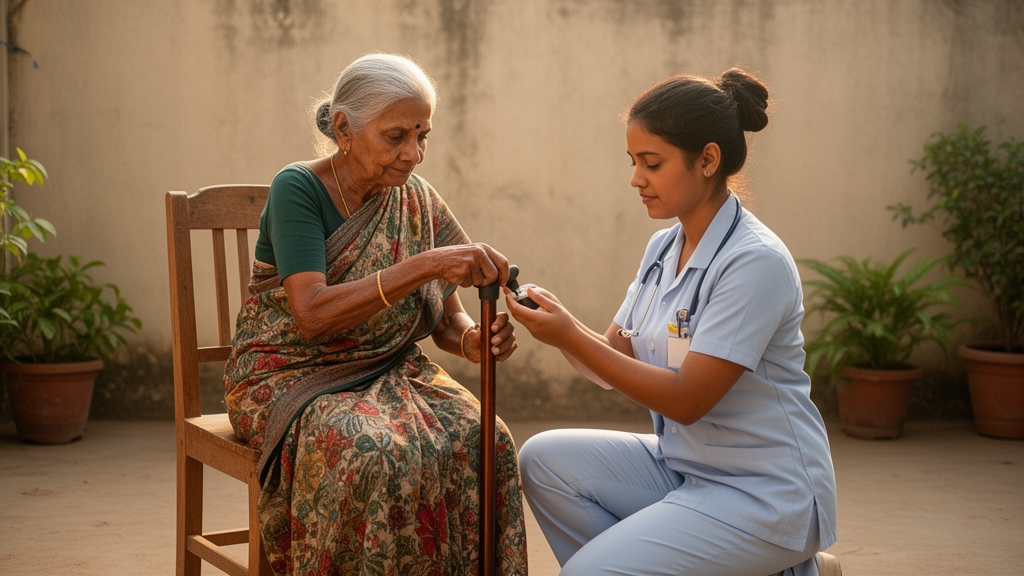
Older adults in Delhi and the surrounding National Capital Region who show impairments in more domains of intrinsic capacity score substantially lower on a multidimensional measure of healthy ageing, according to a community-based cross-sectional study of 809 adults aged 60 and over conducted in India. The research, published in Aging Clinical and Experimental Research, applied the World Health Organization’s Integrated Care for Older People (ICOPE) framework to assess intrinsic capacity and examined how it relates to healthy ageing in a low- and middle-income country setting, where the authors note such evidence has remained limited.
In this study, researchers assessed capacity across multiple domains using the ICOPE framework, while healthy ageing was measured with a multidimensional index. Participants had a mean age of 69.4 years, with a standard deviation of 7.7, and 52.7 percent were female.
The central finding concerns the cumulative effect of impairment across domains. Each additional impaired intrinsic capacity domain was associated with a 1.87-point reduction in the Healthy Ageing Index score, with a 95 percent confidence interval running from −2.68 to −1.05 and a p-value below 0.001. This estimate comes from multivariable linear regression analyses adjusted for sociodemographic factors, so it reflects an association independent of those measured background characteristics rather than a demonstrated causal effect.
When the researchers examined individual domains, the psychological domain stood out. Psychological impairment showed the strongest independent association with poorer healthy ageing, with a regression coefficient of −12.41 (95 percent CI: −14.69 to −10.12; p < 0.001). Locomotor impairment followed, associated with a coefficient of −3.41 (95 percent CI: −5.36 to −1.46; p = 0.001), and sensory impairment was associated with a coefficient of −2.87 (95 percent CI: −4.63 to −1.12; p = 0.001).
The magnitude of the psychological coefficient relative to the other domains suggests that mental capacity may contribute disproportionately to how healthy ageing is expressed in this population, at least as captured by the index used. However, because the study is cross-sectional, it captures a single point in time and cannot establish whether impairments in any domain lead to poorer healthy ageing, whether poorer healthy ageing contributes to domain impairment, or whether both are shaped by other factors.
The study’s scope also matters for interpretation. The 809 participants were community-dwelling adults aged 60 and over residing in Delhi-NCR, India, meaning the findings describe one urban region of one country. The authors frame their work as addressing a gap in evidence from low- and middle-income countries, where research on the association between intrinsic capacity and healthy ageing has been limited, and the results should be read as specific to that context rather than as universal estimates.
The healthy ageing outcome was measured with a multidimensional index, and the regression models adjusted for sociodemographic factors. The published version is an open-access article that was shared early to provide faster access to peer-reviewed, accepted research; it is citable and carries a permanent DOI, with the final Version of Record to follow after further edits.
From the findings, the authors draw a practical conclusion: routine multidomain assessment of intrinsic capacity within the WHO ICOPE framework may help identify older adults at risk of poorer healthy ageing and inform person-centred assessment and care planning. Because the analysis identifies which domains show the strongest independent associations, such screening could in principle prioritise attention to psychological, locomotor and sensory capacities, though the authors’ conclusion is framed as a possibility for identifying risk rather than a demonstrated benefit of implementing such assessments.
For researchers, the study adds a quantified estimate from India to a growing body of work on intrinsic capacity, including earlier cross-sectional studies using the ICOPE framework in community settings and assessments of intrinsic capacity among older Indian adults drawn from the Longitudinal Ageing Study in India. For the 809 participants whose data underpin these results, the message is that the number of impaired capacity domains tracks with a measurable index of healthy ageing, and that psychological capacity, in particular, warrants attention in community-based assessments of older adults.
Subject of Research: The association between multidomain intrinsic capacity impairment and healthy ageing among community-dwelling older adults in India, assessed with the WHO ICOPE framework.
Article Title: Association between intrinsic capacity and healthy ageing among community-dwelling older adults in India: A cross-sectional study using the WHO ICOPE framework
Article References: Kaur, I., & Chandel, S. (2026). Association between intrinsic capacity and healthy ageing among community-dwelling older adults in India: A cross-sectional study using the WHO ICOPE framework. Aging Clinical and Experimental Research. https://doi.org/10.1007/s40520-026-03534-w
Image Credits: AI Generated
DOI: 10.1007/s40520-026-03534-w
Keywords: intrinsic capacity, healthy ageing, WHO ICOPE, older adults, India, cross-sectional study, psychological impairment, locomotor impairment, sensory impairment, community-dwelling, Delhi-NCR, linear regression
News Source: Beatrice Stafford. (October 29, 2026). Intrinsic capacity impairments linked to poorer healthy ageing in older Indian adults. Scienmag.