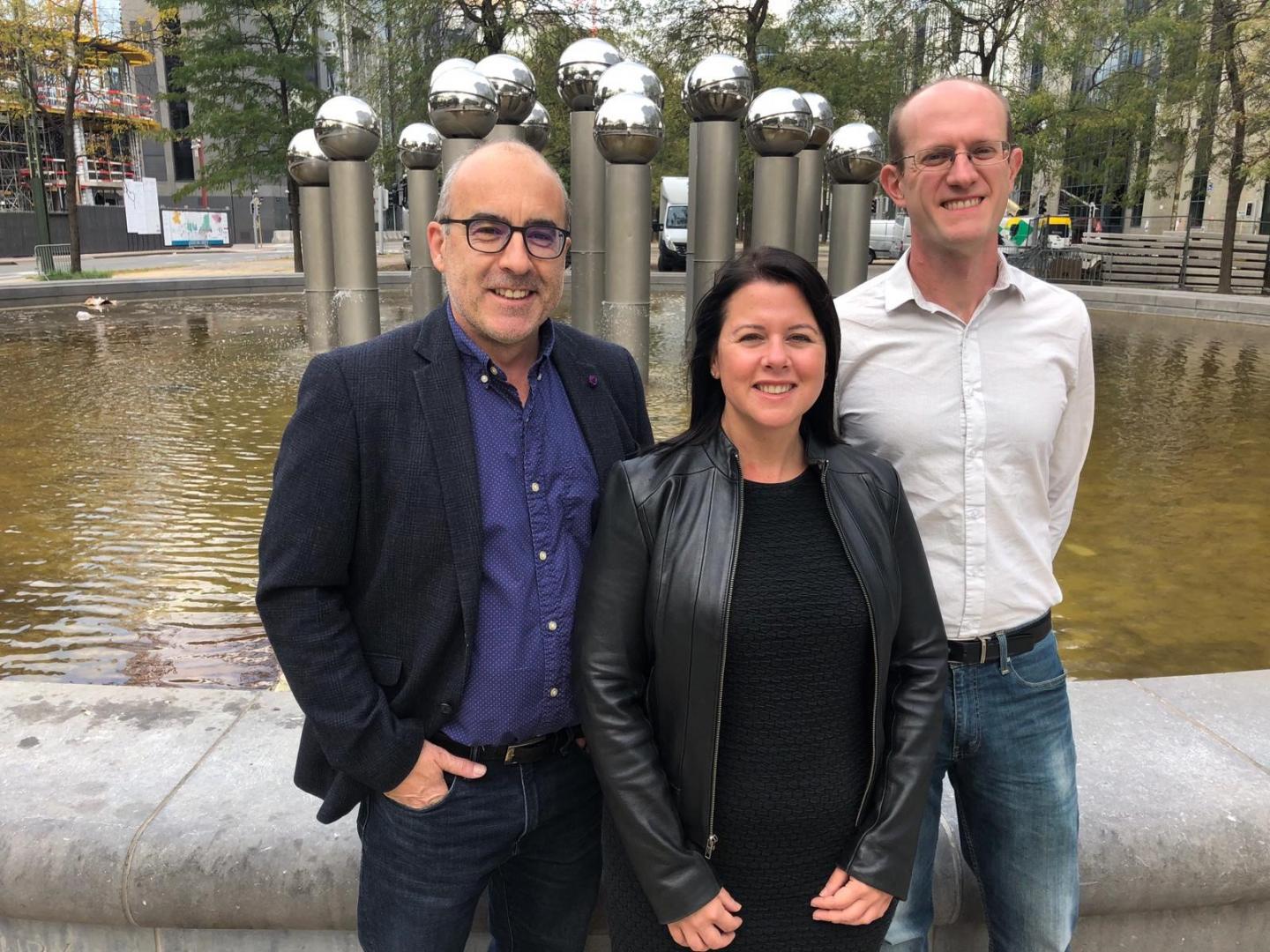
Credit: Steve P. Jackson, Joanna Loizou and Jacob Corn
ERC Synergy Grants are intended to enable a minimum of two and a maximum of four Principal Investigators and their teams to bring together complementary skills, knowledge, and resources in new ways that are more than additive, in order to jointly address ambitious research problems. In their project “Dna Damage Response: Actionabilities, Maps and Mechanisms” (Acronym: DDREAMM) Joanna Loizou, Jacob Corn and Steve P. Jackson team up to shed light on DNA-damage response (DDR) systems.
Within this ERC Synergy Grant, starting in January 2020, the three teams will devote the next six years to mapping and understanding how eukaryotic cells monitor and protect their genomes. To do this they will use cutting-edge technologies in gene editing and chemical biology. Hence, they will take multidisciplinary approaches to create deeply integrated genetic and physical maps of DNA repair pathways and interactions in many human cell types. This work will provide major insights into human genome surveillance in multiple cell types, yield powerful tools to precisely control DNA repair outcomes, and speed the development of new therapies for cancer and other diseases. In response to receiving this grant, Joanna says: “The ERC Synergy Grant allows Jacob, Steve and myself to bring together our unique expertise in an unparalleled manner, to tackle the fundamentally important question of how our genomes are maintained”.
In the research project, each individual lab will play to its strengths while also assimilating expertise from the other labs. As the ERC Synergy grant will be focused on rapidly evolving scientific arenas, the international partnership offers a possibility to collectively embrace and exploit the very latest technological developments and scientific opportunities, in ways that would not be possible if the three groups operated individually.
Joanna Loizou’s long-standing expertise is embedded in investigating the cellular pathways that respond to DNA damage, to maintain genome stability and suppress disease. Her important contributions within this field began during her PhD (2000-2004, UK) and continued during two postdoctoral positions (2004-2007, France and 2007-2011, UK). During these training posts, Joanna consistently made seminal discoveries, by identifying a novel kinase that regulates DNA repair (Loizou et al, Cell 2004), linking the DNA damage response to post-translational modifications and epigenetic regulation (Murr* & Loizou*, et al Nature Cell Biology 2006) and identifying and characterizing a novel tumour suppressor (Loizou et al, Cancer Cell 2011).
In September 2011, Joanna established her independent group at CeMM, Vienna, Austria. Her vision is to piece together the intricate puzzle that encompasses the human DNA damage response at the cellular level, hence providing a complete understanding of how such pathways go wrong in disease states, with a strong emphasis on cancer. To achieve this her team uses genome-scale approaches, based around genetics, genomics, proteomics and chemical biology. She hypothesizes, and has proven, that by investigating the regulatory pathways of DNA repair taking unbiased approaches, we can advance our knowledge of how cells respond to DNA damage, uncover genetic interactions required for DNA repair and cellular survival, and unravel the impact on the genome upon engagement of DNA damage and DNA repair pathways. Hence, she envisages that her research will shed light on the mechanisms leading to cancer development and pave the way for better treatments for cancer and other DNA repair-associated diseases.
###
Media Contact
Eva Schweng
[email protected]
0043-140-160-70051
Original Source
https:/