Consociating grapevine plants with common sage alters the atmospheric profile of volatile organic compounds and reduces the susceptibility of grapevine foliage to downy mildew, according to research conducted by agronomists at Università Cattolica del Sacro Cuore, the University of Bologna, and the Research Center for Plant Health Modelling. Across both enclosed atmospheric chambers and a multi-year vineyard field trial, the presence of sage, scientifically known as Salvia officinalis, diminished disease severity following artificial leaf inoculation with the oomycete pathogen Plasmopara viticola by 35.8 to 52.2 percent. The investigation evaluated how natural volatile emissions from an aromatic companion plant influence disease dynamics, exploring ecological alternatives to the intensive synthetic and copper-based fungicide applications currently relied upon in conventional viticulture.
While cover crops such as clover and vetch are frequently utilized between vine rows to improve soil moisture, enhance nutrient availability, and physically mitigate splash dispersal of overwintering oospores from the soil, they do not release volatile chemicals tailored to suppress airborne pathogen cycles. Medicinal and aromatic plants belonging to the Lamiaceae family produce an array of bioactive secondary metabolites, including terpenes, terpenoids, and phenolic compounds, synthesized within specialized glandular trichomes and released into the atmosphere. The researchers aimed to establish whether living sage plants grown alongside grapevines could act as a continuous, in situ source of airborne volatile organic compounds capable of priming grapevine defenses or suppressing pathogen infection directly under both controlled settings and commercial field conditions.
To evaluate the biological and chemical interactions under strictly regulated environmental conditions, the researchers first established an airtight box experiment in a research greenhouse in Piacenza, Italy, across 2024 and 2025. Two-year-old potted Vitis vinifera cultivar Chardonnay cuttings grafted onto Kober 5BB rootstocks were placed in sealed transparent polyethylene chambers either alone or paired with potted Salvia officinalis plants for periods of 24 or 48 hours. Control chambers holding only grapevine plants or only sage plants were maintained simultaneously across three biological replicates per treatment. Throughout the 48-hour periods, internal temperatures averaged 26.6 degrees Celsius during the daytime and 24.7 degrees during dark intervals, with relative humidity stabilizing at saturation within approximately four hours. Diffusive passive samplers captured volatile organic compounds in the chamber air over discrete 12-hour intervals, which were desorbed with dichloromethane and analyzed using gas chromatography coupled with mass spectrometry.
Chemical profiling of the chamber atmospheres detected a total of 23 volatile organic compounds, with terpenoids representing 56 percent of the volatilome and ketones accounting for 26 percent, alongside lower concentrations of alcohols and esters. Every volatile detected in the combined consociation boxes was also present in the chambers housing sage alone, whereas grapevines maintained without sage generated only 16 volatile compounds. Principal component analysis revealed that the first two components explained 62.7 percent and 17.6 percent of total variance, with the overall chemical signature of consociated chambers clustering tightly with sage monocultures rather than grapevine monocultures. Specific compounds that distinguished the sage-influenced atmospheres included thujol, eucalyptol, and limonene, whereas isolated grapevine chambers were characterized primarily by alcohols such as n-butanol, 1-heptanol, and 1-octanol.
Following 24 or 48 hours of airtight exposure, the test plants were removed from the chambers and maintained in standard greenhouse conditions for an additional 48 hours before their third or fourth leaves below the shoot apex were harvested for disease testing. Detached leaves were placed in moistened Petri dishes and artificially sprayed on their abaxial surfaces with a standardized sporangial suspension containing 50,000 Plasmopara viticola sporangia per milliliter using a precision hand-held nebulizer. Analysis using linear mixed-effects models indicated that consociation with sage significantly reduced subsequent downy mildew severity compared to non-consociated controls at both the 24-hour evaluation point and the 48-hour exposure mark, with the longer consociation exhibiting a more pronounced suppression. Sporulation intensity, evaluated as sporangiophore density per lesion area, was also significantly lower on leaves from consociated chambers, remaining stable across both exposure durations.
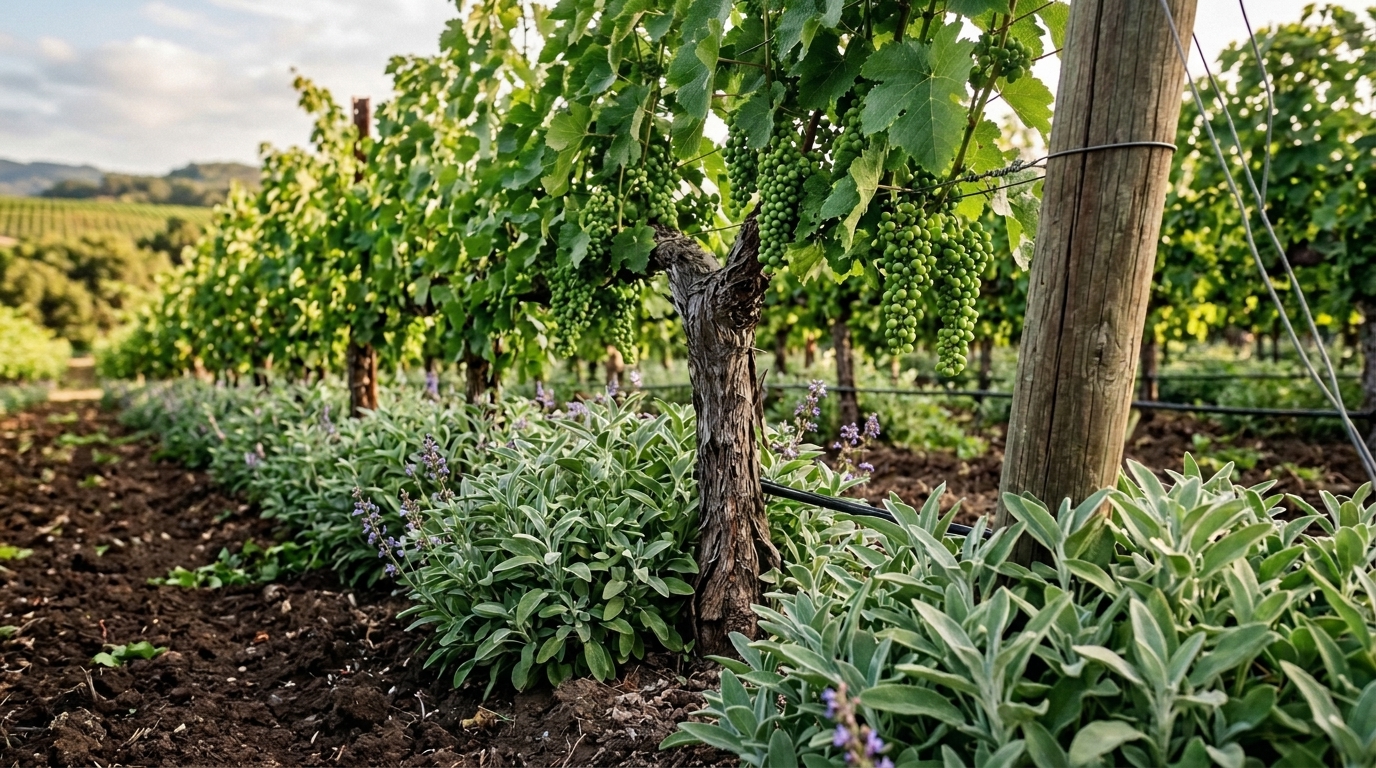
To test whether these volatile-mediated effects persist under open-air agricultural environments, the team conducted a three-year field trial from 2023 to 2025 in a 0.83-hectare commercial vineyard planted with Vitis vinifera cultivar Malvasia di Candia Aromatica in Castell Arquato, northern Italy. The trial established two distinct four-row strip plots separated by a 50-meter buffer zone designed to prevent volatile cross-contamination between treatments. In the consociated strip, sage shrubs were transplanted directly within the vine rows between adjacent vines, creating a localized perennial aromatic companion system, whereas the control strip contained grapevines grown without companion plants. Initial irrigation and balanced fertilizer were supplied exclusively at planting to ensure establishment, after which the sage received no further watering or fertilization over the three-year period, requiring only annual canopy pruning back by one-third to two-thirds in early May to maintain compact vegetative growth.
Grapevine susceptibility was monitored across the three consecutive growing seasons through nine sampling sessions, collecting leaves from three equidistant spatial blocks along the central rows of each strip plot. After harvest, leaves were rinsed for five minutes to eliminate any potential traces of early-season copper or sulfur fungicides, which were halted at least 12 to 15 days before sampling. Uniform 16-millimeter leaf discs were excised, placed in Petri dishes, and inoculated with the standardized pathogen suspension. The field data demonstrated an overall significant protective effect, with mean downy mildew severity reaching 40.2 percent on leaf discs from the control strip compared to 25.8 percent on discs harvested from the sage-consociated vines, reflecting a 1.5-fold higher disease level in the absence of companion sage.
The efficacy of the within-row sage consociation in the vineyard varied across specific temporal windows, reflecting the inherent environmental complexity of open field viticulture. Post-hoc pairwise comparisons revealed significant reductions in downy mildew severity during five of the nine sampling sessions, primarily when baseline disease pressure in control tissues exceeded 40 percent of leaf surface area. In contrast, during two late-July sessions characterized by drought conditions and inactive shoot growth, overall disease severity remained below 20 percent and differences between treatments were not statistically significant, likely due to baseline drought-induced physiological defenses or ontogenic, age-related tissue resistance. A slight inversion was observed during one sampling session in early June 2025 where control tissues exhibited lower severity than consociated vines, an outcome the authors noted requires further dedicated agronomic investigation.
During the final two sampling dates of the 2024 season, the researchers introduced supplementary laboratory assays to assess potential immediate inhibitory actions of sage volatiles during the infection process. Excised leaf discs from both field treatments were placed into Petri dishes that had either one or two freshly detached sage leaves affixed to the interior lids prior to pathogen inoculation. The addition of sage leaves within the dish atmosphere produced a progressive supplementary reduction in downy mildew severity, decreasing disease metrics by an additional 26.1 to 59.0 percent. The field consociation treatment displayed its greatest relative difference in the absence of lid-mounted sage leaves, while adding sage foliage directly into the dishes reduced severity across all groups, suggesting that sage volatiles exert direct inhibitory activity on pathogen germination or penetration in addition to priming plant physiological resistance.
The authors emphasized that the single-strip field layout, necessitated by the requirement for a 50-meter buffer to avoid volatile drift priming adjacent control rows, introduces potential spatial confounding inherent to macro-strip agroecological designs. While the statistical mixed-effects models accommodated multi-temporal sampling and hierarchical nested blocks, definitive confirmation across diverse vineyard microclimates requires expanded trials with replicated plots at multiple geographic locations. Furthermore, while the perennial shrub habit of Salvia officinalis proved resilient in Mediterranean conditions without supplemental irrigation, practical adoption will require long-term evaluations of root competition for soil nutrients and water, potential impacts on grape yield and vine vigor, and any sensory influences of aromatic volatiles on grape and wine profiles.
Subject of Research: Reduction of grapevine downy mildew susceptibility through sage consociation
Article Title: The consociation with sage (Salvia officinalis) reduces the susceptibility of grapevine leaves to Plasmopara viticola
Article References: Campana, C., Fittipaldi Broussard, M., Chinnici, F., Caffi, T., Rossi, V., & Fedele, G. (2026). The consociation with sage (Salvia officinalis) reduces the susceptibility of grapevine leaves to Plasmopara viticola. Frontiers in Agronomy, 8, Article 1947731. https://doi.org/10.3389/fagro.2026.1947731
Image Credits: AI Generated
DOI: 10.3389/fagro.2026.1947731
Keywords: viticulture, Salvia officinalis, Plasmopara viticola, downy mildew, volatile organic compounds, intercropping, agroecology, plant defence, consociation, sage, Salvia, officinalis
News Source: Alan Morgan. (November 7, 2026). Intercropping Sage With Grapevines Reduces Susceptibility to Downy Mildew. Scienmag.