• HOME
  • NEWS
  • EXPLORE
    • CAREER
      • Companies
      • Jobs
    • EVENTS
    • iGEM
      • News
      • Team
    • PHOTOS
    • VIDEO
    • WIKI
  • BLOG
  • COMMUNITY
    • FACEBOOK
    • INSTAGRAM
    • TWITTER
Friday, November 20, 2026
BIOENGINEER.ORG
No Result
View All Result
  • Login
  • HOME
  • NEWS
  • EXPLORE
    • CAREER
      • Companies
      • Jobs
        • Lecturer
        • PhD Studentship
        • Postdoc
        • Research Assistant
    • EVENTS
    • iGEM
      • News
      • Team
    • PHOTOS
    • VIDEO
    • WIKI
  • BLOG
  • COMMUNITY
    • FACEBOOK
    • INSTAGRAM
    • TWITTER
No Result
View All Result
Bioengineer.org
No Result
View All Result
Home NEWS Science News Agriculture

Autoclaved Onion Extract Enhances Sweet Odor and Sensory Acceptability

by
November 20, 2026
in Agriculture
Reading Time: 2 mins read
0
Autoclaved Onion Extract Enhances Sweet Odor and Sensory Acceptability

Autoclaved Onion Extract Enhances Sweet Odor and Sensory Acceptability

Share on FacebookShare on TwitterShare on LinkedinShare on RedditShare on Telegram

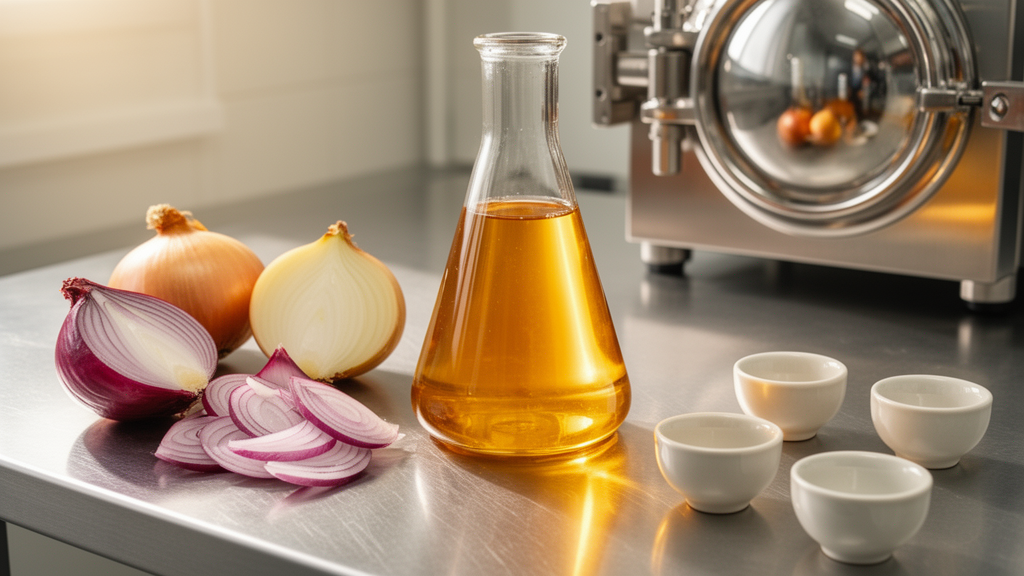
Hydrothermal processing significantly alters the flavor profile and overall appeal of onion extracts, with autoclaved preparations delivering the highest sensory acceptability and sweet odor intensity. According to a comparative study published in Food Science and Biotechnology, subjecting onion (Allium cepa L.) to autoclave treatment produced superior extraction yields and browning intensity compared to raw juice and other heating methods, highlighting its potential utility for natural flavorings.

The investigation evaluated four distinct preparations to understand how thermal extraction influences flavor compounds and physical qualities. The research team compared fresh onion juice against three thermal methods: steamed extract, hot water extract, and autoclaved extract. Physicochemical properties, flavor-related compounds, volatile profiles, and sensory characteristics were systematically measured across each treatment to determine how processing conditions drive flavor development.

The results revealed distinct sensory and chemical profiles across the different preparation techniques. While autoclaved extract achieved the greatest browning intensity and highest sensory scores, steamed extract retained the highest total sugar content. Hot water extract demonstrated a more pronounced cooked onion-like flavor than the steamed preparation. Conversely, untreated onion juice exhibited a stronger raw onion-like odor, alongside greater pungency, bitterness, and astringency.

Chromatographic analysis of volatile profiles indicated that autoclaved extract generated higher peak areas for specific compounds, namely 3-methylbutanal and 2-pentylfuran, than the other thermal preparations.

Exploratory principal component analysis and partial least squares regression effectively distinguished the untreated onion juice from all hydrothermally treated extracts. The authors concluded that hydrothermal processing substantially modifies onion flavor characteristics and consumer acceptability, while emphasizing that inherent differences in extraction mechanisms must also be taken into account when developing natural flavoring ingredients.

Subject of Research: Hydrothermal extraction methods and flavor characteristics of onion extracts

Article Title: Effects of different hydrothermal treatments for the development of natural onion flavorings: flavor and sensory characteristics of onion extracts

Article References: Choi, Y., Shin, E.-C., Kim, S., Kim, D., Kim, M. J., & Cho, S. (2026). Effects of different hydrothermal treatments for the development of natural onion flavorings: flavor and sensory characteristics of onion extracts. Food Science and Biotechnology. https://doi.org/10.1007/s10068-026-02380-w

Image Credits: AI Generated

DOI: 10.1007/s10068-026-02380-w

Keywords: Onion, Allium cepa L, Hydrothermal treatment, Autoclaved extract, Steamed extract, Hot water extract, Onion juice, Flavor characteristics, Sensory acceptability, Sweet odor intensity, Browning intensity, Extraction yield, Total sugar content, 3-methylbutanal, 2-pentylfuran, Volatile profiles, Food science, Natural flavorings

News Source: Gregory Coleman. (November 20, 2026). Autoclaved Onion Extract Enhances Sweet Odor and Sensory Acceptability. Scienmag.


Tags: 2-pentylfuran3-methylbutanalAllium cepa LAutoclaved extractbrowning intensityextraction yieldFlavor characteristicsFood scienceHot water extracthydrothermal treatmentNatural flavoringsOnionOnion juiceSensory acceptabilitySteamed extractSweet odor intensityTotal sugar contentvolatile profiles
Share12Tweet7Share2ShareShareShare1

Related Posts

Gardenia Yellow E500 Shows No Genotoxic or Cell Transformation Effects Across Multi-Tiered Tests

Gardenia Yellow E500 Shows No Genotoxic or Cell Transformation Effects Across Multi-Tiered Tests

November 20, 2026
On-Farm Agricultural Waste Bioconversion Restores Degraded Wasteland Soils and Enhances Vegetable Productivity

On-Farm Agricultural Waste Bioconversion Restores Degraded Wasteland Soils and Enhances Vegetable Productivity

November 20, 2026

Eastern Uganda Survey Compares Food Security and Water Access Between Settlements

November 20, 2026

Critical Review Evaluates Edible Cricket Nutrition, Processing Hurdles, and Food Safety Risks

November 20, 2026

POPULAR NEWS

  • Metastatic Wilms Tumor Rapidly Develops in Infant With Beckwith–Wiedemann Syndrome

    Metastatic Wilms Tumor Rapidly Develops in Infant With Beckwith–Wiedemann Syndrome

    29 shares
    Share 12 Tweet 7
  • Water Molecules Bridge Spiro Barbiturate Tetrazoles into Stable Macrocyclic Dimers

    29 shares
    Share 12 Tweet 7
  • Gardenia Yellow E500 Shows No Genotoxic or Cell Transformation Effects Across Multi-Tiered Tests

    29 shares
    Share 12 Tweet 7
  • Lower Solution Temperature Degrades High-Temperature Strength and Creep in Ni-Based Superalloy

    29 shares
    Share 12 Tweet 7

About

We bring you the latest biotechnology news from best research centers and universities around the world. Check our website.

Follow us

Recent News

Salivary miRNA Panels Show Promise for Oral Cancer Detection

Parkinson’s LRRK2 Mutations Disrupt Lysosomal Iron and Drive Human Neuronal Ferroptosis

Vibration Analysis Tracks Stiffness and Corrosion in Reinforced Concrete Beams

Subscribe to Blog via Email

Enter your email address to subscribe to this blog and receive notifications of new posts by email.

Join 89 other subscribers
  • Contact Us

Bioengineer.org © Copyright 2023 All Rights Reserved.

Welcome Back!

Login to your account below

Forgotten Password?

Retrieve your password

Please enter your username or email address to reset your password.

Log In
No Result
View All Result
  • Homepages
    • Home Page 1
    • Home Page 2
  • News
  • National
  • Business
  • Health
  • Lifestyle
  • Science

Bioengineer.org © Copyright 2023 All Rights Reserved.