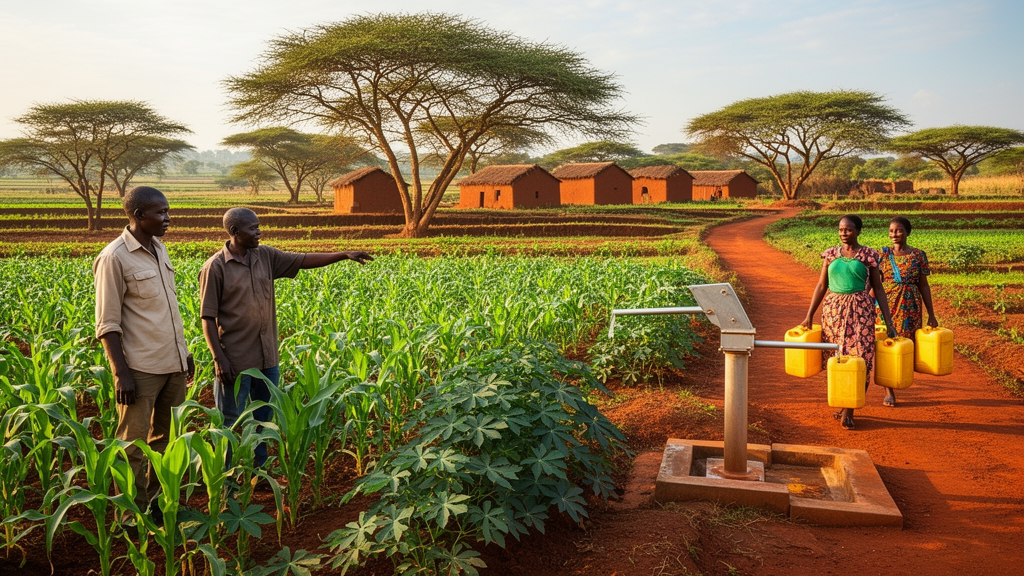
A comparative cross-sectional study conducted across rural and peri-urban communities in Mbale District, Eastern Uganda, has revealed widespread food insecurity across both environments, accompanied by pronounced differences in water access, water treatment, and household sanitation practices. Drawing upon data gathered from 221 households, researchers Sunday Mark Oyet, Robert Mbabazi Kaahwa, Christopher Muggaga, and Duncan Ongeng documented that 81.1 percent of rural households and 85.5 percent of peri-urban households were classified as food insecure under the Household Food Insecurity Access Scale. While peri-urban settlements demonstrated substantially greater access to improved and safe drinking water sources than their rural counterparts, rural families were notably more proactive in treating their drinking water and maintained higher rates of private latrine availability.
The investigation was grounded in a multidimensional conceptual framework linking household livelihood perspectives with the core pillars of food and nutrition security: availability, access, utilization, stability, agency, and sustainability. As settlement patterns shift across Sub-Saharan Africa, peri-urbanization alters traditional agricultural land use, market exposure, and infrastructure availability. To establish how these environmental transitions influence living conditions, the authors evaluated socio-economic determinants alongside selected Water, Sanitation, and Hygiene (WASH) metrics. These WASH conditions served as operational indicators of nutrition security, reflecting environmental determinants that govern infection risk, nutrient absorption, and biological utilization within human bodies.
Field investigations took place across Mbale District, located in the Bugisu sub-region of Eastern Uganda, which spans approximately 534.4 square kilometers and houses an estimated population of 290,356 residents. Using a multi-stage sampling design, two sub-counties were purposively selected to represent typical rural and peri-urban settlements, after which parishes and villages were chosen through random ballot methods. Within individual villages, enumerators drew household participants via systematic random sampling intervals derived from official local council registers. Eligibility required adult household heads or adult residents with at least six months of continuous residency, yielding an analytical sample of 111 rural households and 110 peri-urban households.
Standardized face-to-face interviews administered in English and Lumasaaba captured extensive socio-demographic details, economic behaviors, and food acquisition strategies. The primary measure of food access, the Household Food Insecurity Access Scale (HFIAS), evaluated nine specific occurrence questions covering psychological anxiety over food shortages, dietary quality deterioration, and quantitative reductions in food consumption over the preceding four weeks. Parallel semi-structured questionnaires recorded source of drinking water, water purification techniques, toilet facility availability, latrine sharing practices, and handwashing habits across routine domestic activities.
Demographic evaluations revealed that households in both locations were predominantly male-headed, accounting for 90.1 percent of rural families and 82.7 percent of peri-urban families, with mean head-of-household ages of 42.5 and 44.9 years, respectively. Significant divergence emerged in primary occupations and food supply strategies. Farming represented the primary livelihood for 61.3 percent of rural household heads and 84.4 percent of rural spouses, enabling 51.4 percent of rural families to obtain sustenance predominantly through own-farm production. Conversely, casual labour was common among peri-urban household heads at 36.4 percent, and 67.3 percent of peri-urban families depended primarily upon cash market purchases to meet their daily nutritional needs.
Across individual HFIAS dimensions, anxiety and uncertainty affected 78.4 percent of rural and 86.4 percent of peri-urban respondents within the four-week recall period. Insufficient dietary quality was widely reported, with 77.1 percent of rural and 82.1 percent of peri-urban households forced to consume less-preferred or monotonous food choices due to financial shortfalls. Outright quantity reductions were also common, reported by 46.8 percent of rural and 53.5 percent of peri-urban households. Severe experiences were not absent: 37.8 percent of rural and 45.5 percent of peri-urban respondents reported going to sleep hungry, while 9.9 percent and 20.9 percent, respectively, endured an entire day and night without consuming any food.
Categorization based on standard HFIAS score thresholds classified 60.4 percent of rural households and 65.5 percent of peri-urban households as severely food insecure, alongside 15.3 percent rural and 16.4 percent peri-urban classified as moderately food insecure. Only 18.9 percent of rural and 14.5 percent of peri-urban households qualified as strictly food secure. While peri-urban households exhibited a slightly higher mean HFIAS score of 12.65 compared with 11.17 among rural households, this statistical margin did not reach significance at the conventional threshold, confirming that acute challenges in obtaining adequate nourishment remain pervasive across both geographic contexts.
Independent evaluations of WASH infrastructure highlighted divergent vulnerabilities between the two settlement types. Safe drinking water sources—encompassing private and public piped taps, protected wells, protected springs, and boreholes—were accessible to 90.0 percent of peri-urban households compared with 67.6 percent of rural households, a statistically significant advantage. Conversely, 32.4 percent of rural households relied on unsafe surface water from unprotected springs or rivers, compared with 10.0 percent in peri-urban areas. However, rural households compensated by demonstrating significantly higher rates of water treatment at 61.3 percent, compared with only 43.6 percent among peri-urban residents.
Distinct divergence also characterized water treatment methods and household sanitation infrastructure. Among households treating drinking water, rural families relied heavily on chemical treatment, with 76.5 percent introducing chlorine or bleach and 22.1 percent boiling water. In contrast, 43.8 percent of treating peri-urban households boiled their water and 52.1 percent applied chemical disinfectants. Regarding sanitation facilities, rural households maintained higher overall access to latrines at 95.5 percent, whereas 10.0 percent of peri-urban households lacked any domestic toilet facility. Latrine sharing was reported by roughly one-third of households in both environments (33.3 percent rural versus 32.7 percent peri-urban), while reported handwashing compliance remained consistently above 93 percent across both groups.
Binary logistic regression models isolated distinct predictive factors governing food security in each setting. Among rural households, higher educational attainment of the household head significantly raised the likelihood of achieving food security, with secondary or tertiary education yielding an odds ratio of 2.55 compared to primary or no schooling. In peri-urban areas, household size emerged as the critical determinant: families comprising six or more members had significantly lower odds of being food secure (odds ratio of 0.33) relative to smaller units. Factors such as gender, age of household head, food expenditure, and access to credit did not demonstrate statistically significant associations with food security status in either regression model.
Regression analyses examining nutrition security proxies highlighted further socio-economic dynamics within rural environments. Rural household heads with secondary or tertiary education were substantially more likely to access safe water sources (odds ratio of 3.75), as were larger households with six or more residents (odds ratio of 3.27). In contrast, rural households relying on purchased food had significantly reduced odds of accessing safe water (odds ratio of 0.25) and experienced more than threefold higher odds of sharing toilet facilities with neighbors (odds ratio of 3.11). In peri-urban regression models, none of the evaluated demographic or socio-economic predictors exhibited statistically significant associations with the four measured WASH outcomes.
The study authors contextualized these outcomes by emphasizing the complex trade-offs inherent to rapid peri-urban growth. While closer proximity to urban centers enhances market access and physical infrastructure like piped water, heightened dependence on purchased food leaves peri-urban households vulnerable to income instability and price shocks. Meanwhile, rural populations face logistical barriers to infrastructure but benefit from household food cultivation and targeted community-led sanitation initiatives. The researchers acknowledged that the cross-sectional study design precludes causal conclusions and noted that self-reported survey data could be subject to recall bias, underscoring the need for future longitudinal studies incorporating direct clinical and anthropometric nutrition measurements.
Subject of Research: Comparative analysis of household food security and water, sanitation, and hygiene conditions in rural and peri-urban Mbale District, Uganda
Article Title: Determinants of household food and nutrition security status between peri-urban and rural areas in Mbale District, Eastern Uganda
Article References: Oyet, S. M., Kaahwa, R. M., Muggaga, C., & Ongeng, D. (2026). Determinants of household food and nutrition security status between peri-urban and rural areas in Mbale District, Eastern Uganda. Journal of Agriculture and Food Research, 32, Article 103451. https://doi.org/10.1016/j.jafr.2026.103451
Image Credits: AI Generated
DOI: 10.1016/j.jafr.2026.103451
Keywords: food security, nutrition security, water sanitation and hygiene, peri-urban households, rural households, Mbale District, Uganda, Household Food Insecurity Access Scale, drinking water safety, water treatment, toilet facility access, household size, education level, cross-sectional study, public health nutrition, dietary diversity
News Source: Daisy Hatcher. (November 20, 2026). Eastern Uganda Survey Compares Food Security and Water Access Between Settlements. Scienmag.