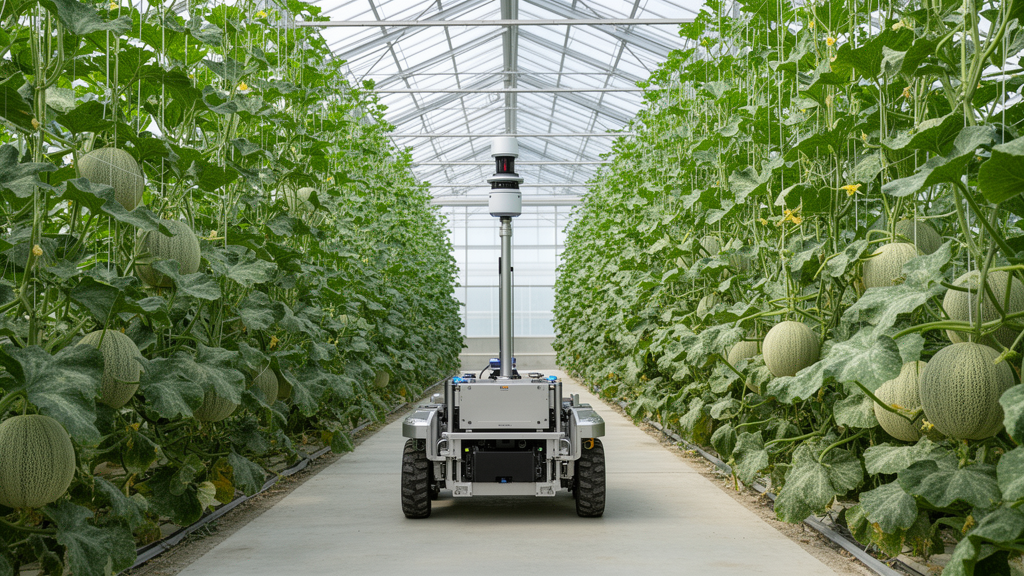
Researchers have developed and evaluated an autonomous ground robotic platform equipped with a rotating three-dimensional light detection and ranging sensor to map greenhouse-grown melon crops, isolate individual plant point clouds, and track stem height across successive growth stages. Vertically trellised melon cultivation inside modern greenhouses produces high economic yields under controlled conditions, yet evaluating plant performance across large populations has traditionally depended on manual measurements using tapes and calipers. Such manual field practices require extensive labor, introduce observer-dependent variability, risk inducing physical thigmo-morphogenetic stress via repeated mechanical contact, and struggle to scale across commercial operations. To resolve these operational limitations, the engineering team engineered a mobile robotic mapping pipeline combining edge-based simultaneous localization and mapping with an offline point-cloud segmentation and tracking framework tailored specifically for narrow greenhouse rows and overlapping foliage.
Deploying optical sensors within dense greenhouse canopies presents severe perception challenges that defeat conventional geometric clustering algorithms. In vertically trained melon cultivation, plants are suspended along continuous vertical trellis wires, while adjacent melon leaves interlock across tight row spacings. Trellis cables contribute extraneous non-plant returns that can easily bridge adjacent canopies, while conventional Euclidean clustering or region growing algorithms frequently merge neighboring plants into single amorphous clusters or fracture single vines into disjoint pieces. Furthermore, indoor greenhouse structures block satellite navigation signals and exhibit repetitive geometric features that disrupt robot state estimation. The investigation addressed these coupled challenges by pairing autonomous edge navigation with an offline instance-segmentation algorithm termed Skeleton-Guided Clustering, which anchors plant candidates at detected cultivation pots and uses graph connectivity to assign ambiguous foliage.
The experimental mobile platform was constructed on a compact aluminum-extrusion chassis driven by differential stepper motors and passive caster wheels, sized specifically to navigate within narrow 0.8-meter cultivation aisles. Above the chassis, an elevated Livox Mid-360 LiDAR sensor provided a continuous horizontal field of view across the adjacent crop rows. High-level sensor ingestion and computation were handled onboard by an NVIDIA Jetson Orin NX computer running Robot Operating System 2 Humble, interfaced over USB serial with an Arduino Uno microcontroller that directed pulse and direction controls to two TB6600 stepper drivers powering NEMA 23 motors. Sensor data were processed onboard using a FAST-LIO framework, combining 360-degree LiDAR returns and high-frequency inertial measurement unit readings to calculate real-time odometry and register sequential scans into a unified coordinate frame without requiring global navigation satellite systems.
Controlled field trials were conducted at the Hoa Lac Experimental Farm within a greenhouse cultivation area comprising two parallel 15-meter rows containing 72 netted melon plants (Cucumis melo L. var. reticulatus cv. Sweet 695). Each plant grew in a coconut-coir substrate pot measuring 0.3 meters in diameter and 0.3 meters in height, placed at 0.4-meter intervals along each row. Autonomous scanning runs were executed at weekly intervals across seven consecutive dates spanning early April through mid-May 2026. Traveling along preprogrammed waypoints at speeds between 0.2 and 0.3 meters per second, the mobile robot completed row traversals in 7 to 10 minutes per session, executing an autonomous 180-degree differential pivot turn inside a 2-meter headland area at the end of each pass. Trajectory accuracy was benchmarked against an independent Marvelmind ultrasonic indoor positioning system, recording horizontal trajectory root mean square errors ranging between 0.049 and 0.060 meters across the weekly sessions.
Following each autonomous traversal, the accumulated point clouds were transferred to a central computing server for structured geometric filtering and instance separation. The processing sequence first rotated coordinates by 50 degrees about the horizontal axis and fitted a ground datum plane using random sample consensus on low-elevation returns to establish a reference datum for plant elevation. Potential cultivation pots were located by projecting points within specific height bands onto a horizontal occupancy grid and convolving the surface with a disk matching pot dimensions. Confirmed pot centers were tracked across scanning sessions using an offline consensus association filter, establishing 72 stationary spatial anchors that served as structural root references for each melon plant throughout the seven-week experiment.
Individual plant segmentation operated outward from each confirmed pot position by constructing local directed graph representations from voxelized point clouds. To eliminate support structures without clipping genuine vines, a plant-protected wire filtering algorithm identified linear vertical and horizontal segments using principal component analysis, but excluded points falling within 0.08 meters of the plant axis or within 0.04 meters of an identified plant skeleton. Unassigned points situated within overlapping canopy regions were subsequently arbitrated to specific plants based on combined Euclidean distances to the nearest skeleton node and horizontal proximity to the respective pot center.
In a controlled ablation study evaluating all 72 reference melon plants across all seven weekly scans, the complete skeleton-guided segmentation workflow attained an overall macro-averaged mean Intersection over Union of 0.778926, an average precision of 0.970903, a recall of 0.796619, and a macro F1-score of 0.871750. Systematic component ablation revealed that within-pot boundary point recovery contributed the largest single quantitative performance gain; omitting the two-round boundary recovery step reduced the mean Intersection over Union by 4.5951 percentage points down to 0.732975 and lowered the F1-score to 0.838510. By contrast, replacing skeleton-distance guidance with a geometry-only fallback based solely on pot-axis proximity produced a comparatively minor decrease in mean Intersection over Union of 0.1469 percentage points, reflecting that vertical trellis training maintained lower stems in relatively upright alignments that closely coincided with simple pot center axes.
Longitudinal phenotypic trait extraction focused on repeated automated plant height estimation across the 504 paired plant-session observations. The automated algorithm extracted ground-to-top plant height by identifying the upper vertical point elevation of each segmented plant cluster relative to the fitted greenhouse floor datum. When pooled across all 504 observations spanning the seven-week growth cycle, automated LiDAR estimates correlated strongly with manual tape measurements, yielding a pooled coefficient of determination of 0.9630, a mean absolute error of 0.0836 meters, a root mean square error of 0.1151 meters, and an overall signed bias of positive 0.0180 meters.
However, granular stage-by-stage statistical analyses revealed critical limitations in stage-specific precision that were masked by pooled growth trajectories. When evaluated within individual weekly scanning sessions, the coefficient of determination fell to negative values across all seven weeks, ranging from negative 0.2144 in Week 1 down to negative 13.5085 in Week 7. Concurrently, the weekly mean absolute error expanded progressively from 0.0339 meters in the initial post-transplant week to 0.1245 meters as canopies attained maximum density in Week 7. These negative within-stage correlations indicate that within any single week, residual estimation errors exceeded the natural plant-to-plant height variance present within the cohort, demonstrating that the pooled association was largely driven by overall temporal growth between stages rather than precise differentiation of subtle height differences among neighboring plants.
The study highlights specific mechanical and computational considerations that warrant further development prior to commercial deployment. Because the height extraction metric relied on the maximum vertical coordinate within each filtered cluster, isolated residual returns from overhead trellis wires or slight sensor misalignments could artificially elevate height estimates, while dense foliage occlusion could obscure the true apical tip. The researchers emphasized that future iterations should benchmark robust percentile thresholds and local parabolic apex fitting against manual ground truth, incorporate joint semantic classification of support wires and plant organs, and explore stem-base detection routines to enable deployment in pot-free soil farming systems.
Subject of Research: Mobile robotic LiDAR phenotyping of greenhouse melon crops
Article Title: A mobile-LiDAR platform for pot-anchored plant segmentation and repeated height measurement of greenhouse-grown Cucumis melo L.
Article References: Vu, M.-T., Nguyen, T. S., Tran, H.-T., Cao, H.-N., & Pham, M. T. (2026). A mobile-LiDAR platform for pot-anchored plant segmentation and repeated height measurement of greenhouse-grown Cucumis melo L.. Smart Agricultural Technology, 15, Article 102729. https://doi.org/10.1016/j.atech.2026.102729
Image Credits: AI Generated
DOI: 10.1016/j.atech.2026.102729
Keywords: agricultural robotics, mobile LiDAR, greenhouse phenotyping, Cucumis melo, plant segmentation, point cloud processing, skeleton guidance, 3D phenotyping, precision horticulture, controlled-environment agriculture, FAST-LIO, autonomous navigation, crop monitoring, instance segmentation, structural phenotyping, trellis cultivation, height estimation
News Source: Alan Morgan. (November 20, 2026). Mobile LiDAR Platform Segments Greenhouse Melon Plants and Tracks Structural Growth. Scienmag.