

• HOME
  • NEWS
  • EXPLORE
    • CAREER
      • Companies
      • Jobs
    • EVENTS
    • iGEM
      • News
      • Team
    • PHOTOS
    • VIDEO
    • WIKI
  • BLOG
  • COMMUNITY
    • FACEBOOK
    • INSTAGRAM
    • TWITTER
Tuesday, July 7, 2026
BIOENGINEER.ORG
No Result
View All Result
  • Login
  • HOME
  • NEWS
  • EXPLORE
    • CAREER
      • Companies
      • Jobs
        • Lecturer
        • PhD Studentship
        • Postdoc
        • Research Assistant
    • EVENTS
    • iGEM
      • News
      • Team
    • PHOTOS
    • VIDEO
    • WIKI
  • BLOG
  • COMMUNITY
    • FACEBOOK
    • INSTAGRAM
    • TWITTER
  • HOME
  • NEWS
  • EXPLORE
    • CAREER
      • Companies
      • Jobs
        • Lecturer
        • PhD Studentship
        • Postdoc
        • Research Assistant
    • EVENTS
    • iGEM
      • News
      • Team
    • PHOTOS
    • VIDEO
    • WIKI
  • BLOG
  • COMMUNITY
    • FACEBOOK
    • INSTAGRAM
    • TWITTER
No Result
View All Result
Bioengineer.org
No Result
View All Result
Home NEWS Science News Biology

Interactive protein posttranslational modifications regulate stress responses

Bioengineer by Bioengineer
July 28, 2017
in Biology
Reading Time: 2 mins read
0
Share on FacebookShare on TwitterShare on LinkedinShare on RedditShare on Telegram
IMAGE

Credit: IGDB

Methylation and nitric oxide (NO)-based S-nitrosylation are highly conserved protein posttranslational modifications that regulate diverse biological processes, including abiotic stress responses. However, little is known about the underlying molecular mechanisms.

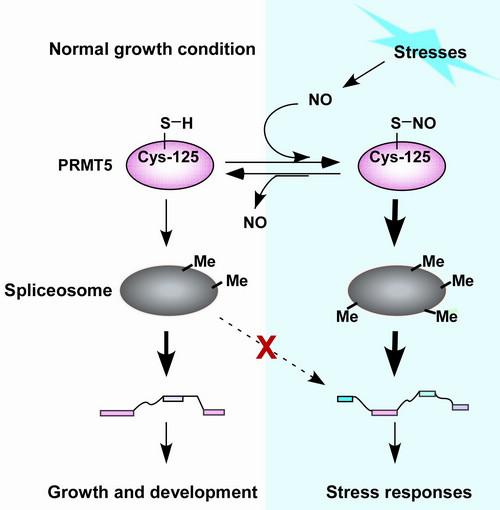
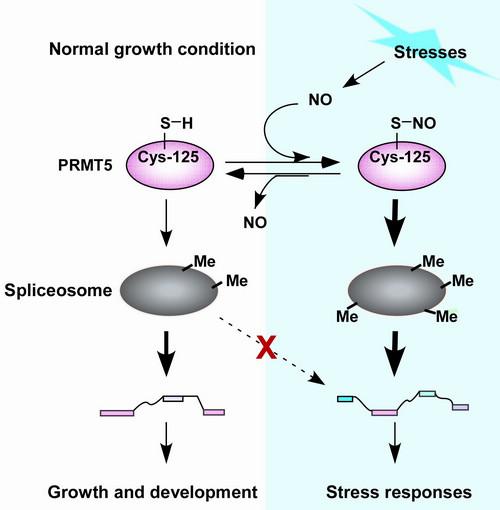
Dr. ZUO Jianru's group at the Institute of Genetics and Developmental Biology (IGDB) of the Chinese Academy of Sciences identified PRMT5, a protein arginine methyltransferase, as an S-nitrosylated protein in a nitroproteomics study in Arabidopsis. PRMT5 is a highly conserved enzyme that catalyzes arginine symmetric dimethylation of various proteins, including key components of the spliceosome.

Subsequently, in collaboration with the groups of CAO Xiaofeng (IGDB), BAO Shilai (IGDB), and KONG Zhaosheng (Institute of Microbiology), they discovered that NO positively regulates the methyltransferase activity of PRMT5 through S-nitrosylation at Cys-125 in response to abiotic stresses.

Consequently, S-nitrosylation at Cys-125 of PRMT5 enhances arginine symmetric dimethylation, leading to proper splicing-specific pre-mRNA of stress-related genes and eventually boosting the tolerance to stress. Importantly, S-nitrosylation at Cys-125 is essential for PRMT5-regulated stress responses mediated by NO.

These findings define a molecular link through which plants transduce stress-triggered NO signals to protein methylation machinery in response to environmental alterations.

The results of this research, entitled "Nitric oxide regulates protein methylation during stress responses in plants", were recently published online in Molecular Cell.

###

This study was supported by grants from the National Natural Science Foundation of China, the Strategic Priority Research Program of the Chinese Academy of Sciences, the State Key Laboratory of Plant Genomics, and a postdoctoral fellowship from the China Postdoctoral Science Foundation and the Chinese Academy of Sciences.

Media Contact

Zuo Jianru
[email protected]

http://english.cas.cn/

Original Source

http://english.cas.cn/newsroom/research_news/201707/t20170726_181325.shtml http://dx.doi.org/10.1016/j.molcel.2017.06.031


Share12Tweet8Share2ShareShareShare2

Related Posts

Here are a few rewritten headlines for a science magazine post, each with a slightly different tone: Intriguing & poetic: How do organs sculpt themselves? Sea stars hold the secret Direct & research-focused: Sea stars reveal the hidden rules of organ formation Metaphorical & inviting: Tiny architects beneath the waves: What sea stars teach us about building organs Short & punchy: Star-shaped clues to how our organs take shape Question-led: Could a sea star show us how organs form? Elegant & feature-style: The body’s blueprint, glimpsed in a sea star’s arm

July 6, 2026
Bacteria evolve faster with unconventional gene copies — Biology

Bacteria evolve faster with unconventional gene copies

July 6, 2026

Neighbours rewire soil feedback via root microbiome shifts

July 6, 2026

Evolution-Inspired Biosensors Revolutionize Lipid Tracking in Real Time

July 2, 2026
Please login to join discussion

POPULAR NEWS

  • Detection of EDCs in Breast Milk and Infant Urine Up to Six Months Highlights Early Exposure Risks

    77 shares
    Share 31 Tweet 19
  • New Drug Candidate Developed at McMaster Shows Potential for Treating Brain Cancer

    58 shares
    Share 23 Tweet 15
  • Saying Goodbye to PGY-6: Pediatric Fellowship Realities

    103 shares
    Share 41 Tweet 26
  • KTU Researchers Explore Ultrasound’s Role in Enhancing Blood Flow Beyond Diagnostics

    53 shares
    Share 21 Tweet 13

About

We bring you the latest biotechnology news from best research centers and universities around the world. Check our website.

Follow us

Recent News

Flame retardant BDE-209 targets molecularly linked to ulcerative colitis

Ultra-high frequency particle impacts mimic rockbursts to shatter hard rock

Kidney transplant outcomes in older adults studied by German researchers

Subscribe to Blog via Email

Enter your email address to subscribe to this blog and receive notifications of new posts by email.

Join 83 other subscribers
  • Contact Us

Bioengineer.org © Copyright 2023 All Rights Reserved.

Welcome Back!

Login to your account below

Forgotten Password?

Retrieve your password

Please enter your username or email address to reset your password.

Log In
No Result
View All Result
  • Homepages
    • Home Page 1
    • Home Page 2
  • News
  • National
  • Business
  • Health
  • Lifestyle
  • Science

Bioengineer.org © Copyright 2023 All Rights Reserved.
