• HOME
  • NEWS
  • EXPLORE
    • CAREER
      • Companies
      • Jobs
    • EVENTS
    • iGEM
      • News
      • Team
    • PHOTOS
    • VIDEO
    • WIKI
  • BLOG
  • COMMUNITY
    • FACEBOOK
    • INSTAGRAM
    • TWITTER
Thursday, June 25, 2026
BIOENGINEER.ORG
No Result
View All Result
  • Login
  • HOME
  • NEWS
  • EXPLORE
    • CAREER
      • Companies
      • Jobs
        • Lecturer
        • PhD Studentship
        • Postdoc
        • Research Assistant
    • EVENTS
    • iGEM
      • News
      • Team
    • PHOTOS
    • VIDEO
    • WIKI
  • BLOG
  • COMMUNITY
    • FACEBOOK
    • INSTAGRAM
    • TWITTER
  • HOME
  • NEWS
  • EXPLORE
    • CAREER
      • Companies
      • Jobs
        • Lecturer
        • PhD Studentship
        • Postdoc
        • Research Assistant
    • EVENTS
    • iGEM
      • News
      • Team
    • PHOTOS
    • VIDEO
    • WIKI
  • BLOG
  • COMMUNITY
    • FACEBOOK
    • INSTAGRAM
    • TWITTER
No Result
View All Result
Bioengineer.org
No Result
View All Result
Home NEWS Science News Health

Insect wings hold antimicrobial clues for improved medical implants

Bioengineer by Bioengineer
April 6, 2020
in Health
Reading Time: 2 mins read
0
IMAGE
Share on FacebookShare on TwitterShare on LinkedinShare on RedditShare on Telegram

IMAGE

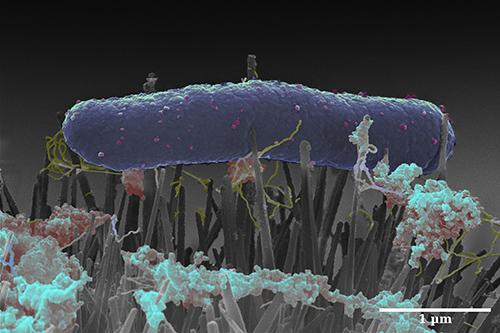
Credit: Professor Bo Su, University of Bristol

Some insect wings such as cicada and dragonfly possess nanopillar structures that kill bacteria upon contact. However, to date, the precise mechanisms that cause bacterial death have been unknown.

Using a range of advanced imaging tools, functional assays and proteomic analyses, a study by the University of Bristol has identified new ways in which nanopillars can damage bacteria.

These important findings, published in Nature Communications, will aid the design of better antimicrobial surfaces for potential biomedical applications such as medical implants and devices that are not reliant on antibiotics.

Bo Su, Professor of Biomedical Materials at the University of Bristol’s Dental School, who authored the research said:

“In this work, we sought to better understand nanopillar-mediated bactericidal mechanisms. The current dogma is that nanopillars kill bacteria by puncturing bacterial cells, resulting in lysis. However, our study shows that the antibacterial effects of nanopillars are actually multifactorial, nanotopography- and species-dependent.

“Alongside deformation and subsequent penetration of the bacterial cell envelope by nanopillars, particularly for Gram-negative bacteria, we found the key to the antibacterial properties of these nanopillars might also be the cumulative effects of physical impedance and induction of oxidative stress.

“We can now hopefully translate this expanded understanding of nanopillar-bacteria interactions into the design of improved biomaterials for use in real world applications.”

Funded by the Medical Research Council, the implications of the research are far-reaching. Prof. Su explains:

“Now we understand the mechanisms by which nanopillars damage bacteria, the next step is to apply this knowledge to the rational design and fabrication of nanopatterned surfaces with enhanced antimicrobial properties.

“Additionally, we will investigate the human stem cell response to these nanopillars, so as to develop truly cell-instructive implants that not only prevent bacterial infection but also facilitate tissue integration.”

###

Paper:

Antibacterial effects of nanopillar surfaces are mediated by cell impedance, penetration and induction of oxidative stress, Nature Communications. DOI: 10.1038/s41467-020-15471-x.

Media Contact
Shona East
[email protected]

Related Journal Article

http://dx.doi.org/10.1038/s41467-020-15471-x

Tags: BacteriologyBiologyBiomedical/Environmental/Chemical EngineeringBiotechnologyCell BiologyDentistry/Periodontal DiseaseEntomologyMedicine/HealthTransplantation
Share12Tweet8Share2ShareShareShare2

Related Posts

Tracking Lanthanide-Labeled Microplastics in Plants

June 25, 2026

Neural Design Enables Zero-Shot Drug-Binding Proteins

June 25, 2026

Genomic Insights into Human Skin Fungi Diversity

June 25, 2026

Chiral Laser Gyroscopes Surpass Lock-In Limit

June 25, 2026
Please login to join discussion

POPULAR NEWS

  • Saying Goodbye to PGY-6: Pediatric Fellowship Realities

    103 shares
    Share 41 Tweet 26
  • Multi-Hospital Study Reveals Long Covid Burden Is Twice as High as Current Estimates

    92 shares
    Share 36 Tweet 23
  • Detection of EDCs in Breast Milk and Infant Urine Up to Six Months Highlights Early Exposure Risks

    77 shares
    Share 31 Tweet 19
  • New Drug Candidate Developed at McMaster Shows Potential for Treating Brain Cancer

    58 shares
    Share 23 Tweet 15

About

We bring you the latest biotechnology news from best research centers and universities around the world. Check our website.

Follow us

Recent News

Tracking Lanthanide-Labeled Microplastics in Plants

POSTECH Researchers Slash Cost of Reconstituted Cell-Free Systems by 95%

AI and Physics Collaborate to Design Advanced Hydrogen Storage Materials

Subscribe to Blog via Email

Enter your email address to subscribe to this blog and receive notifications of new posts by email.

Join 82 other subscribers
  • Contact Us

Bioengineer.org © Copyright 2023 All Rights Reserved.

Welcome Back!

Login to your account below

Forgotten Password?

Retrieve your password

Please enter your username or email address to reset your password.

Log In
No Result
View All Result
  • Homepages
    • Home Page 1
    • Home Page 2
  • News
  • National
  • Business
  • Health
  • Lifestyle
  • Science

Bioengineer.org © Copyright 2023 All Rights Reserved.