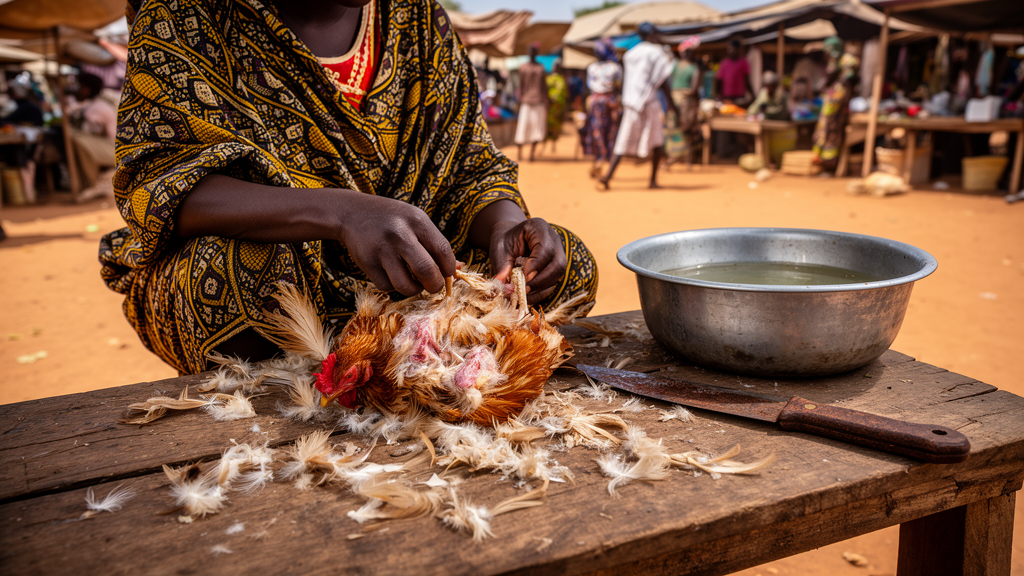
In the bustling municipal markets of Southern Mozambique, broiler chickens are slaughtered by hand, dressed on shared tables, and sold to consumers without refrigeration, formal training, or official inspection. A new cross-sectional study published in Frontiers in Animal Science has now quantified just how precarious this informal value chain is, surveying 119 chicken retail operators across eight markets in the provinces of Maputo, Gaza, and Inhambane. The findings paint a stark picture of a sector that feeds urban populations daily while operating almost entirely outside regulatory frameworks, with contamination risks that researchers say endanger public health.
The research team, led by Noémia André Mugabe of Sokoine University of Agriculture in Tanzania and the Pedagogical University of Maputo in Mozambique, together with Jamal Kussaga and Abdulsudi Issa-Zacharia, conducted the survey between October 2023 and April 2024. They used a structured questionnaire and an observational compliance checklist to capture data on knowledge, attitudes, and practices (KAP) relating to food safety and hygiene during chicken processing. The sample size was calculated using the Raosoft calculator with a 95 percent confidence level and a 5 percent margin of error, applied to an estimated informal operator population of approximately 170 across the eight selected markets. Purposeful sampling, assisted by local market administrators and field assistants from the National Directorate of Animal Health, enrolled 119 consenting operators, matching the statistically calculated target.
The socio-demographic profile of the operators reflects broader patterns in informal food systems across Sub-Saharan Africa. The majority were female (57.1 percent), half were aged between 20 and 40 years, and 52.9 percent were unmarried but living with a partner. Most had secondary education (57.1 percent), while 40.3 percent had only primary schooling and 2.5 percent had no formal education at all. Nearly half (47.9 percent) had between five and nine years of experience in chicken processing, and 75.6 percent resided in peri-urban areas. Critically, 100 percent of operators relied on chicken processing as their main source of income, yet none possessed a processing diploma or degree, and 69.7 percent had never attended any food safety training. The cohort comprised 87 independent processors, 22 hired processor workers, and 10 live chicken sellers who also performed on-site slaughtering services upon customer request.
The physical infrastructure of the markets was equally revealing. All eight markets were classified as informal, with most operating as open-air wet markets. Only 7.6 percent of operators sourced chickens directly from farmers; the majority (76.5 percent) processed birds purchased from live chicken sellers at the market, while 16 percent processed under directives from establishment owners. A staggering 92.4 percent of operators had no access to electricity or solar energy, eliminating any possibility of cold storage. Sanitation varied: 78.2 percent had water-filled toilets, but 21.8 percent used open spaces. Waste disposal was irregular or absent in most markets, with some relying on open dumpsites or burial. None of the operators were registered with any Chicken Processors Commission, 62.2 percent lacked a license to slaughter, and 61.3 percent had never been inspected by municipal or animal health authorities. Among those inspected, 100 percent had received a penalty or warning for non-compliance with good processing practices.
Knowledge scores told a more nuanced story. On a 100-point scale, no operator scored below 50, and the majority achieved good levels (≥75), with mean scores around 76. Multiple linear regression revealed that participation in formal food safety training was the most significant positive predictor of knowledge, with trained operators scoring 6.12 percentage points higher than untrained counterparts (β = 6.116, p < 0.001). Marriage also exerted a positive influence (β = 1.789, p < 0.05). Education level and training attendance were significantly associated with knowledge categories in chi-square analysis (χ² = 9.096 and χ² = 8.354 respectively, p < 0.05). However, universal compliance was observed only for basic measures such as handwashing with soap and water before and after work and proper cleaning and disinfection of instruments. Notable regional disparities emerged: in Inhambane, 93.3 percent of operators refrained from working while ill, compared with only 28.9 percent in Maputo (χ² = 22.636, p < 0.001). Similarly, avoiding eating and drinking at work was observed more in Inhambane (80 percent) than in Maputo (22.2 percent, χ² = 20.618, p < 0.001).
Attitude scores revealed a paradoxical pattern. No operator achieved a good attitude level (≥75); the majority fell into the medium category (≥50 to <75), with mean scores around 57.5. Regression analysis uncovered a significant negative predictive effect for higher education (β = -1.814, p < 0.05) and for formal food safety training attendance (β = -3.19, p < 0.05). Trained operators paradoxically registered lower mean attitude scores (55.30 ± 5.74) than untrained ones (58.58 ± 4.90). The authors attribute this counterintuitive trend to a common behavioral phenomenon: formal training improves an operator’s internal awareness of biological risks, leading to more discerning and realistic self-reporting, whereas untrained operators exhibit an optimism bias or deceptive sense of security, inflating their self-reported attitudes. Regional differences were pronounced: peri-urban operators showed significantly stronger agreement on the importance of protective clothing (χ² = 38.39, p < 0.001) and safe slaughter as professional responsibility (χ² = 25.71, p < 0.001), while urban operators demonstrated higher awareness of nail hygiene (χ² = 9.109, p = 0.011) and prohibiting personnel with hand injuries from handling meat (χ² = 14.64, p = 0.001).
Practice scores were uniformly medium, with means around 74.3 and no operator scoring below 50 or above 81. Chi-square tests revealed significant associations between practice categories and marital status (χ² = 12.308, p < 0.05), education level (χ² = 9.046, p < 0.05), and residence area (χ² = 8.607, p < 0.05). However, multiple linear regression found no socio-demographic indicator to be a statistically significant predictor of continuous practice scores, and training attendance exhibited no independent predictive influence (β = -0.432, p ≥ 0.05). This absence of predictive weight underscores a significant knowledge-practice gap. Operators are structurally limited: without electricity, cold-chain systems, or adequate handwashing stations, even improved cognitive awareness cannot translate into sanitary behavior. The authors emphasize that educational interventions must be paired with physical marketplace infrastructure enhancements to achieve meaningful public health improvements.
Specific hygienic practices revealed both encouraging compliance and alarming deficiencies. All participants disinfected equipment (78.2 percent through boiling or steam), cleaned spaces by batch, washed carcasses after evisceration, and separated slaughter from plucking areas. However, the complete lack of carcass disinfection post-washing (100 percent) and the absence of refrigeration facilities (100 percent) represent terminal failures in the processing chain. Scalding water was changed only once daily by 79 percent of operators, and 31.1 percent admitted to slaughtering sick chickens or transporting dead birds. Handwashing places with soap or detergent were universally absent at work sites (100 percent reported never having them), though 65.6 percent in Maputo, 71.4 percent in Gaza, and 100 percent in Inhambane always washed hands before and after processing. Eating and drinking at work was prevalent in Maputo (74.4 percent always), and jewellery use during work was significantly higher there (43.3 percent always, χ² = 31.009, p < 0.001). Waste disposal practices were inadequate, with scalding and plucking water discarded on processing floors (26.9 percent), in drains (38.7 percent), or in pits outside markets (34.5 percent).
Perhaps the most striking statistical finding was the significant negative correlation between knowledge and attitude scores (r = -0.220, p < 0.05), suggesting that operators with greater food safety knowledge may hold less favorable attitudes toward safety practices. A robust positive correlation existed between hygiene knowledge and hygiene behaviors (r = 0.282, p < 0.01), indicating that increased knowledge correlates with improved practices. A negative association was also found between practices and attitude (r = -0.218, p < 0.05). The authors note that peri-urban residence was negatively correlated with training attendance (r = -0.374, p < 0.01), meaning those living in peri-urban regions were less inclined to attend food safety training. These inverse relationships prompt intriguing questions about the design of educational programs, which the authors argue must encompass both instructional and motivational elements to enhance overall food safety.
The study concludes that informal poultry processing in Southern Mozambique endangers public health through a combination of structural informality, absent infrastructure, and hazardous behaviors. The risks stem from operators’ lack of official slaughter training, refrigeration facilities, and municipal inspection, which collectively lower their knowledge, attitudes, and hygiene standards. The presence of flies on processed carcasses during interviews, along with reports of cockroaches, rats, cats, and dogs in processing areas at dusk, further promotes cross-contamination by pathogens such as Escherichia coli, Salmonella, and Campylobacter. The authors recommend that governments mandate food safety training and licensing for informal operators, conduct unannounced inspections, provide refrigeration and handwashing stations, and enforce proper slaughter waste disposal through burial, incineration, or animal feed. Without such targeted interventions, they warn, the contamination risks in these markets will continue to threaten the health of urban and peri-urban consumers who depend on them daily.
Subject of Research: Food Safety
Article Title: Assessment of knowledge, attitudes, and food safety practices among market operators in the broiler chicken value chain in Southern Mozambique
Article References: Mugabe, N. A., Kussaga, J., & Issa-Zacharia, A. (2026). Assessment of knowledge, attitudes, and food safety practices among market operators in the broiler chicken value chain in Southern Mozambique. Frontiers in Animal Science, 7, Article 1863925. https://doi.org/10.3389/fanim.2026.1863925
Image Credits: AI Generated
DOI: 10.3389/fanim.2026.1863925
Keywords: food safety, poultry, Mozambique, informal markets, KAP study, public health, Assessment, knowledge, attitudes, food, safety, practices
News Source: Daisy Hatcher. (October 17, 2026). Informal Chicken Slaughter in Southern Mozambique Markets Reveals Alarming Food Safety Gaps. Scienmag.