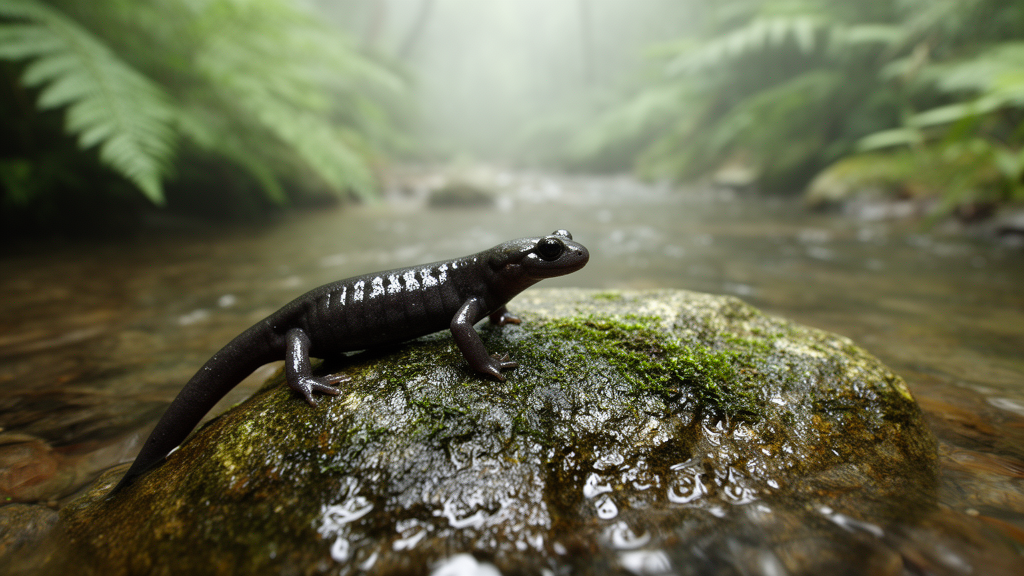
High in the mountains of Taiwan, a small cream-colored salamander has quietly rewritten a chapter of evolutionary biology. Hynobius fucus, a species endemic to the island and first described in 2008, has now had its chromosomes analyzed for the first time, and the results point to a surprising direction of karyotype evolution within the genus Hynobius. While classical theory held that chromosome numbers in salamander families tend to decrease over evolutionary time, the new study suggests that in this lineage the opposite occurred: the diploid chromosome number increased from 2n = 56 in a pond-type ancestor to 2n = 58 in the stream-type species that now inhabit Taiwan’s mountain torrents.
The research, published in the journal Comparative Cytogenetics, is dedicated to the memory of the late Dr. June-Shian Lai of National Taiwan Normal University, a pioneer in the study of Taiwan’s mountainous salamanders. Lai, together with Kuang-Yang Lue, described two new species from northern Taiwan in 2008, Hynobius fucus and Hynobius glacialis, but no chromosomal data existed for either species until now. The specimen examined in the new work was collected in July 2009 by Chan Yi-Hao and Nikolay Poyarkov under Lai’s supervision, from the foot of the Hsueh-Shan Mountains in Guanwu, Miaoli County, at an altitude of roughly 1,300 meters.
Preparing chromosomes from an amphibian is a delicate business. The team used a classic technique developed by Kezer and Sessions in 1979, injecting the immature juvenile with a colchicine solution to arrest cells in metaphase, the stage at which chromosomes are most condensed and visible. Forty-eight hours later, cells were taken from the gastrointestinal epithelium, treated with distilled water to swell them, fixed in Carnoy’s solution of acetic acid and methanol, and separated with 45 percent acetic acid. Slides were air-dried, stained with 4 percent Giemsa solution, and photographed under an Olympus microscope. The chosen specimen was selected precisely because it displayed a good somatic metaphase figure under staining.
The analysis revealed that Hynobius fucus possesses 29 pairs of homologous chromosomes, giving a diploid number of 2n = 58. This matches the chromosome counts of the other three rheophilic stream-type Taiwanese species studied previously: Hynobius arisanensis, Hynobius sonani, and Hynobius formosanus. The 29 pairs consist of nine pairs of large bi-armed chromosomes, four pairs of medium bi-armed chromosomes, six pairs of small bi-armed chromosomes, and ten pairs of small uni-armed chromosomes, yielding a fundamental number of 96, meaning 96 chromosome arms in total. Only one of the four Taiwanese species, H. formosanus, differs slightly, with a fundamental number of 94.
Beyond the raw chromosome count, the study brought developmental evidence to bear on the question of H. fucus’s lifestyle. In the winter season of 2025, laboratory breeding produced tail-bud stage embryos laid on January 1. These embryos, along with the species’ large egg size, nutritious egg yolks, and cream-colored body lacking melanin protection against ultraviolet light, confirm that H. fucus is undoubtedly a lotic stream-type salamander, adapted to life in flowing water. Intriguingly, adult males during the breeding season develop a vertically flattened tail fin, a trait typical of pond-type salamanders, hinting at the species’ complex evolutionary heritage.
The comparison with mainland China proved decisive. Five species of Hynobius with 56 chromosomes live on the Eurasian mainland, including the Korean peninsula, and notably, no salamander with 58 chromosomes has ever been found there. Hynobius fucus shows a karyotype most similar to that of the recently described pond-type Hynobius bambusicolus from Fujian Province, the region directly across from Taiwan, differing by just one pair of small chromosomes. The key lies in the microchromosomes. H. bambusicolus has six pairs of bi-armed microchromosomes and nine pairs of uni-armed microchromosomes, while H. fucus has six pairs of bi-armed and ten pairs of uni-armed microchromosomes. Speciation, the authors conclude, occurred in the direction of increasing one pair of uni-armed microchromosomes.
A similar pattern holds for the other Taiwanese species. H. arisanensis and H. sonani both carry ten pairs of uni-armed microchromosomes, suggesting they too arose from an ancestral lineage resembling H. bambusicolus by gaining one pair. Meanwhile, H. formosanus, with five pairs of bi-armed and eleven pairs of uni-armed microchromosomes, appears to have differentiated from the ancestral lineage of four pond-type species on the mainland, including Hynobius amjiensis, by the same mechanism. In total, five Taiwanese species with 58 chromosomes appear to have been born from two distinct pond-type ancestral lineages with 56 chromosomes, each through the addition of a single pair of uni-armed microchromosomes.
Recent nuclear DNA analysis by Chen and colleagues in 2024 confirmed that all five Taiwanese salamander species are monophyletic, sharing a common ancestor, with H. fucus occupying the outermost branch of the molecular phylogenetic tree and living at the lowest altitudes, from 1,300 to 2,290 meters, closest to the ancestral type. The scenario reconstructed by the cytogenetic and molecular data combined is that salamander ancestors invaded Taiwan from mainland China, established themselves in mountainous areas between 1,300 and 3,600 meters, and then speciated into five species. The chromosomes of H. glacialis, which lives at 3,400 meters near the island’s highest peaks, remain unknown, but the four species studied so far all carry 2n = 58.
The study also challenges a long-standing generalization. Morescalchi proposed in 1975 that karyotype evolution in families of urodeles tends to proceed from higher to lower chromosome numbers, but he did not examine changes within genera. The Taiwanese evidence suggests that within the genus Hynobius, chromosome numbers evolved from fewer to more, from 56 to 58. Developmental physiology supports this inference. Pond-type Hynobius with 56 chromosomes possess pointed interdigital membranes that larvae use to anchor their bodies to pond bottoms, responding to slight currents and catching small prey. Stream-type species with 58 chromosomes grow inside egg sacs nourished by yolk and have no need for these membranes, which degenerate into vestigial structures. In both 56- and 58-chromosome species, the membranes disappear as the third toe develops, and their morphology in Taiwanese and Chinese salamanders closely mirrors that of Japanese relatives, reinforcing the evolutionary direction from 56 to 58.
As a future challenge, the authors recommend molecular hybridization experiments to obtain direct scientific evidence for the increase in a single pair of uni-armed microchromosomes. Techniques such as chromosome painting and fluorescence in situ hybridization with chromosome-specific probes could compare the 56-chromosome pond-type species from Fujian Province with the 58-chromosome stream-type H. fucus, revealing exactly how the extra chromosome pair arose. For now, the humble mountain salamanders of Taiwan, studied through the legacy of June-Shian Lai, have shown that even a single pair of tiny chromosomes can carry the story of an entire evolutionary transition from still ponds to rushing streams.
Subject of Research: Karyotype of Hynobius fucus Lai et Lue, 2008, a salamander endemic to Taiwan with comments in memory of June-Shian Lai, a pioneer in studies of mountainous salamanders ( Urodela , Hynobiidae )
Article Title: Karyotype of Hynobius fucus Lai et Lue, 2008, a salamander endemic to Taiwan with comments in memory of June-Shian Lai, a pioneer in studies of mountainous salamanders ( Urodela , Hynobiidae )
Article References: Iizuka, K., Koishi, H., Poyarkov, N. A., Takeuchi, Y., & Ju, Y.-T. (2025). Karyotype of Hynobius fucus Lai et Lue, 2008, a salamander endemic to Taiwan with comments in memory of June-Shian Lai, a pioneer in studies of mountainous salamanders (Urodela, Hynobiidae). Comparative Cytogenetics, 19, 155-165. https://doi.org/10.3897/compcytogen.19.158987
Image Credits: AI Generated
DOI: 10.3897/compcytogen.19.158987
Keywords: Karyotype, Hynobius, fucus, salamander, endemic, Taiwan, comments, memory, June-Shian, pioneer, studies, mountainous
News Source: Gavin Prescott. (October 17, 2026). Chromosomes reveal how Taiwan’s mountain salamanders evolved from pond ancestors into stream dwellers. Scienmag.