


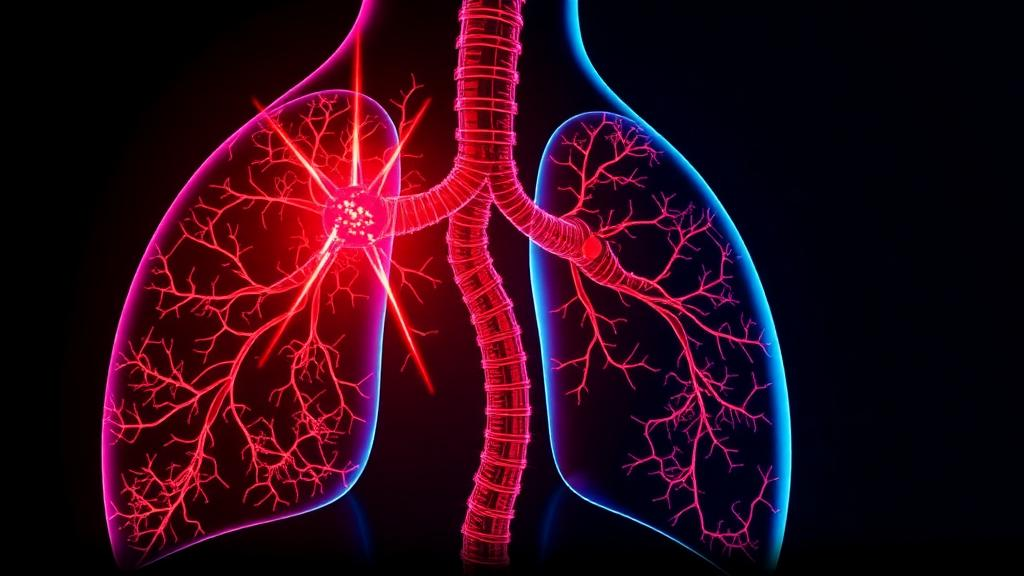
Chronic obstructive pulmonary disease has long been known to raise the risk of lung cancer, but the molecular threads connecting the two conditions have remained tangled. A new study published in Cell Division points to one of those threads: the inflammatory signaling molecule interleukin-8, or IL-8. Researchers report that IL-8, produced in abundance under cigarette-smoke-driven inflammatory conditions, pushes lung cancer cells toward an invasive, migratory state through activation of the STAT3 signaling pathway, a mechanism the authors propose as a bridge between chronic airway inflammation and tumor aggressiveness.
The team, led by Xin Zhou and Junmin Li, built what they call a COPD-like microenvironment in the laboratory. They exposed HBEC3-KT human bronchial epithelial cells to cigarette smoke extract for five consecutive days, then co-cultured these treated cells with two lung cancer cell lines, A549 and 95D, using Transwell chambers that permit soluble factors to pass between compartments without direct cell contact. Before running the experiments, the researchers confirmed with a CCK-8 viability assay that 10 percent cigarette smoke extract did not harm the bronchial cells, with survival remaining above 90 percent, ensuring that any downstream effects reflected inflammatory stimulation rather than cytotoxic injury.
The measurements that followed showed a striking pattern. Enzyme-linked immunosorbent assays revealed a marked increase in IL-8 secretion from the smoke-exposed bronchial epithelial cells, and the signal grew stronger still in the cancer cells after co-culture. Quantitative real-time PCR detected elevated IL-8 messenger RNA under the same conditions, with the highest levels in the co-cultured A549 and 95D cells, and Western blotting confirmed the corresponding protein upregulation. In short, the inflammatory cue traveled from the damaged epithelium to the tumor cells, and IL-8 rose at every step.
To test whether that rise mattered functionally, the researchers manipulated IL-8 directly. When they silenced the gene with small interfering RNA, migration and invasion of both cancer cell lines dropped significantly in Transwell assays. When they forced IL-8 overexpression with a plasmid, migratory and invasive capacity climbed. The molecular signature shifted in parallel: IL-8 knockdown raised the epithelial marker E-cadherin while lowering the mesenchymal markers N-cadherin and Snail, and overexpression produced the opposite pattern. Together these changes describe epithelial-mesenchymal transition, a reversible program in which cells lose polarity and intercellular adhesion and gain the motility and invasiveness that facilitate tumor dissemination.
The mechanistic core of the study lies in STAT3. When the researchers treated A549 and 95D cells with recombinant human IL-8 at 20 nanograms per milliliter, Western blots showed a marked increase in STAT3 phosphorylation, the activating modification of this transcription factor. Adding Stattic, a selective inhibitor of STAT3 activation and dimerization at 5 micromolar, suppressed that phosphorylation and, crucially, reversed the IL-8-driven EMT changes: E-cadherin recovered while N-cadherin and Snail fell back. The same results held in both cell lines, suggesting that STAT3 activation is required for IL-8 to impose its mesenchymal program on lung cancer cells.
The team then asked whether IL-8 was genuinely the mediator of the COPD-like environment’s effects rather than a bystander. Co-culture with smoke-treated bronchial cells lowered E-cadherin and raised N-cadherin and Snail in the cancer cells and boosted their migration and invasion, but knocking down IL-8 markedly reversed all of these changes in both A549 and 95D cells. Conditioned medium from the smoke-exposed epithelial cells produced comparable EMT and invasiveness effects that were also reversed by IL-8 depletion. These gain- and loss-of-function results, performed in triplicate with statistical testing by t-test and analysis of variance, position IL-8 as a necessary conduit for the inflammatory microenvironment’s pro-tumor influence.
Clinical tissue analysis lent the cell culture findings real-world weight. The researchers examined 60 paraffin-embedded lung tissue samples from patients surgically resected at the Affiliated People’s Hospital of Hubei Medical University: 20 normal lung tissues, 20 non-small cell lung cancer tissues from patients without COPD, and 20 from patients with COPD. Immunohistochemical staining scored by two blinded pathologists using the H-score method showed IL-8 expression rising progressively from normal tissue to COPD-negative tumors to COPD-positive tumors. E-cadherin declined across the same sequence, reaching its lowest level in COPD-associated tumors, while Snail climbed to its highest. Notably, smoking status and cumulative smoking exposure in pack-years were comparable between the two tumor groups, which the authors say makes it unlikely that differences in smoking history alone explain the elevated IL-8 in COPD-associated cancers.
The authors are candid about the study’s boundaries. The COPD-like model relied on short-term smoke extract exposure and a two-dimensional indirect co-culture system that cannot fully reproduce chronic COPD pathology or the structural complexity of living tissue, and in vivo validation remains to be done. STAT3 involvement was assessed primarily with a pharmacological inhibitor rather than genetic approaches or rescue experiments. The EMT analysis covered only three markers, and potential cross-talk with NF-κB, PI3K/AKT, and the upstream CXCR1/2-JAK2 axis, through which IL-8 signals in other malignancies, was not directly examined; the authors acknowledge that receptor-level and JAK2-mediated signaling await clarification. The clinical cohort was small, lacked long-term survival data and COPD severity stratification by GOLD staging, and detailed pulmonary function parameters were not consistently available.
Those caveats notwithstanding, the study offers a coherent mechanistic narrative with therapeutic implications. IL-8 is already recognized as a multifunctional chemokine, secreted by airway epithelial cells, macrophages, and tumor cells, that recruits neutrophils, promotes angiogenesis, and correlates in lung cancer tissues with higher tumor grade, greater metastatic potential, and poor prognosis. By showing that this same molecule, amplified under smoke-induced inflammatory conditions, drives EMT through STAT3 phosphorylation, the researchers supply experimental evidence for how COPD’s chronic inflammation could translate into more aggressive tumor behavior. The authors note that IL-8-neutralizing antibodies and STAT3 inhibitors have been developed in other disease contexts, but their efficacy and safety in COPD-associated lung cancer remain undetermined, and challenges such as pathway redundancy and off-target effects would need evaluation in preclinical and clinical studies before any such strategy could advance.
For now, the work reframes a familiar clinical observation in molecular terms. COPD and lung cancer co-occur far more often than chance would predict, and epidemiological evidence cited by the authors indicates that COPD raises lung cancer risk independently of smoking history. This study does not prove causation in patients, and its cell culture and tissue correlation data cannot by themselves establish that IL-8 drives tumor progression in the human airway. What it does provide is a testable mechanism: a specific cytokine, a specific transcription factor, and a specific set of molecular changes that link an inflamed, smoke-damaged epithelium to the epithelial-mesenchymal transition that equips tumor cells to migrate and invade. Larger prospective studies with COPD severity staging and survival follow-up, along with in vivo models and three-dimensional culture systems the authors themselves propose, will determine whether blocking the IL-8-STAT3 axis can translate this laboratory insight into a way to slow malignant progression in the millions of people living with both diseases.
Subject of Research: The role of IL-8 and STAT3 signaling in epithelial-mesenchymal transition and progression of COPD-associated lung cancer
Article Title: IL-8 drives EMT and malignant progression in chronic obstructive pulmonary disease-associated lung cancer via STAT3 signaling
Article References: Zhou, X., Yao, R., Dong, Y., Li, Y., Deng, J., Zhang, X., Ouyang, X., & Li, J. (2026). IL-8 drives EMT and malignant progression in chronic obstructive pulmonary disease-associated lung cancer via STAT3 signaling. Cell Division, 21(1), Article 14. https://doi.org/10.1186/s13008-026-00184-2
Image Credits: AI Generated
DOI: 10.1186/s13008-026-00184-2
Keywords: IL-8, COPD, lung cancer, STAT3, EMT, cigarette smoke extract, chronic inflammation, A549, cell migration, invasion, E-cadherin, tumor microenvironment
News Source: Nathaniel Bowman. (October 29, 2026). Inflammatory Signal IL-8 Links COPD-Linked Lung Cancer Aggression to STAT3. Scienmag.



