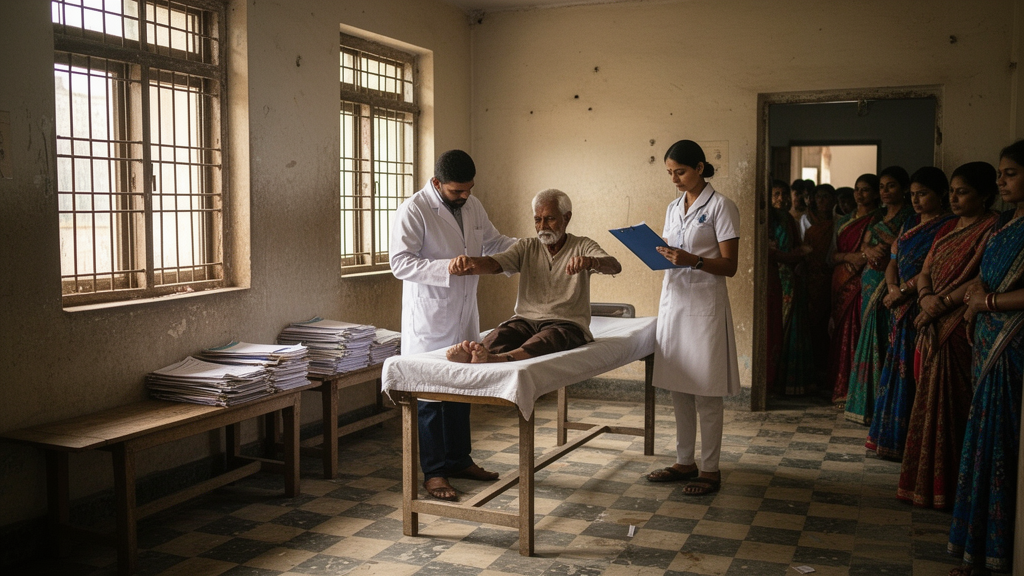
A mapping review of rehabilitation provision in India’s public health system found that services were inadequate and fragmented across ministries, concentrated around disability, and disproportionately available at secondary-care facilities. The review identified a particularly pronounced gap at the primary-care level, where the authors said rehabilitation is most essential. Its synthesis was based on policy and grey literature rather than data on actual implementation, limiting conclusions about how services operate in practice.
The authors framed the review around an estimated 440 million people in India who require rehabilitation services, equivalent to 70% of South-East Asia’s total rehabilitation need. They noted that rehabilitation is an essential strategy for achieving universal health coverage and should be accessible to people with rehabilitation needs, while systematic information about public-system services was unavailable. The scope covered national and sub-national provision across primary, secondary and tertiary healthcare levels, with private-sector services excluded.
For the mapping review, researchers followed the established methodological framework for mapping reviews and reported the work under PRISMA-ScR 2020. Eligibility was structured with the Population–Concept–Context framework. The search covered PubMed, CINAHL and the Cochrane Library from their inception through September 2025, with English-language limits, and included screening of reference lists and consultation with experts. The researchers also hand-searched grey literature from Indian ministry, regulatory and international agency websites and the Shodhganga doctoral-theses repository. They included policy documents, national health programmes and empirical studies concerning rehabilitation service provision in India’s public health system at national and sub-national levels.
Of 820 records identified, including 549 from databases and 271 from grey literature, 32 sources met the inclusion criteria and informed the synthesis. These comprised four scientific studies and 28 grey-literature documents: 16 concerning disability and health programmes, nine concerning insurance and financial-assistance schemes, and three concerning accessibility mandates. Mapping and analysis used predefined themes based on the WHO Health Systems Building Blocks framework. The review found that rehabilitation was desirable at the secondary-healthcare level but virtually absent from primary healthcare, where the authors considered it most needed. Workforce estimates indicated severe shortages, including 0.58–0.88 rehabilitation personnel per 10,000 people at community health centres and 0.20 per 10,000 at district hospitals. The two most pronounced evidence gaps concerned the health workforce and health information systems. Based on this mapped evidence, the authors concluded that national and sub-national gaps warrant action to mandate rehabilitation as essential rather than merely desirable at primary-care level and move from disability-centred provision toward functioning-based services aligned with WHO Rehabilitation 2030. They also called for stronger evidence to support India’s National Rehabilitation Strategic Framework, while explicitly cautioning that the review did not assess implementation data.
Subject of Research: Mapping rehabilitation service provision and gaps across India’s public healthcare system
Article Title: Mapping of mandated Rehabilitation services in India’s public health system: opportunities for mainstreaming rehabilitation
Article References: Mullerpatan, R., Asheel, M., Tobgay, T., Rauch, A., Saini, R. K., Agarwal, B., Solomon, J., Babu, A. S., Ganesan, S., Kadam, N., Chhabra, H. S., Boominathan, P., Sinha, A. G. K., Bhise, A., Gupta, A., Daptardar, A., Chitnis, A., Bhagwat, C., Sharma, C., … Khalil, H. (2026). Mapping of mandated Rehabilitation services in India’s public health system: opportunities for mainstreaming rehabilitation. BMC Health Services Research. https://doi.org/10.1186/s12913-026-15659-9
Image Credits: AI Generated
DOI: 10.1186/s12913-026-15659-9
Keywords: rehabilitation services, public health system, primary healthcare, health workforce, health information systems, India, mapping review, universal health coverage, disability, Mapping, mandated, Rehabilitation
News Source: Ophelia Keating. (October 20, 2026). India rehabilitation mapping review finds fragmented public services and major primary-care gaps. Scienmag.