• HOME
  • NEWS
  • EXPLORE
    • CAREER
      • Companies
      • Jobs
    • EVENTS
    • iGEM
      • News
      • Team
    • PHOTOS
    • VIDEO
    • WIKI
  • BLOG
  • COMMUNITY
    • FACEBOOK
    • INSTAGRAM
    • TWITTER
Friday, July 3, 2026
BIOENGINEER.ORG
No Result
View All Result
  • Login
  • HOME
  • NEWS
  • EXPLORE
    • CAREER
      • Companies
      • Jobs
        • Lecturer
        • PhD Studentship
        • Postdoc
        • Research Assistant
    • EVENTS
    • iGEM
      • News
      • Team
    • PHOTOS
    • VIDEO
    • WIKI
  • BLOG
  • COMMUNITY
    • FACEBOOK
    • INSTAGRAM
    • TWITTER
  • HOME
  • NEWS
  • EXPLORE
    • CAREER
      • Companies
      • Jobs
        • Lecturer
        • PhD Studentship
        • Postdoc
        • Research Assistant
    • EVENTS
    • iGEM
      • News
      • Team
    • PHOTOS
    • VIDEO
    • WIKI
  • BLOG
  • COMMUNITY
    • FACEBOOK
    • INSTAGRAM
    • TWITTER
No Result
View All Result
Bioengineer.org
No Result
View All Result
Home NEWS Science News Chemistry

Increased usability and precision in vascular imaging

Bioengineer by Bioengineer
May 26, 2020
in Chemistry
Reading Time: 2 mins read
0
IMAGE
Share on FacebookShare on TwitterShare on LinkedinShare on RedditShare on Telegram

IMAGE

Credit: Willy Kuo, University of Zurich

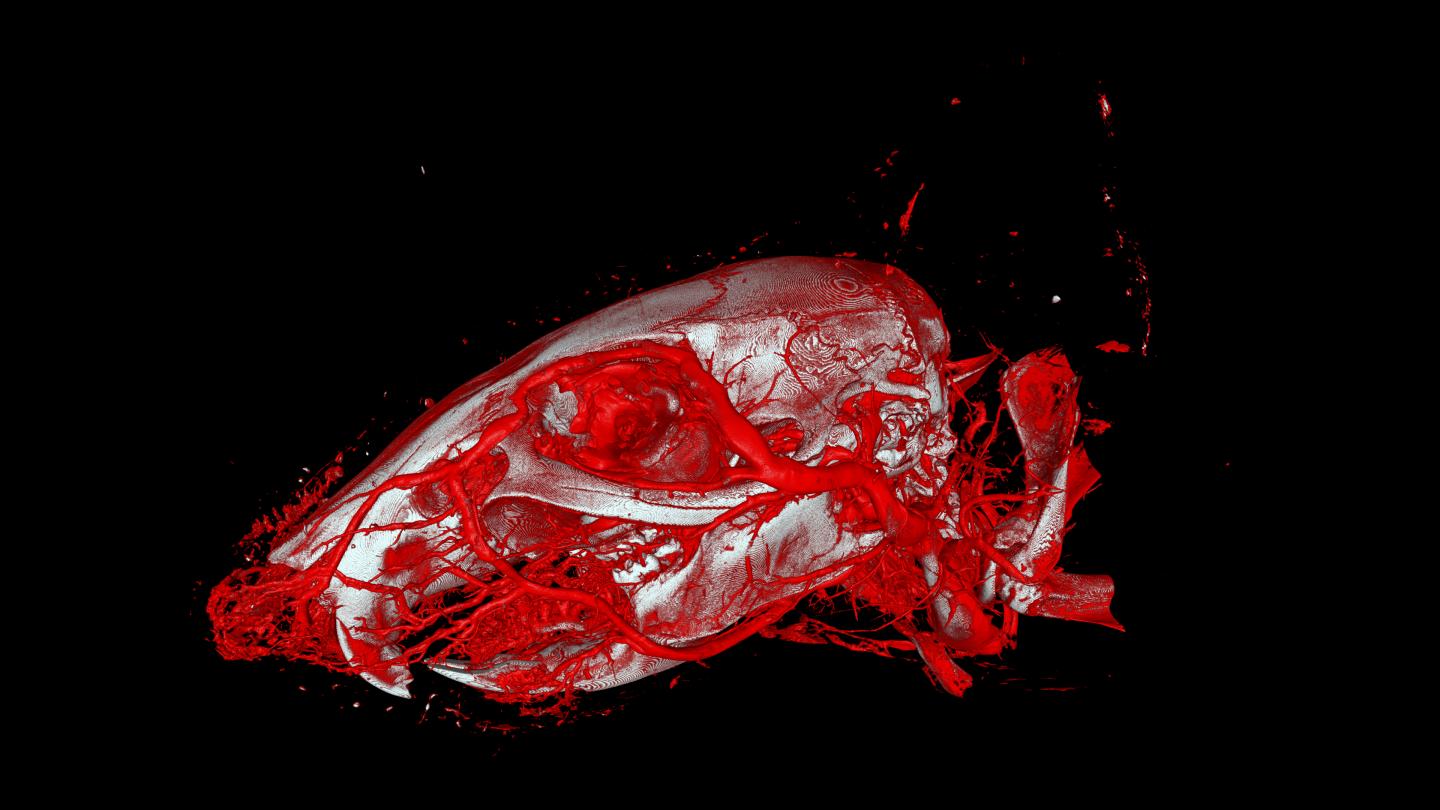
Various diseases in humans and animals – such as tumors, strokes or chronic kidney disease – damage the blood vessels. Capillaries, the smallest blood vessels in the body, are particularly affected. The large surface area of the capillary network enables oxygen to be exchanged between the blood and the surrounding tissue, such as the muscles when we exercise or the brain when we think.

Revealing the vascular structure

For the diagnosis and treatment of cardiovascular and other diseases, it is important to know the three-dimensional structure of blood vessels. This knowledge of the exact anatomy of the capillaries in humans and animals is also crucial for basic research. It enables researchers to investigate diseases that attack the blood vessels and evaluate new treatments. Researchers at the University of Zurich (UZH), the National Centre of Competence in Research Kidney.CH and the Biomaterials Science Center of the University of Basel have now developed a novel X-ray contrast agent called “XlinCA”, with which capillaries can be made visible much more precisely using computer tomography.

Previous methods often faulty

Previously, contrast agents were added to polymerizing plastic resins before they were injected into the blood vessels of euthanized animals. However, it is very difficult to completely fill out the delicate capillaries in various organs with viscous resins. “Without years of experience using the right injection techniques, the capillaries are often only partially filled, or missing entirely. Up to a quarter of the resulting images are therefore unusable,” says Willy Kuo, a postdoctoral researcher at the Institute of Physiology of UZH. By using “XlinCA” instead of other contrast agents, up to 25 percent fewer animals would be needed for experiments, states Kuo.

The basic problem with conventional methods is that plastic and water do not mix. This results in water inclusions where the contrast agent is absent, which causes disconnected vessel segments on the X-ray image. While the water-soluble X-ray contrast agents used in medicine may not have this problem, they cannot be solidified and leak through blood vessel walls into the surrounding tissue within minutes.

Optimum results thanks to custom contrast agent

Contrast agents for medical use in humans consist of small molecules and are relatively simple to produce. “A custom contrast agent for ex vivo use was significantly more difficult to synthesize, since it is made up of polymers – molecules bonded together in long chains,” says Bernhard Spingler, professor at UZH’s Department of Chemistry. “XlinCA” has several advantages over previously used X-ray contrast agents: It is easy to use and enables complete and uninterrupted vascular imaging. It also allows multiple organs or even whole animals such as mice to be examined at the same time.

###

Media Contact
Bernhard Spingler
[email protected]

Original Source

https://www.media.uzh.ch/en/Press-Releases/2020/Contrast-Agent.html

Related Journal Article

http://dx.doi.org/10.1039/C9CC09883F

Tags: BiochemistryBiologyChemistry/Physics/Materials SciencesDiagnosticsMedicine/HealthPhysiologyPolymer Chemistry
Share12Tweet8Share2ShareShareShare2

Related Posts

Graz University of Technology Deciphers the Structural Secrets of MOF Thin Films — Chemistry

Graz University of Technology Deciphers the Structural Secrets of MOF Thin Films

July 2, 2026
Breaking Thermodynamic Limits: Wavelength-Driven Catalysis Advances Ammonia Synthesis — Chemistry

Breaking Thermodynamic Limits: Wavelength-Driven Catalysis Advances Ammonia Synthesis

July 2, 2026

From Quantum Mechanics to AI-Powered Materials Discovery: MARVEL Marks 12 Years of Transforming Computational Science

July 2, 2026

Djire Recognized with National Award for Outstanding Contributions in Research and Teaching

July 2, 2026
Please login to join discussion

POPULAR NEWS

  • Detection of EDCs in Breast Milk and Infant Urine Up to Six Months Highlights Early Exposure Risks

    77 shares
    Share 31 Tweet 19
  • Saying Goodbye to PGY-6: Pediatric Fellowship Realities

    103 shares
    Share 41 Tweet 26
  • New Drug Candidate Developed at McMaster Shows Potential for Treating Brain Cancer

    58 shares
    Share 23 Tweet 15
  • KTU Researchers Explore Ultrasound’s Role in Enhancing Blood Flow Beyond Diagnostics

    53 shares
    Share 21 Tweet 13

About

BIOENGINEER.ORG

We bring you the latest biotechnology news from best research centers and universities around the world. Check our website.

Follow us

Recent News

Steatosis Drives Liver Metastasis Diversity in CRC

Unlocking the Mysteries of Alzheimer’s Disease

Pensoft Introduces New Peer-Reviewed Journal of Regeneration to Advance Restorative Biology Across Species

Subscribe to Blog via Email

Enter your email address to subscribe to this blog and receive notifications of new posts by email.

Join 83 other subscribers
  • Contact Us

Bioengineer.org © Copyright 2023 All Rights Reserved.

Welcome Back!

Login to your account below

Forgotten Password?

Retrieve your password

Please enter your username or email address to reset your password.

Log In
No Result
View All Result
  • Homepages
    • Home Page 1
    • Home Page 2
  • News
  • National
  • Business
  • Health
  • Lifestyle
  • Science

Bioengineer.org © Copyright 2023 All Rights Reserved.