A research team led by Professor Yanhong Xiao at Fudan University, collaborating with scientists from the Weizmann Institute of Science and Shanxi University, has generated a thirty-channel spatial array of polarization-squeezed light inside a single paraffin-coated rubidium vapor cell. Reporting in the journal Light: Science & Applications, the physicists demonstrated that the multi-beam system achieves a maximum measured squeezing level of 2 dB. Instead of functioning as thirty uncoupled, isolated emitters that require individual stabilization, the optical channels are collectively regulated through shared ground-state atomic coherence. By harnessing thermal atomic motion within the vapor cell, the architecture establishes a global dissipative coupling that synchronizes quantum properties across spatially separated optical channels.
Squeezed light serves as a critical non-classical resource across quantum technologies, including precision measurement, quantum imaging, and quantum information processing. In an optical squeezed state, quantum fluctuations in one quadrature are suppressed below the shot-noise level characteristic of a standard coherent state, balanced by a corresponding increase in fluctuations within the conjugate quadrature. As quantum architectures scale toward larger, distributed configurations, producing numerous individually addressable squeezed beams with uniform quantum-noise characteristics presents a severe physical hurdle. Replicating discrete single-channel squeezing apparatuses multiplies hardware volume, pump laser power, and active stabilization controls. Simultaneously, traditional multiplexing methods relying on time or frequency domains fail to offer direct, parallel access to multiple spatially separated outputs.
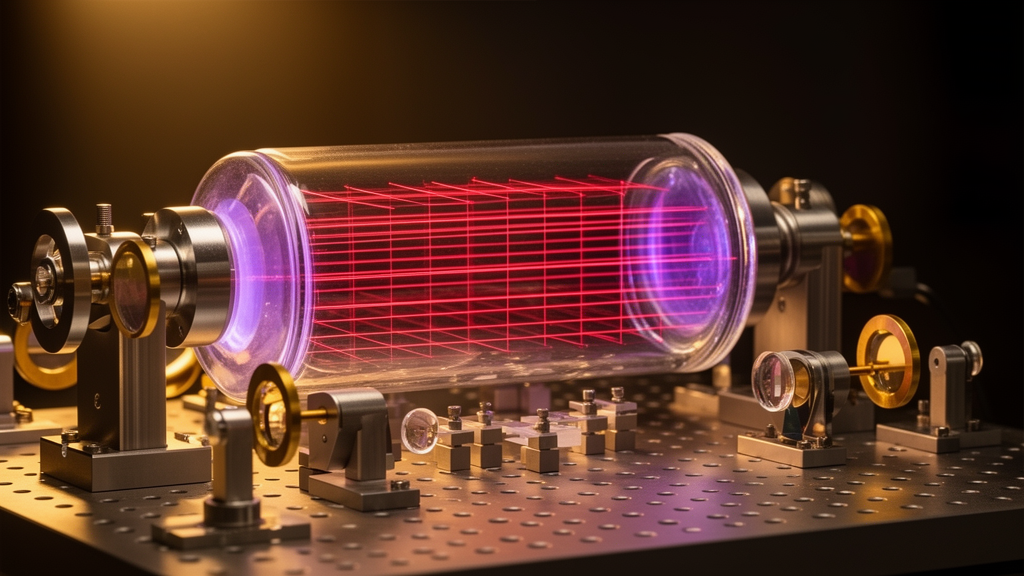
To overcome these scaling bottlenecks, the researchers deployed an optical layout centered on collective atomic interactions within a single gas cell. In their experimental design, a diffractive optical element splits a single 795 nm laser beam into a two-dimensional spatial array of separated light paths propagating through the rubidium vapor. Within each illuminated path, an atomic-coherence-enhanced polarization self-rotation process, which can equivalently be described as degenerate four-wave mixing, generates a squeezed vacuum state in the polarization orthogonal to the incident pump beam. Rather than remaining isolated to their respective optical corridors, the beams interact collectively with the vapor medium to establish long-lived ground-state atomic coherence throughout the shared interaction chamber.
The underlying physical mechanism governing this synchronization is the transport of atomic coherence driven by thermal motion. Atoms continuously transit from the localized, illuminated beam regions into the dark, unlit volume of the cell, carrying quantum coherence across the physical gaps between distinct optical paths. Because an internal paraffin coating lines the glass chamber, the rubidium atoms preserve their long-lived ground-state coherence through thousands of atom-wall collisions. Consequently, thermal atomic velocity distributes and homogenizes this collective coherence throughout the entire vapor volume. The intervening dark space effectively functions as a common, dynamically evolving atomic reservoir, mediating continuous global dissipative coupling across all thirty spatially separated light channels.
This shared reservoir substantially alters the threshold and operational characteristics of the multi-channel array. When tested at an individual beam power of approximately 1 mW per channel, an isolated single laser beam is unable to produce measurable squeezing on its own. In contrast, operating all thirty beams simultaneously yields approximately 1.5 dB of polarization squeezing across the coupled array. Experimental evaluations across randomly chosen channels revealed closely aligned squeezing levels and squeezing ellipse orientations. However, the performance enhancements granted by collective atomic dynamics are bounded by intrinsic physical constraints: because cumulative optical power scales with the number of channels, finite optical depth, optical pumping effects, and spontaneous-emission noise eventually steer the collective atomic system into saturation.
Direct experimental confirmation of collective synchronization was achieved by intentionally introducing a channel driven by an uneven pump power. When evaluated in isolation, this mismatched channel exhibited a squeezing performance markedly different from the rest of the array. Once reintegrated into the actively coupled thirty-beam lattice, the aberrant channel was drawn toward the ensemble value, shrinking the measured inter-channel squeezing discrepancy from 0.79 dB down to 0.19 dB. Time-resolved measurements confirmed that the perturbed beam relaxed toward the collective steady state significantly faster when surrounded by the full array. The authors noted that this synchronization cannot be explained by motional averaging by itself; rather, thermal transport mediates dissipative coupling while nonlinear saturation in the light-atom interaction steers individual beams into a uniform dynamical state, behaving analogously to passive mode locking in optical laser cavities.
The study establishes that thermal atomic motion and coherence-preserving surface coatings can operate as functional synchronization assets rather than unavoidable sources of decoherence or parasitic cross-talk in multi-channel quantum systems. Because the thirty generated output beams are spatially resolved and intrinsically resonant with rubidium atomic transitions, the architecture naturally interfaces with rubidium-based quantum memories, atomic sensors, and spatial imaging networks. While the beams exiting the vapor cell are not mutually entangled in their initial state, subsequent linear-optical interference operations could convert the separate squeezed channels into continuous-variable multipartite entangled networks. Scaling to larger vapor cells, integrating more thermally resilient anti-relaxation wall coatings, and refining atom-light parameters may permit higher channel counts and stronger squeezing for distributed sensing and quantum processing.
Subject of Research: Large-scale squeezed-light array synchronization via atomic vapor coherence
Article Title: Shared atomic coherence synchronizes a large-scale squeezed-light array
Article References: Shared atomic coherence synchronizes a large-scale squeezed-light array. Original publication (Bibliographic details unavailable.)
Image Credits: AI Generated
DOI: Not provided
Keywords: squeezed light, quantum optics, polarization squeezing, rubidium vapor cell, atomic coherence, quantum sensing, quantum information, dissipative coupling, thermal atomic motion, passive mode locking, four wave mixing, quantum noise reduction, Fudan University, spatial light array, continuous variable quantum
News Source: Bethany Barker. (November 11, 2026). Atomic Coherence Synchronizes a Thirty Channel Squeezed Light Array in Rubidium Vapor. Scienmag.