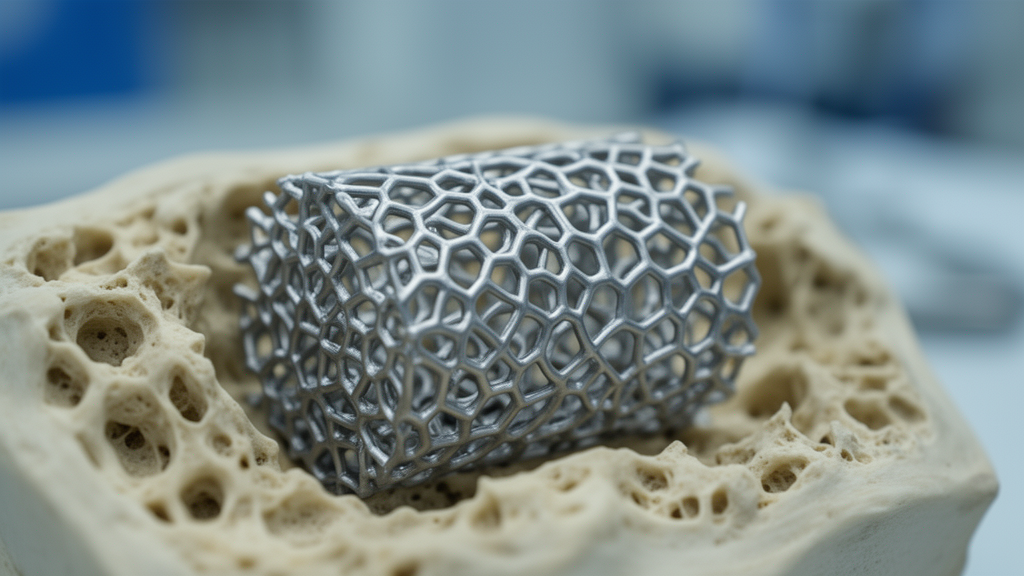
In an in vivo biomechanical evaluation, cementless diaphyseal prostheses featuring three-dimensionally printed trabecular titanium surfaces significantly enhanced construct stability compared to standard grit-blasted implants at eight weeks postoperatively. The experimental investigation, conducted in a caprine model, demonstrated that biomimetic porous architecture partially narrows the performance gap that traditionally separates cementless biological fixation from cemented fixation during early healing periods prior to complete osseointegration.
The study addressed a central clinical challenge in orthopedic surgery: segmental diaphyseal reconstruction following surgical tumor resection or severe bone trauma requires prosthetic implants that deliver robust early mechanical stability to support postoperative rehabilitation. Whether modern 3D-printed trabecular surfaces could sufficiently bridge this initial stability shortfall remained incompletely defined in living models.
To rigorously test construct performance, researchers established a standardized 2-centimeter femoral diaphyseal defect in eighteen skeletally mature adult caprines. The animals were randomly assigned to three experimental cohorts of six subjects each: a cemented prosthesis group, an uncemented grit-blasted prosthesis group, and an uncemented 3D-printed trabecular prosthesis group.
Throughout the recovery period, an observer blinded to the experimental groupings recorded daily assessments to determine the exact time to first sustained weight-bearing for each animal. Following sacrifice at eight weeks postoperatively, harvested prosthesis–bone composites were subjected to rigorous biomechanical profiling using a Bose ElectroForce 3510 servo-hydraulic test system. The testing protocol included axial tensile loading from 0 to 500 newtons, cyclic torsion across an angular displacement range of 0 to 2 degrees, and monotonic torsion loading carried out to catastrophic failure.
Biomechanical measurements revealed distinct hierarchical differences across the three implant configurations under tensile and cyclic torsional stresses. When exposed to a 500-newton tensile load, axial displacement was lowest in the cemented group at 0.619 ± 0.013 millimeters, intermediate in the 3D-printed trabecular group at 1.018 ± 0.061 millimeters, and highest in the grit-blasted group at 1.100 ± 0.001 millimeters, with all pairwise differences reaching statistical significance (P < 0.05). Under cyclic torsional loading at 2 degrees of angular displacement, resistance followed a corresponding pattern: cemented constructs resisted 6.515 ± 0.120 newton-meters of torque, outperforming the 3D-printed trabecular constructs at 2.802 ± 0.203 newton-meters and the grit-blasted constructs at 2.400 ± 0.052 newton-meters (pairwise P < 0.001).
Monotonic failure testing further confirmed that cemented fixation provided the greatest ultimate torsional strength, recording a maximum failure torque of 30.46 ± 0.42 newton-meters, compared to 16.17 ± 1.24 newton-meters for 3D-printed trabecular implants and 11.88 ± 3.74 newton-meters for grit-blasted implants (P < 0.001). In functional ambulatory assessments, caprines receiving cemented prostheses achieved sustained weight-bearing significantly earlier, averaging 19 ± 1.55 days, compared with 25.83 ± 0.98 days in the trabecular group and 27.33 ± 3.44 days in the grit-blasted group (P < 0.001). However, the functional difference between the two cementless cohorts was not statistically significant (P = 0.498).
The authors concluded that while cemented fixation retains superior mechanical construct stability at eight weeks due to cement micro-locking, 3D-printed biomimetic trabecular geometry yields substantially better mechanical resistance than conventional grit-blasted textures before biological osseointegration is fully established. These biomechanical findings provide an experimental rationale for optimizing porous surface architecture in diaphyseal implants and establishing tailored postoperative rehabilitation protocols during limb-salvage reconstructions.
The contrast between laboratory biomechanical performance and functional recovery underscores important considerations for postoperative rehabilitation. While the 3D-printed biomimetic trabecular geometry achieved statistically significant gains over conventional grit-blasted surfaces under tensile stress, cyclic torsion, and monotonic loading to failure, these mechanical advantages did not translate into a statistically meaningful acceleration in functional mobility. Animals fitted with either cementless design required an average of roughly twenty-six to twenty-seven days to achieve sustained weight-bearing, demonstrating that laboratory construct stability does not immediately shorten the biological timeline required for initial animal ambulation.
Subject of Research: Biomechanical stability of 3D-printed trabecular diaphyseal prostheses in caprines
Article Title: Eight-week construct performance of cementless diaphyseal prostheses with 3D-printed trabecular geometry: an in vivo caprine biomechanical study
Article References: Zhao, L., Guo, C., Liu, H., Zhang, Y., Hu, Y., Li, M., & Yan, S. (2026). Eight-week construct performance of cementless diaphyseal prostheses with 3D-printed trabecular geometry: an in vivo caprine biomechanical study. BMC Musculoskeletal Disorders. https://doi.org/10.1186/s12891-026-10645-y
Image Credits: AI Generated
DOI: 10.1186/s12891-026-10645-y
Keywords: diaphyseal prostheses, 3D-printed implants, trabecular geometry, cementless fixation, cemented fixation, grit-blasted surface, caprine biomechanics, femoral defect, axial displacement, torsion-to-failure, weight-bearing recovery, bone reconstruction, limb-salvage procedures, in vivo biomechanical testing, osseointegration, titanium prostheses
News Source: Ophelia Keating. (November 12, 2026). 3D-Printed Trabecular Implants Outperform Grit-Blasted Surfaces in Caprine Bone Defect Study. Scienmag.