• HOME
  • NEWS
  • EXPLORE
    • CAREER
      • Companies
      • Jobs
    • EVENTS
    • iGEM
      • News
      • Team
    • PHOTOS
    • VIDEO
    • WIKI
  • BLOG
  • COMMUNITY
    • FACEBOOK
    • INSTAGRAM
    • TWITTER
Monday, August 10, 2026
BIOENGINEER.ORG
No Result
View All Result
  • Login
  • HOME
  • NEWS
  • EXPLORE
    • CAREER
      • Companies
      • Jobs
        • Lecturer
        • PhD Studentship
        • Postdoc
        • Research Assistant
    • EVENTS
    • iGEM
      • News
      • Team
    • PHOTOS
    • VIDEO
    • WIKI
  • BLOG
  • COMMUNITY
    • FACEBOOK
    • INSTAGRAM
    • TWITTER
  • HOME
  • NEWS
  • EXPLORE
    • CAREER
      • Companies
      • Jobs
        • Lecturer
        • PhD Studentship
        • Postdoc
        • Research Assistant
    • EVENTS
    • iGEM
      • News
      • Team
    • PHOTOS
    • VIDEO
    • WIKI
  • BLOG
  • COMMUNITY
    • FACEBOOK
    • INSTAGRAM
    • TWITTER
No Result
View All Result
Bioengineer.org
No Result
View All Result
Home NEWS Science News Chemistry

“Inchworm” pattern of Indonesian earthquake rupture powered seismic “boom”

Bioengineer by Bioengineer
July 27, 2020
in Chemistry
Reading Time: 2 mins read
0
IMAGE
Share on FacebookShare on TwitterShare on LinkedinShare on RedditShare on Telegram

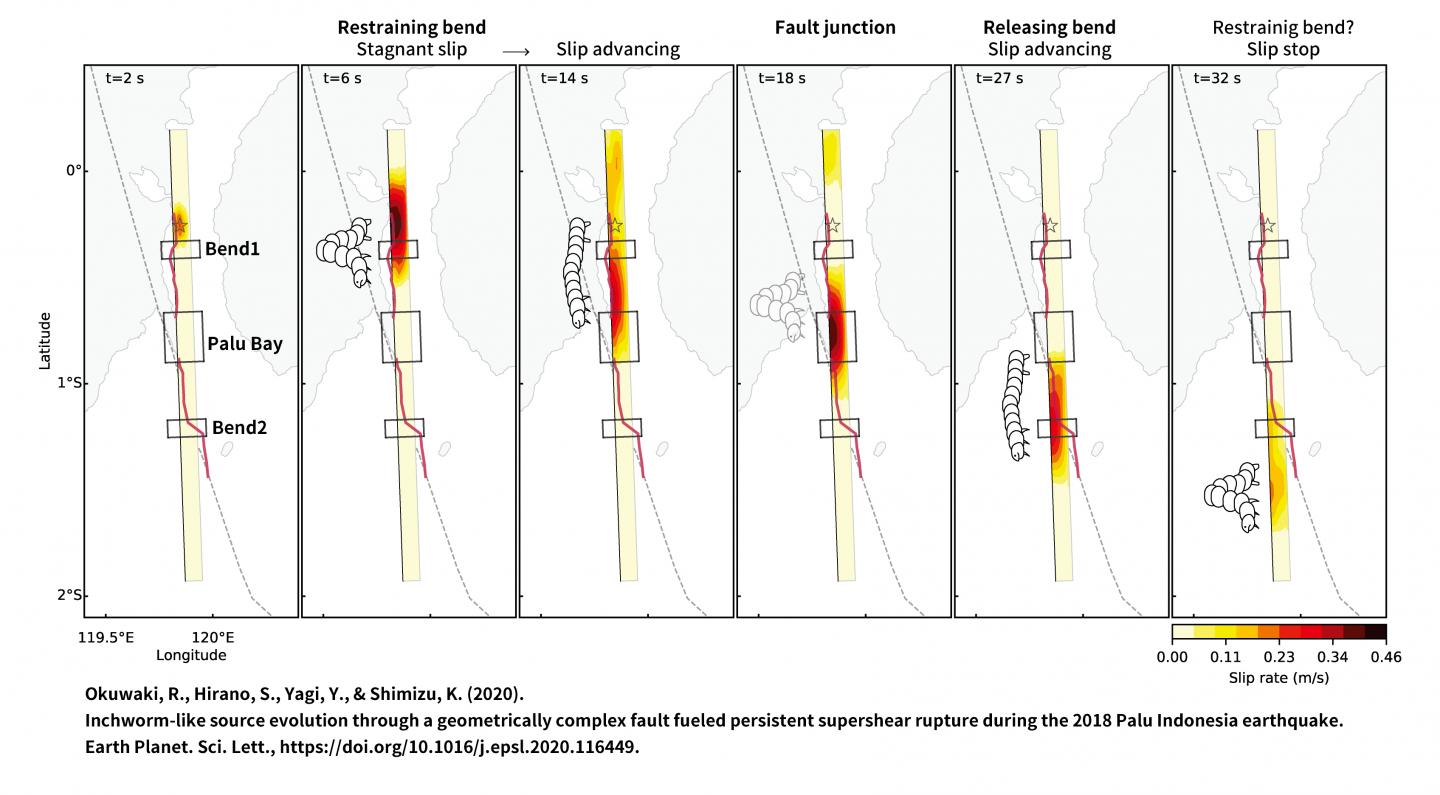
University of Tsukuba researchers report “inchworm-like” slip evolution of supershear rupture along the Palu-Koro fault during the 2018 Palu earthquake in Indonesia, showing the effect of complex fault geometry on rupture propagation
IMAGE

Credit: University of Tsukuba

Tsukuba, Japan – Earthquakes are often imagined as originating from a single point where the seismic waves are strongest, the hypocenter underground or the epicenter at the Earth’s surface, with seismic energy radiating outward in a circular pattern. But this simplified model fails to account for the complex geometry of the actual fault systems where earthquakes occur. The real situation may be much more complex–and more interesting. In some remarkable cases, a phenomenon called “supershear” rupture can occur, where the earthquake rupture propagates along the fault at a speed faster than the seismic waves themselves can travel–a process analogous to a sonic boom.

In a new study published in Earth and Planetary Science Letters, researchers at the University of Tsukuba investigated a case of supershear rupture, the 2018 Palu earthquake (moment magnitude: 7.6) in Sulawesi, Indonesia, and its relationship with the complex geometry of the fault system.

Study co-author Professor Yuji Yagi explains, “We used globally observed teleseismic wave data and performed finite-fault inversion to simultaneously resolve the spatiotemporal evolution of slip and the complex fault geometry.”

The results of this analysis showed that the propagation of supershear rupture of the Palu-Koro fault southward from the earthquake’s epicenter was sustained by a pattern of repeated delay and advancement of slip along the fault, associated with the fault system’s complex geometry. Areas with particularly high slip rates, referred to as “slipping patches,” were identified near the epicenter as well as 60, 100, and 135 km south of the epicenter. In addition, three distinct episodes of rupture after the process initiated were distinguished, with delays in the advancement of the slipping patches between them.

Tracing the surface rupture of the earthquake showed two major bends in the earthquake fault, 10-25 km south of the epicenter and 100-110 km south of the epicenter. Supershear rupture persisted along this geometrically complex fault.

As lead author Professor Ryo Okuwaki describes, “Our study shows that the geometric complexity of a fault can significantly influence the velocity of rupture propagation. Our model of the 2018 Palu earthquake shows a zigzag pattern of slip deceleration and acceleration associated with bends in the fault, which we have named inchworm-like slip evolution. We propose that the geometric complexity of a fault system can promote persistent supershear rupture, enhanced by repeated inchworm-like slip evolution.”

These findings may have significant implications regarding assessment of future earthquake impacts and related disasters. For example, the authors suggest that the slipping patch they detected beneath Palu Bay may have contributed to generation of the 2018 Palu tsunami, which added to the devastation of the earthquake.

###

Media Contact
Naoko Yamashina
[email protected]

Related Journal Article

http://dx.doi.org/10.1016/j.epsl.2020.116449

Tags: Earth ScienceGeographyGeology/SoilGeophysics/GravityPlate Tectonics
Share12Tweet8Share2ShareShareShare2

Related Posts

AI system could save lives by predicting how modern house fires spread

AI system could save lives by predicting how modern house fires spread

August 10, 2026
Pusan National University Team Develops 3D-Printed Switchable Soft Actuators

Pusan National University Team Develops 3D-Printed Switchable Soft Actuators

August 10, 2026

Marine microplastics retain concerning plastic-additive chemicals even after breaking apart

August 10, 2026

Hebrew University Congratulates Haim Sompolinsky on Receiving 2026 Dirac Medal

August 8, 2026
Please login to join discussion

POPULAR NEWS

  • Sex Differences Shape Blood Metabolite Profiles in Familial Parkinson’s Disease

    29 shares
    Share 12 Tweet 7
  • Scientists Track Drug Self-Administration in Head-Fixed Mice

    29 shares
    Share 12 Tweet 7
  • Food systems miss targets, exposing urgent gaps before 2050

    29 shares
    Share 12 Tweet 7
  • Dolby Laboratories Acquires FAU’s Video Compression Technology Portfolio

    29 shares
    Share 12 Tweet 7

About

We bring you the latest biotechnology news from best research centers and universities around the world. Check our website.

Follow us

Recent News

Sex Differences Shape Blood Metabolite Profiles in Familial Parkinson’s Disease

Scientists Track Drug Self-Administration in Head-Fixed Mice

Food systems miss targets, exposing urgent gaps before 2050

Subscribe to Blog via Email

Success! An email was just sent to confirm your subscription. Please find the email now and click 'Confirm' to start subscribing.

Join 86 other subscribers
  • Contact Us

Bioengineer.org © Copyright 2023 All Rights Reserved.

Welcome Back!

Login to your account below

Forgotten Password?

Retrieve your password

Please enter your username or email address to reset your password.

Log In
No Result
View All Result
  • Homepages
    • Home Page 1
    • Home Page 2
  • News
  • National
  • Business
  • Health
  • Lifestyle
  • Science

Bioengineer.org © Copyright 2023 All Rights Reserved.