• HOME
  • NEWS
  • EXPLORE
    • CAREER
      • Companies
      • Jobs
    • EVENTS
    • iGEM
      • News
      • Team
    • PHOTOS
    • VIDEO
    • WIKI
  • BLOG
  • COMMUNITY
    • FACEBOOK
    • INSTAGRAM
    • TWITTER
Sunday, May 10, 2026
BIOENGINEER.ORG
No Result
View All Result
  • Login
  • HOME
  • NEWS
  • EXPLORE
    • CAREER
      • Companies
      • Jobs
        • Lecturer
        • PhD Studentship
        • Postdoc
        • Research Assistant
    • EVENTS
    • iGEM
      • News
      • Team
    • PHOTOS
    • VIDEO
    • WIKI
  • BLOG
  • COMMUNITY
    • FACEBOOK
    • INSTAGRAM
    • TWITTER
  • HOME
  • NEWS
  • EXPLORE
    • CAREER
      • Companies
      • Jobs
        • Lecturer
        • PhD Studentship
        • Postdoc
        • Research Assistant
    • EVENTS
    • iGEM
      • News
      • Team
    • PHOTOS
    • VIDEO
    • WIKI
  • BLOG
  • COMMUNITY
    • FACEBOOK
    • INSTAGRAM
    • TWITTER
No Result
View All Result
Bioengineer.org
No Result
View All Result
Home NEWS Science News Chemistry

In a new quantum simulator, light behaves like a magnet

Bioengineer by Bioengineer
March 21, 2019
in Chemistry
Reading Time: 2 mins read
0
IMAGE
Share on FacebookShare on TwitterShare on LinkedinShare on RedditShare on Telegram

IMAGE

Credit: R. Ravasio/EPFL

When subject to the laws of quantum mechanics, systems made of many interacting particles can display behaviour so complex that its quantitative description defies the capabilities of the most powerful computers in the world. In 1981, the visionary physicist Richard Feynman argued we can simulate such complex behavior using an artificial apparatus governed by the very same quantum laws – what has come to be known as a “quantum simulator”.

One example of a complex quantum system is that of magnets placed at really low temperatures. Close to absolute zero (-273.15 degrees Celsius), magnetic materials may undergo what is known as a “quantum phase transition”. Like a conventional phase transition (e.g. ice melting into water, or water evaporating into steam), the system still switches between two states, except that close to the transition point the system manifests quantum entanglement – the most profound feature predicted by quantum mechanics. Studying this phenomenon in real materials is an astoundingly challenging task for experimental physicists.

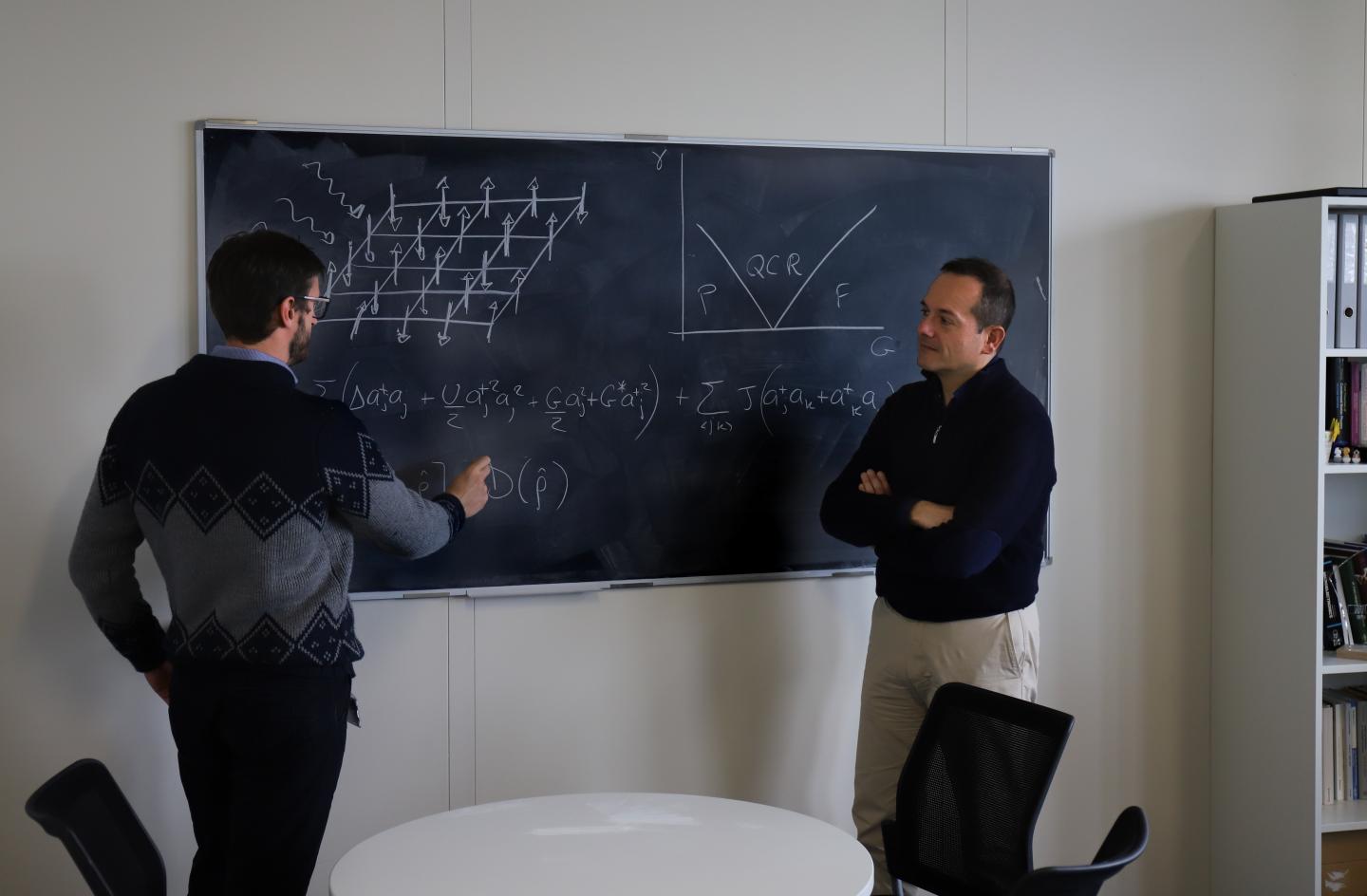
But physicists led by Vincenzo Savona at EPFL have now come up with a quantum simulator that promises to solve the problem. “The simulator is a simple photonic device that can easily be built and run with current experimental techniques,” says Riccardo Rota, the postdoc at Savona’s lab who led the study. “But more importantly, it can simulate the complex behavior of real, interacting magnets at very low temperatures.”

The simulator may be built using superconducting circuits – the same technological platform used in modern quantum computers. The circuits are coupled to laser fields in such a way that it causes an effective interaction among light particles (photons). “When we studied the simulator, we found that the photons behaved in the same way as magnetic dipoles across the quantum phase transition in real materials,” says Rota. In short, we can now use photons to run a virtual experiment on quantum magnets instead of having to set up the experiment itself.

“We are theorists,” says Savona. “We came up with the idea for this particular quantum simulator and modelled its behavior using traditional computer simulations, which can be done when the quantum simulator addresses a small enough system. Our findings prove that the quantum simulator we propose is viable, and we are now in talks with experimental groups who would like to actually build and use it.”

Understandably, Rota is excited: “Our simulator can be applied to a broad class of quantum systems, allowing physicists to study several complex quantum phenomena. It is a truly remarkable advance in the development of quantum technologies.”

###

Other contributors

Université Paris Diderot (France)

Reference

Riccardo Rota, Fabrizio Minganti, Cristiano Ciuti, Vincenzo Savona. Quantum critical regime in a quadratically-driven nonlinear photonic lattice. Physical Review Letters 122, 110405 (21 March 2019). DOI: 10.1103/PhysRevLett.122.110405

Media Contact
Nik Papageorgiou
[email protected]

Related Journal Article

http://dx.doi.org/10.1103/PhysRevLett.122.110405

Tags: Chemistry/Physics/Materials SciencesElectrical Engineering/ElectronicsElectromagneticsHardwareMaterialsSuperconductors/Semiconductors
Share12Tweet8Share2ShareShareShare2

Related Posts

Miniature Sensor Uses Light to Detect Touch — Chemistry

Miniature Sensor Uses Light to Detect Touch

May 8, 2026
Iron Minerals Determine Whether Dissolved Organic Matter Fuels Microbes or Becomes Long-Term Carbon Storage — Chemistry

Iron Minerals Determine Whether Dissolved Organic Matter Fuels Microbes or Becomes Long-Term Carbon Storage

May 8, 2026

Kate Evans Appointed Associate Lab Director for Biological and Environmental Systems Science at ORNL

May 8, 2026

Advancing Multiscale Modeling and Overcoming Operational Challenges in Autothermal CO₂-to-Methanol Reactors

May 8, 2026
Please login to join discussion

POPULAR NEWS

  • Research Indicates Potential Connection Between Prenatal Medication Exposure and Elevated Autism Risk

    840 shares
    Share 336 Tweet 210
  • New Study Reveals Plants Can Detect the Sound of Rain

    727 shares
    Share 290 Tweet 181
  • Scientists Investigate Possible Connection Between COVID-19 and Increased Lung Cancer Risk

    68 shares
    Share 27 Tweet 17
  • Salmonella Haem Blocks Macrophages, Boosts Infection

    61 shares
    Share 24 Tweet 15

About

We bring you the latest biotechnology news from best research centers and universities around the world. Check our website.

Follow us

Recent News

Evaluating Digoxin Use in Patients with Symptomatic Rheumatic Heart Disease

Evaluating the Effectiveness and Safety of Digitalis Glycosides in Treating Heart Failure

Urdu Fall Risk Questionnaire Adapted for Elderly

Subscribe to Blog via Email

Enter your email address to subscribe to this blog and receive notifications of new posts by email.

Join 82 other subscribers
  • Contact Us

Bioengineer.org © Copyright 2023 All Rights Reserved.

Welcome Back!

Login to your account below

Forgotten Password?

Retrieve your password

Please enter your username or email address to reset your password.

Log In
No Result
View All Result
  • Homepages
    • Home Page 1
    • Home Page 2
  • News
  • National
  • Business
  • Health
  • Lifestyle
  • Science

Bioengineer.org © Copyright 2023 All Rights Reserved.