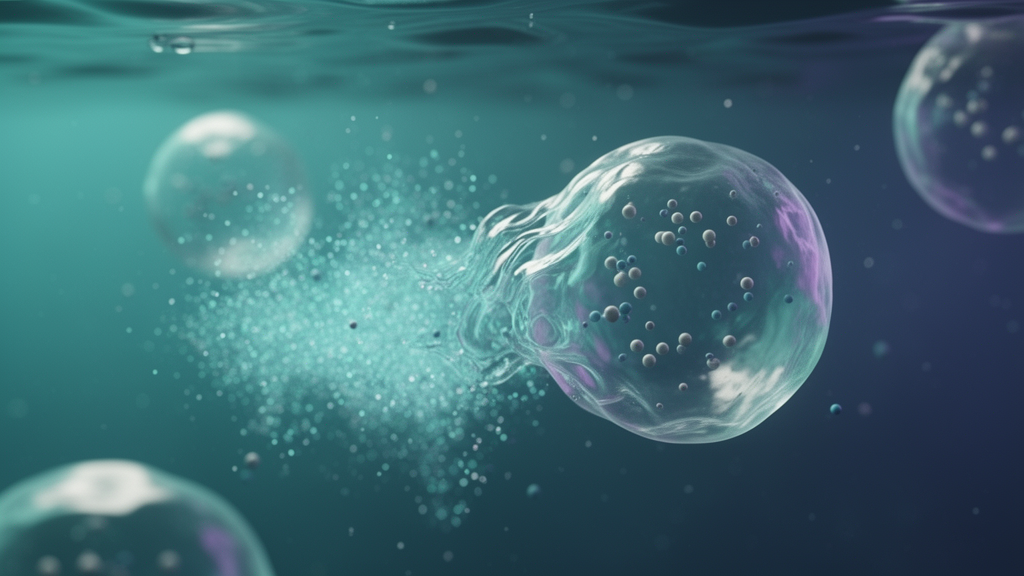
Researchers have demonstrated that synthetic polymeric vesicles can execute autonomous negative chemotaxis, directing their physical migration away from chemical concentration gradients without requiring enzymatic fuel, catalytic reactions, or external power inputs. Directed movement in response to chemical stimuli represents a foundational hallmark of biological organisms, yet replicating directional navigation within artificial protocells has historically demanded intricate catalytic pathways or complex adaptive molecular architectures. In a study published in Nature Chemistry, a research team led by Daniela A. Wilson demonstrated that minimal synthetic polymersomes can achieve sustained repulsive motile behavior driven entirely by intrinsic membrane conformational dynamics. By uncovering how localized interactions with signaling molecules trigger reversible structural reorganizations across polymeric bilayers, the authors identified an unrecognized physical mechanism that transduces molecular recognition directly into mechanical propulsion. This minimal system emulates the cytoskeletal remodeling that drives biological motility, establishing a versatile framework for engineering functional artificial protocells capable of navigating complex chemical environments.
To construct the responsive vesicles, the investigators synthesized two distinct amphiphilic diblock copolymers with precisely controlled ratios of hydrophilic poly(ethylene glycol) and hydrophobic poly(lactic acid) blocks, designated PEG22-b-PLA90 and PEG44-b-PLA86, via ring-opening polymerization. These block copolymers were subsequently self-assembled into hollow spherical vesicular structures, known as polymersomes, utilizing a solvent-switch method from an organic mixture of tetrahydrofuran and dioxane into water. Dynamic light scattering analysis revealed that the resulting self-assembled vesicular populations possessed a unimodal size distribution, characterized by a mean hydrodynamic diameter of 346 ± 10 nanometers and a polydispersity index of 0.05 ± 0.02. Cryogenic transmission electron microscopy further confirmed the vesicular morphology, verifying the presence of well-defined bilayer membrane envelopes. The synthetic molecular design paired a hydrophilic corona with a hydrophobic core whose glass transition temperature near room temperature endowed the polymeric membrane with dynamic flexibility, establishing an adaptable platform to examine stimuli-responsive structural reorganizations in aqueous media.
Seeking a signaling trigger capable of interacting directly with the synthetic membrane without catalytic decomposition, the researchers selected lactic acid, a key biological signaling molecule that regulates gene expression, mitochondrial adaptation, and cellular energy metabolism in living systems. Lactic acid can engage in diverse non-covalent interactions, including hydrogen bonding, van der Waals forces, and hydrophobic associations with polymer chains. To examine the chemotactic response of the polymersomes under macroscopic conditions, the team first conducted experiments inside a custom-designed glass flow device measuring 22 millimeters by 4 millimeters by 5.5 millimeters, configured to minimize fluid drift and convection. Nile red-loaded polymersomes and a one-molar lactic acid solution were introduced at opposite ends of the pre-filled aqueous chamber. After two hours, fluorescence microscopy revealed that polymersomes exposed to the lactic acid gradient traversed a displacement of only 7.8 millimeters to their leading edge, compared to 16.9 millimeters in water controls, demonstrating pronounced negative chemotaxis away from the chemical source.
To further validate and quantitatively evaluate this repulsive behavior under precisely regulated laminar conditions, the researchers constructed a microfluidic device with a three-inlet psi-channel geometry that closely mimics fluidic environments. The polymersome suspension was pumped continuously through the middle channel at a concentration of 0.15 milligrams per milliliter, while pure water and a ten-millimolar lactic acid solution at pH 3.1 flowed through the left and right side channels, respectively. Operating under low-Reynolds-number laminar flow conditions at a volumetric flow rate of 50 microliters per hour per inlet, the system established stable concentration gradients perpendicular to the flow velocity of 1157 micrometers per second. Fluorescence intensity profiles acquired 38 millimeters downstream, corresponding to an interaction time of 32.8 seconds, revealed a distinct lateral migration away from the lactic acid stream. Across four independent microfluidic devices, the polymersomes displayed a reproducible negative chemotactic shift of −4.6 ± 1.2 micrometers at the normalized fluorescence midpoint, providing robust quantitative confirmation of directed repulsion.
Because negative chemotaxis in synthetic systems remains rare and poorly understood, the investigators implemented a systematic, flowchart-guided analytical framework to evaluate and rule out conventional physical mechanisms. The team first examined osmophoresis, wherein osmotic pressure gradients generated across semipermeable membranes by impermeable solutes drive net water flows, propelling particles toward regions of lower solute concentration. By establishing gradients of impermeable glucose matched at 13 millimolar to equal the osmolarity of 10 millimolar lactic acid, the authors measured a negligible chemotactic shift of −0.1 ± 1.7 micrometers across four devices, conclusively excluding osmophoresis. The researchers next evaluated whether reduced diffusion could account for the observed directional movement, as reduced mobility on the solute side might theoretically alter particle distributions. Dynamic light scattering measurements revealed virtually identical diffusion coefficients for the vesicles in pure water and in ten-millimolar lactic acid solutions, demonstrating that altered diffusion was not a contributing factor to the observed negative chemotaxis.
The authors subsequently examined whether macroscopic bulk fluid flows, such as convective transport, buoyancy currents, or Marangoni surface flows, could be responsible for transporting the vesicles. To rigorously test these hydrodynamic effects, the team employed rigid poly(ethylene glycol)-block-polystyrene polymersomes, which closely matched the poly(lactic acid) polymersomes in hydrodynamic size, vesicular morphology, and corona chemistry. When subjected to identical lactic acid gradients in the microfluidic device, the rigid polystyrene vesicles yielded a negligible shift of −0.5 ± 1.5 micrometers, effectively eliminating bulk fluid flows as a potential mechanism. The investigators then addressed non-electrolyte diffusiophoresis, which governs movement in gradients of un-ionized solutes representing approximately 85 percent of lactic acid molecules at pH 3.1. Isothermal titration calorimetry revealed favorable exothermic binding between un-ionized lactic acid and the polymersomes via hydrogen bonding. Under force-free diffusiophoretic principles, attractive solute-surface interactions generate slip flows that drive particles toward higher solute concentrations, directly contradicting the observed negative chemotaxis.
Having excluded non-electrolyte diffusiophoresis, the researchers evaluated electrolyte diffusiophoresis arising from the remaining 15 percent ionized lactate and hydronium species, which generate spontaneous diffusion-potential electric fields due to differing ionic mobilities. Because particle diffusiophoretic velocity depends upon zeta potential and hydrodynamic radius, the team matched the surface charge and size of rigid polystyrene vesicles to the flexible poly(lactic acid) polymersomes across simulated channel pH profiles. On the left side of the channel where lactic acid concentrations were low, polystyrene vesicles exhibited a negative shift of −17.2 ± 0.4 micrometers compared to −22.8 ± 0.9 micrometers for poly(lactic acid) vesicles. On the right side exposed to higher lactic acid concentrations, the polystyrene vesicles displayed no significant displacement at −0.5 ± 1.5 micrometers, whereas poly(lactic acid) vesicles exhibited a persistent negative shift of −4.6 ± 1.2 micrometers. This divergence proved that electrolyte diffusiophoresis accounts for only a minor fraction of the total response, confirming an additional mechanism.
To uncover this missing mechanism, the investigators examined physical manifestations of membrane dynamics using air-liquid surface tensiometry and localized polarity-sensitive fluorescence spectroscopy. Wilhelmy plate tensiometer measurements demonstrated that the surface tension of rigid polystyrene polymersome solutions remained constant at 72.1 ± 0.1 millinewtons per meter over 24 hours in ten-millimolar lactic acid. In contrast, flexible poly(lactic acid) polymersomes exhibited a rapid decrease to 71.5 ± 0.1 millinewtons per meter within one minute, declining to 58.1 ± 0.1 millinewtons per meter after 24 hours. Because the vesicles remained intact without dissolving, this surface tension decline revealed that lactic acid triggered conformational rearrangements that partially exposed hydrophobic poly(lactic acid) segments. This reorganization was independently confirmed using a pyrene-based molecular probe embedded in the corona, which registered a significant decline in its fluorescence peak ratio from 1.75 ± 0.01 to 1.65 ± 0.01, demonstrating heightened local hydrophobicity and conformational rearrangement upon exposure to lactic acid.
The underlying molecular rearrangements and whole-particle propulsion were further clarified through atomistic molecular dynamics and dissipative particle dynamics simulations. Atomistic simulations performed in GROMACS revealed specific hydrogen bonding between the hydroxyl and carboxyl protons of lactic acid and the carbonyl oxygens of poly(lactic acid) blocks. These interactions caused polymer chains to adopt extended conformations, increasing their time-averaged radius of gyration from 1.25 ± 0.04 nanometers to 1.68 ± 0.04 nanometers and their end-to-end distance from 1.97 ± 0.05 nanometers to 2.41 ± 0.04 nanometers. Dissipative particle dynamics simulations of assembled bilayers demonstrated that penetrating lactic acid disrupted the corona, driving hydrophobic segment exposure to the aqueous environment. Coarse-grained simulations of intact vesicles exposed to asymmetric lactic acid gradients successfully reproduced sustained center-of-mass translational displacement of approximately 32 simulation units over 500,000 steps away from the chemical source. Angular momentum values remained negligible around zero, confirming that vesicle displacement was dominated by pure translational drift rather than rotational effects.
Integrating their experimental and computational results, the researchers established a comprehensive biophysical model: asymmetric exposure of hydrophobic poly(lactic acid) segments across the vesicle creates a localized gradient of interfacial tension. Because dense polymer chain entanglements prevent lateral membrane fluidity, the interfacial stress cannot dissipate through internal Marangoni recirculation, instead generating an external fluid slip flow directed toward higher lactic acid concentrations that propels the vesicle away. The authors demonstrated the broad generality of this conformational propulsion using structurally related weak acids, observing consistent negative chemotactic shifts for acetic acid (−4.6 ± 0.9 micrometers), 3-hydroxypropionic acid (−5.9 ± 1.0 micrometers), and propionic acid (−10.8 ± 0.8 micrometers), while non-interacting zwitterionic alanine yielded no displacement at 0.3 ± 0.3 micrometers. By showing that intrinsic conformational dynamics can transduce non-covalent chemical recognition into directed physical movement, the study provides a versatile framework for developing fuel-free motile platforms and engineering functional artificial protocells with autonomous, life-like behaviors.
Subject of Research: Conformationally driven negative chemotaxis in synthetic polymersomes
Article Title: Conformationally driven negative chemotaxis in synthetic vesicles
Article References: Wang, D., Luan, J., Kanagarajan, A., Hendrikse, R. L., Wilson, M. R., Zhang, S., Li, W., & Wilson, D. A. (2026). Conformationally driven negative chemotaxis in synthetic vesicles. Nature Chemistry. https://doi.org/10.1038/s41557-026-02298-0
Image Credits: AI Generated
DOI: 10.1038/s41557-026-02298-0
Keywords: negative chemotaxis, polymersomes, synthetic vesicles, polymeric membranes, conformational dynamics, lactic acid, interfacial tension, slip flow, microfluidics, dissipative particle dynamics, atomistic simulations, diffusiophoresis, osmophoresis, amphiphilic copolymers, protocells, surface tension, mechanical transduction
News Source: Neil Sanderson. (November 12, 2026). Synthetic Polymer Vesicles Achieve Autonomous Negative Chemotaxis Through Membrane Conformational Dynamics. Scienmag.