• HOME
  • NEWS
  • EXPLORE
    • CAREER
      • Companies
      • Jobs
    • EVENTS
    • iGEM
      • News
      • Team
    • PHOTOS
    • VIDEO
    • WIKI
  • BLOG
  • COMMUNITY
    • FACEBOOK
    • INSTAGRAM
    • TWITTER
Monday, May 11, 2026
BIOENGINEER.ORG
No Result
View All Result
  • Login
  • HOME
  • NEWS
  • EXPLORE
    • CAREER
      • Companies
      • Jobs
        • Lecturer
        • PhD Studentship
        • Postdoc
        • Research Assistant
    • EVENTS
    • iGEM
      • News
      • Team
    • PHOTOS
    • VIDEO
    • WIKI
  • BLOG
  • COMMUNITY
    • FACEBOOK
    • INSTAGRAM
    • TWITTER
  • HOME
  • NEWS
  • EXPLORE
    • CAREER
      • Companies
      • Jobs
        • Lecturer
        • PhD Studentship
        • Postdoc
        • Research Assistant
    • EVENTS
    • iGEM
      • News
      • Team
    • PHOTOS
    • VIDEO
    • WIKI
  • BLOG
  • COMMUNITY
    • FACEBOOK
    • INSTAGRAM
    • TWITTER
No Result
View All Result
Bioengineer.org
No Result
View All Result
Home NEWS Science News Chemistry

Improving long-term climate calculations

Bioengineer by Bioengineer
January 19, 2021
in Chemistry
Reading Time: 3 mins read
0
IMAGE
Share on FacebookShare on TwitterShare on LinkedinShare on RedditShare on Telegram

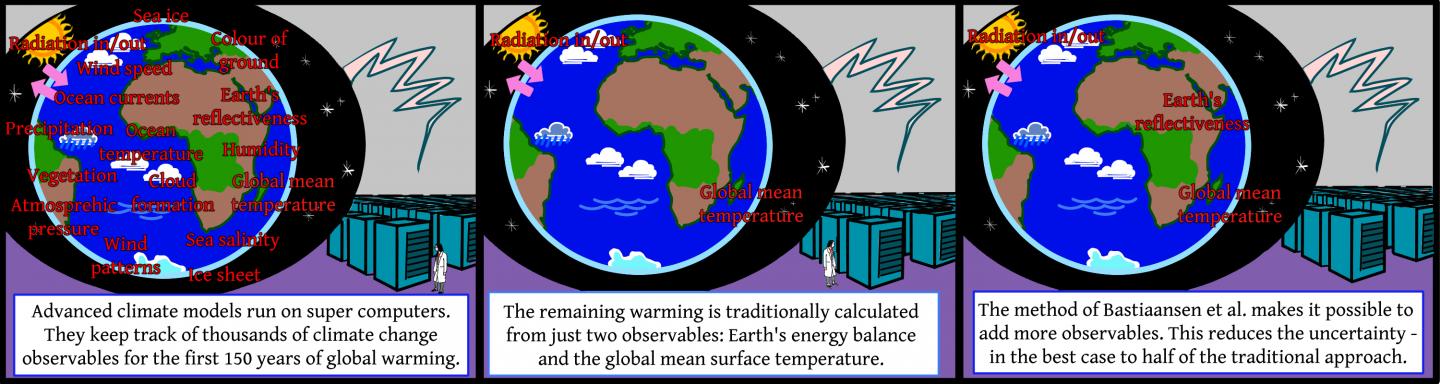
A new method reduces uncertainties in computer model estimations of climate change over thousands of years.
IMAGE

Credit: TiPES/HP

Climate researchers have found a simple but efficient way to improve estimations of ultimate global warming from complex climate models. The finding is relevant for the evaluation and comparison of climate models and thus for accurate projections of future climate change – especially beyond the year 2100. The study is published in Geophysical Research Letters by Dr. Robbin Bastiaansen and colleagues at the Institute for Marine and Atmospheric Research Utrecht, Utrecht University, The Netherlands. The work is part of the European TiPES project coordinated by the University of Copenhagen, Denmark.

Complex climate models are rarely used to simulate the effect of global warming for a given amount of CO2 beyond a couple of centuries into the future. The reason for this is twofold. First, even on a supercomputer, such a model must already run for months to obtain a 150-year projection; reaching the end of a long simulation is therefore not practical. Second, policymakers are mainly concerned about how much climate change a given amount of CO2 will cause within the coming decades.

Earth warms for more than 1000 years

In the real world, however, temperatures continue to go up for more than a thousand years after CO2 is added to the Earth system. A typical climate model simulation therefore estimates less than half of the summed global warming. That is a challenge because, in order to improve models, it is necessary to compare and evaluate models. The final global mean temperature from a given amount of CO2 is an important parameter in the evaluation of a model.

The traditional way of solving this problem is to take the two most predominant results (called observables) from the simulation of the first 150 years and use these to estimate at which global mean surface temperature a full simulation would have ended. The two observables most often used are the global mean surface temperature and the radiation imbalance at the top of the atmosphere. This leads to a rather good estimation but the approach introduces considerable uncertainty – mainly underestimating total global warming.

More accurate estimates

However, an advanced climate model produces a multitude of other data on, for example future ocean currents, weather patterns, sea ice extend, ground color, climate belts, precipitation, and many more.

“And what we did, was add another observable on top of the two traditional ones. That is the idea. If you use additional observables, you will improve estimates over longer time scales. And our work is proof that this is possible,” explains Dr. Robbin Bastiaansen.

In the best-case scenario, the new method halved the uncertainty compared to traditional methods.

The work is expected to be useful in assessing tipping points in the Earth system, as studied in the TiPES project, funded by the EU Horizon 2020.

###

Media Contact
Henrik Prætorius
[email protected]

Original Source

https://doi.org/10.1029/2020GL091090.

Related Journal Article

http://dx.doi.org/10.1029/2020GL091090.

Tags: Climate ChangeClimate ScienceEarth ScienceGeophysics
Share12Tweet8Share2ShareShareShare2

Related Posts

Miniature Sensor Uses Light to Detect Touch — Chemistry

Miniature Sensor Uses Light to Detect Touch

May 8, 2026
Iron Minerals Determine Whether Dissolved Organic Matter Fuels Microbes or Becomes Long-Term Carbon Storage — Chemistry

Iron Minerals Determine Whether Dissolved Organic Matter Fuels Microbes or Becomes Long-Term Carbon Storage

May 8, 2026

Kate Evans Appointed Associate Lab Director for Biological and Environmental Systems Science at ORNL

May 8, 2026

Advancing Multiscale Modeling and Overcoming Operational Challenges in Autothermal COâ‚‚-to-Methanol Reactors

May 8, 2026
Please login to join discussion

POPULAR NEWS

  • Research Indicates Potential Connection Between Prenatal Medication Exposure and Elevated Autism Risk

    840 shares
    Share 336 Tweet 210
  • New Study Reveals Plants Can Detect the Sound of Rain

    727 shares
    Share 290 Tweet 181
  • Scientists Investigate Possible Connection Between COVID-19 and Increased Lung Cancer Risk

    68 shares
    Share 27 Tweet 17
  • Salmonella Haem Blocks Macrophages, Boosts Infection

    61 shares
    Share 24 Tweet 15

About

We bring you the latest biotechnology news from best research centers and universities around the world. Check our website.

Follow us

Recent News

Evaluating Digoxin Use in Patients with Symptomatic Rheumatic Heart Disease

Evaluating the Effectiveness and Safety of Digitalis Glycosides in Treating Heart Failure

Urdu Fall Risk Questionnaire Adapted for Elderly

Subscribe to Blog via Email

Success! An email was just sent to confirm your subscription. Please find the email now and click 'Confirm' to start subscribing.

Join 82 other subscribers
  • Contact Us

Bioengineer.org © Copyright 2023 All Rights Reserved.

Welcome Back!

Login to your account below

Forgotten Password?

Retrieve your password

Please enter your username or email address to reset your password.

Log In
No Result
View All Result
  • Homepages
    • Home Page 1
    • Home Page 2
  • News
  • National
  • Business
  • Health
  • Lifestyle
  • Science

Bioengineer.org © Copyright 2023 All Rights Reserved.