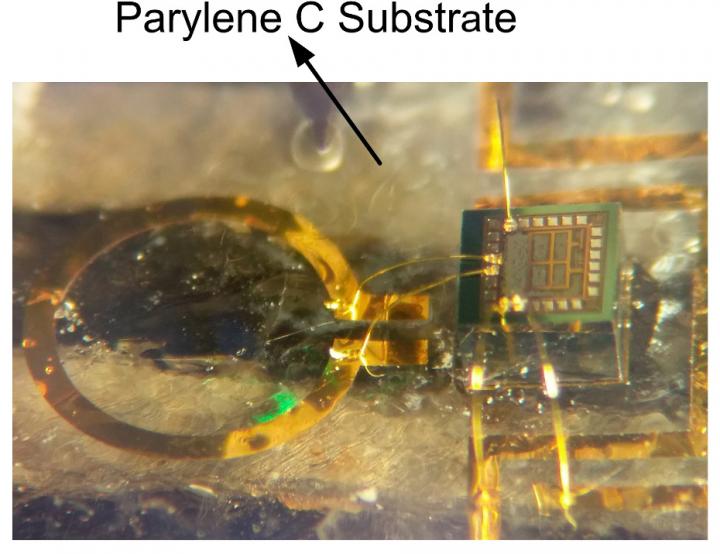
Credit: Hansraj Bhamra/Purdue University
WEST LAFAYETTE, Ind. – Purdue University innovators are working on inventions to use micro-chip technology in implantable devices and other wearable products such as smart watches to improve biomedical devices, including those used to monitor people with glaucoma and heart disease.
The Purdue team developed a fully implantable radio-frequency transmitter chip for wireless sensor nodes and biomedical devices. The research is published in the journal IEEE Transactions on Circuits and Systems II. The transmitter chip consumes lowest amount of energy per digital bit published to date.
The transmitter works in a similar fashion to communication technology in mobile phones and smart watches, but the Purdue transmitter has an unprecedented level of miniaturization and low-energy consumption that it can be implanted into an eye to monitor pressure for a glaucoma patient or into another part of the body to measure data related to heart functions.
“A transmitter is an integral part of these kinds of devices,” said Hansraj Bhamra, a research and development scientist who created the technology while he was a graduate student at Purdue. “It facilitates a wireless communication between the sensor node or biomedical device and a smart phone application. The user can simply operate the device through a smart phone application and receive the biophysiological data in real-time. The transmitter in this case enables a 24-hour intraocular pressure monitoring for glaucoma patients”
The Purdue transmitter chip works with sensor nodes in a process similar to the way sensors in the smart cars and other Internet of Things devices connect through various communication components to achieve tasks such as auto-driving.
“In addition to being low power, our transmitter operates on wireless power to replace the conventional batteries,” said Pedro Irazoqui, the Reilly Professor of Biomedical Engineering and professor of electrical and computer engineering at Purdue. “Batteries are undesirable since they increase the device size and weight and make it uncomfortable for patients. In addition, the batteries are built of toxic material and require frequent recharging or replacement surgeries.”
###
The innovators have worked with the Purdue Research Foundation Office of Technology Commercialization to patent this and other technologies. They are looking for partners to continue developing their technologies. For more information, contact OTC at [email protected].
Irazoqui also founded Bionode, a Purdue-affiliated startup that markets biotechnology and other related devices.
About Purdue Research Foundation Office of Technology Commercialization
The Purdue Research Foundation Office of Technology Commercialization operates one of the most comprehensive technology transfer programs among leading research universities in the U.S. Services provided by this office support the economic development initiatives of Purdue University and benefit the university’s academic activities through commercializing, licensing and protecting Purdue intellectual property. The office recently moved into the Convergence Center for Innovation and Collaboration in Discovery Park District, adjacent to the Purdue campus. In fiscal year 2020, the office reported 148 deals finalized with 225 technologies signed, 408 disclosures received and 180 issued U.S. patents. The office is managed by the Purdue Research Foundation, which received the 2019 Innovation and Economic Prosperity Universities Award for Place from the Association of Public and Land-grant Universities. In 2020, IPWatchdog Institute ranked Purdue third nationally in startup creation and in the top 20 for patents. The Purdue Research Foundation is a private, nonprofit foundation created to advance the mission of Purdue University. Contact [email protected] for more information.
About Purdue University
Purdue University is a top public research institution developing practical solutions to today’s toughest challenges. Ranked the No. 6 Most Innovative University in the United States by U.S. News & World Report, Purdue delivers world-changing research and out-of-this-world discovery. Committed to hands-on and online, real-world learning, Purdue offers a transformative education to all. Committed to affordability and accessibility, Purdue has frozen tuition and most fees at 2012-13 levels, enabling more students than ever to graduate debt-free. See how Purdue never stops in the persistent pursuit of the next giant leap at purdue.edu.
Writer: Chris Adam, [email protected]
Sources: Hansraj Bhamra, [email protected]
Pedro Irazoqui, [email protected]
Media Contact
Chris Adam
[email protected]
Related Journal Article
http://dx.