


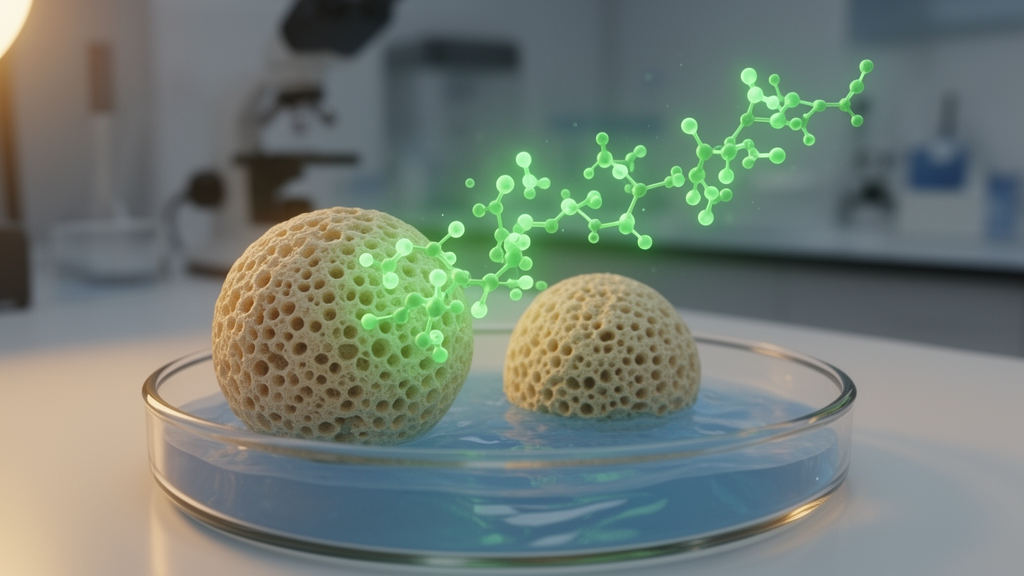
Long-chain alkanes, the hydrocarbon molecules spanning 15 to 36 carbon atoms, are among the most stubborn substrates in industrial chemistry. Their chemical inertness and hydrophobic nature make them difficult to transform, yet a bacterial enzyme known as long-chain alkane monooxygenase, or LadA, can break them down through terminal oxidation, producing primary alcohols as the first oxidation products. A new study published in AMB Express reports that this enzyme, taken from the thermophilic bacterium Geobacillus thermodenitrificans NG80-2, becomes markedly more robust when immobilized on a solid support, opening a path toward reusable biocatalysts for alkane conversion.
Their approach was physical adsorption, a straightforward immobilization technique in which the enzyme attaches to the surface of a polymeric support without chemical modification. After testing conditions, the researchers identified an enzyme-to-support ratio of 1.5 percent by weight, a reaction time of two hours, and a buffer system at pH 8.0 as the optimal setup for binding LadA onto a commercial resin called Seplite LX120.
Confirming that the enzyme had indeed bound to the support required structural evidence. Together, these techniques validated the successful immobilization, yielding a preparation the researchers designate LX_LadA.
The performance gains reported for the immobilized enzyme are substantial. It also sustained high activity across a broad temperature range from 30 to 80 degrees Celsius.
Stability across chemical conditions proved equally impressive. The immobilized enzyme displayed its highest stability at pH 8.0 but remained stable over a wide pH range stretching from 6.0 to 11.0, spanning mildly acidic to strongly alkaline environments.
In operational stability tests, LX_LadA retained significant activity for up to four consecutive reaction cycles. The authors conclude that immobilizing LadA on Seplite LX120 enhanced both the physicochemical and operational properties of the enzyme, highlighting its potential for sustainable industrial alkane bioconversion processes.
By fixing this catalyst onto a durable polymeric resin, the study converts a fragile biological tool into a sturdier, recoverable one.
Subject of Research: Immobilization of the long-chain alkane monooxygenase LadA on Seplite LX120 to enhance enzyme stability and reusability
Article Title: Immobilized long-chain alkane monooxygenase as an enhanced biocatalyst
Article References: Johan, U. U. M., Ishak, S. N. H., Latip, W., Kamarudin, N. H. A., Rahman, R. N. Z. R. A., & Ali, M. S. M. (2026). Immobilized long-chain alkane monooxygenase as an enhanced biocatalyst. AMB Express. https://doi.org/10.1186/s13568-026-02105-6
Image Credits: AI Generated
DOI: 10.1186/s13568-026-02105-6
Keywords: alkane monooxygenase, LadA, enzyme immobilization, Geobacillus thermodenitrificans, Seplite LX120, biocatalysis, thermostability, long-chain alkanes, terminal oxidation, industrial biotechnology, enzyme reuse, biodegradation
News Source: Gregory Coleman. (October 30, 2026). Immobilized Enzyme Shows Enhanced Stability for Alkane Bioconversion. Scienmag.



