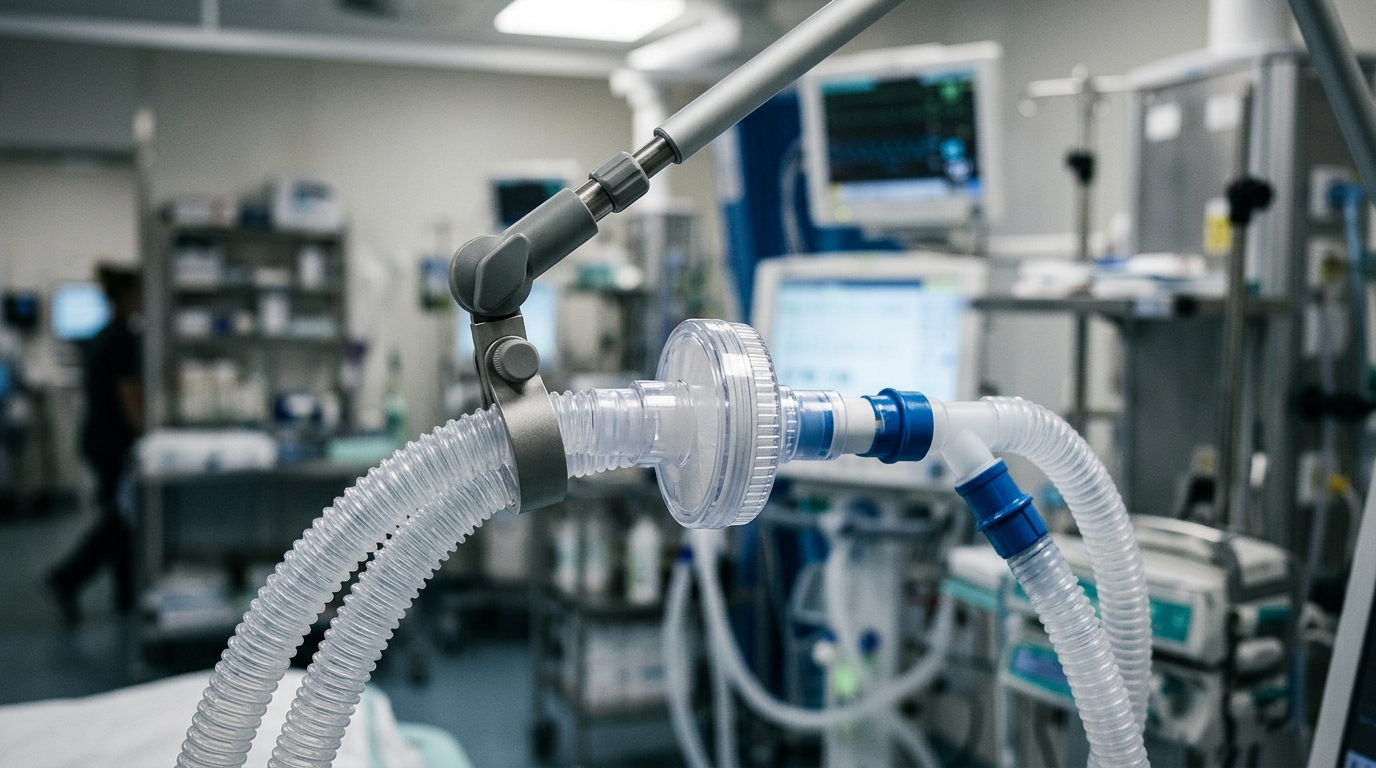
Ventilator-associated pneumonia remains one of the most feared complications of intensive care, and a new immunological analysis now explains why a promising immune-boosting therapy did not stop it. In a study published in Nature Communications, researchers re-examined data from the PREV-HAP clinical trial (ClinicalTrials.gov NCT04793568), which tested whether interferon-gamma could prevent ventilator-associated pneumonia; the trial did not show a benefit of IFN-γ on VAP prevention. The trial showed no benefit, and the new work investigated the immunological basis of this therapeutic failure: IFN-γ improved phenotypic and metabolic features of monocyte immune suppression, most notably by increasing HLA-DR expression, yet its modulation did not prevent lung pathology.
The research team, led by Jonas Schmid and Burkhard Becher with collaborators including Antoine Roquilly and Mihai Netea, carried out longitudinal high-dimensional immunoprofiling on 104 participants of the PREV-HAP trial, registered as NCT04793568. By tracking immune cells in each patient over time, they could compare the immune landscapes of people who later developed ventilator-associated pneumonia with those who did not, and measure how interferon-gamma changed the immune system along the way.
The therapy clearly worked on its molecular target. Trauma is known to leave circulating monocytes in a state of immune paralysis, and interferon-gamma reversed key features of that suppression. Most notably, the treatment increased expression of HLA-DR on monocytes, a well-established biomarker for patient outcomes.
But the intervention failed to prevent lung pathology. The researchers suggest one possible contributing mechanism: interferon-gamma also induced CCR7, a receptor that guides cells toward lymph nodes rather than sites of inflammation. The researchers suggest the failure may possibly be due to CCR7 induction by IFN-γ, though this remains a possible rather than proven explanation. The authors conclude that monocytic HLA-DR expression reflects the immune status rather than directly influencing VAP susceptibility.
The decisive clues came from a different arm of the immune system. Patients who subsequently developed ventilator-associated pneumonia showed pre-existing deficits in their T-cell and B-cell compartments, detectable before infection set in. These lymphoid alterations, rather than the state of monocytes, appear to be the more relevant determinants of infection risk in ventilated patients. The authors suggest that lymphoid immune alterations may represent more relevant determinants of infection risk in ventilated patients.
The authors summarize the conceptual shift directly in their abstract: monocytic HLA-DR expression appears to reflect the immune status rather than directly influencing susceptibility to ventilator-associated pneumonia, while lymphoid immune alterations may represent more relevant determinants of infection risk.
The study carries practical weight for trial design as well. The work used longitudinal high-dimensional immunoprofiling on 104 trial participants, identifying pre-existing deficits in T- and B-cell subsets in patients who subsequently developed VAP.
Because the analysis was based on 104 trial participants and focused on trauma patients requiring ventilation, the findings are most directly applicable to that population, and the authors note the interpretation of the CCR7 effect as a possible, not proven, explanation for the therapeutic failure. The article was shared early as a peer-reviewed, accepted version of record in progress.
Subject of Research: Why interferon-gamma failed to prevent ventilator-associated pneumonia in trauma patients despite restoring monocyte immune function.
Article Title: Reversal of trauma-induced monocyte paralysis by IFN-γ fails to prevent ventilator-associated pneumonia, implicating lymphoid deficits in infection risk
Article References: Schmid, J., Unger, S., Ziogas, A., Kreutmair, S., Mayoux, M., Ulutekin, C., Sparano, C., Villar-Vesga, J., Vermeer, M., Lin, M., Tuzlak, S., Wertheimer, T., Kim, D., Dergun, S., Novakovic, B., Hurtado-Navarro, L., Ferreira, A. V., Bruno, M., Saric, M., … Becher, B. (2026). Reversal of trauma-induced monocyte paralysis by IFN-γ fails to prevent ventilator-associated pneumonia, implicating lymphoid deficits in infection risk. Nature Communications. https://doi.org/10.1038/s41467-026-78844-8
Image Credits: AI Generated
DOI: 10.1038/s41467-026-78844-8
Keywords: ventilator-associated pneumonia, interferon-gamma, monocytes, HLA-DR, T cells, B cells, trauma, PREV-HAP trial, immune paralysis, CCR7, intensive care, immunoprofiling
News Source: Ophelia Keating. (November 4, 2026). IFN-γ Restores Trauma-Dampened Monocytes but Fails to Prevent Ventilator-Associated Pneumonia. Scienmag.