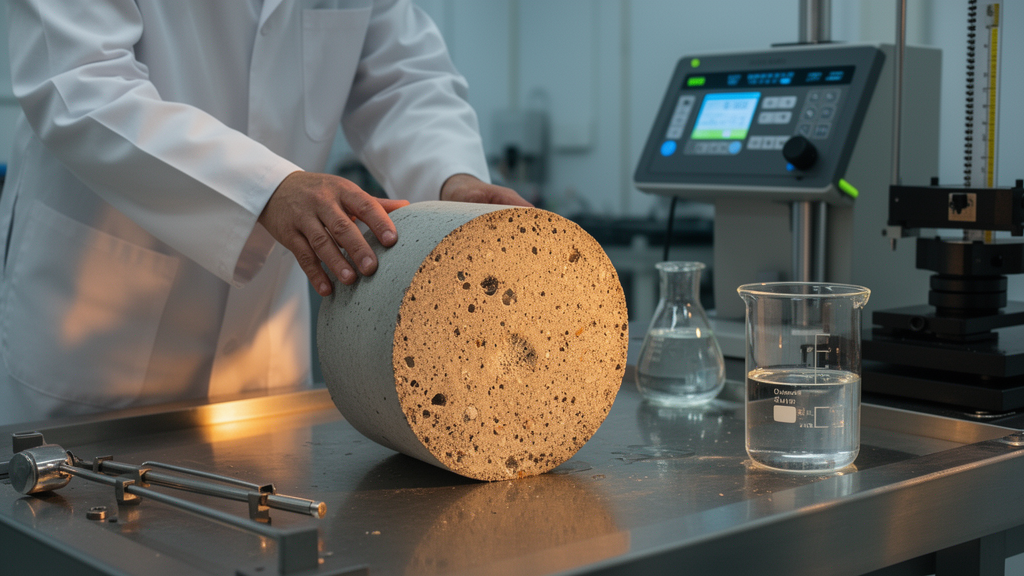
A newly proposed computational intelligence framework accurately predicts concrete chloride penetration while isolating a minimal set of critical input variables, according to a recent study published in the International Journal of Computational Intelligence Systems. Developed by researchers Morteza Khorshidi, Amirehsan Teimortashlu, and Ehsan Afaridegan, the data-driven framework models Rapid Chloride Permeability Test values to offer a practical computational alternative to conventional laboratory testing.
Assessing concrete durability against chloride ion ingress has historically relied on the standard Rapid Chloride Permeability Test, commonly designated as the RCPT. However, conducting the experimental test presents substantial practical difficulties across engineering workflows, as experimental measurements remain time-consuming, expensive, and exceptionally sensitive to changing laboratory conditions. To address these experimental drawbacks, researchers have increasingly prioritized the design of dependable predictive machine learning frameworks that estimate chloride permeability directly from mixture and environmental properties.
To establish a rigorous computational benchmark, the investigative team compiled a comprehensive database containing 483 experimental concrete samples gathered from earlier published research. Beyond utilizing primary concrete mix design parameters, the researchers systematically generated additional ratio-based and interaction features. These newly engineered feature sets were structured specifically to capture complex, nonlinear relationships governing interactions among mixture constituents and environmental exposure states.
Variable selection was conducted through two complementary computational strategies: a Q-learning algorithm combined with a Decision Tree model, termed Q-learning–DT, alongside a non-dominated sorting genetic algorithm paired with a Decision Tree, denoted as NSGA-II–DT. Comparative evaluation established that the NSGA-II–DT technique demonstrated superior feature optimization by isolating only five key input variables from the candidate pool, while maintaining high predictive accuracy throughout downstream estimation tasks.
Following feature reduction, the authors developed and evaluated four sophisticated hybrid computational intelligence architectures: CatBoost–SWOA, NGBoost–WOA, TabNet–EVOA, and TabPFN–HEOA. Model assessments relied on comprehensive statistical performance indices and visual Taylor diagrams to contrast prediction behaviors across the benchmarked formulations. Among the four evaluated systems, the hybrid CatBoost–SWOA model demonstrated the best overall predictive capability when evaluated on the independent testing dataset, attaining an R2 value of 0.966 alongside the lowest root mean square error.
Uncertainty analysis conducted using residual bootstrapping corroborated the structural robustness and numerical stability of the leading CatBoost–SWOA formulation. Across evaluated runs, this specific configuration produced the narrowest confidence intervals and yielded the lowest overall uncertainty metrics.
Interpretability assessments using SHAP, or Shapley Additive Explanations, further clarified the physical factors that governed model predictions. The interpretability analysis revealed that curing temperature and fly ash content represent the two most influential input parameters dictating RCPT values. By coupling explainable variable selection with robust ensemble learning, the framework provides an accurate, reliable, and interpretable alternative to labor-intensive experimental testing in concrete durability engineering.
Subject of Research: Machine learning prediction of concrete chloride penetration
Article Title: Explainable Feature Selection and Hybrid Computational Intelligence Models for Predicting Chloride Penetration in Concrete
Article References: Khorshidi, M., Teimortashlu, A., & Afaridegan, E. (2026). Explainable Feature Selection and Hybrid Computational Intelligence Models for Predicting Chloride Penetration in Concrete. International Journal of Computational Intelligence Systems. https://doi.org/10.1007/s44196-026-01650-z
Image Credits: AI Generated
DOI: 10.1007/s44196-026-01650-z
Keywords: Concrete Durability, Chloride Penetration, Rapid Chloride Permeability Test, CatBoost, Feature Selection, NSGA-II, Decision Trees, Q-Learning, Fly Ash, Curing Temperature, SHAP Interpretability, Computational Intelligence, Residual Bootstrapping, Predictive Modeling, Machine Learning
News Source: Teresa Odom. (November 20, 2026). Hybrid Machine Learning Accurately Predicts Concrete Chloride Penetration from Key Parameters. Scienmag.