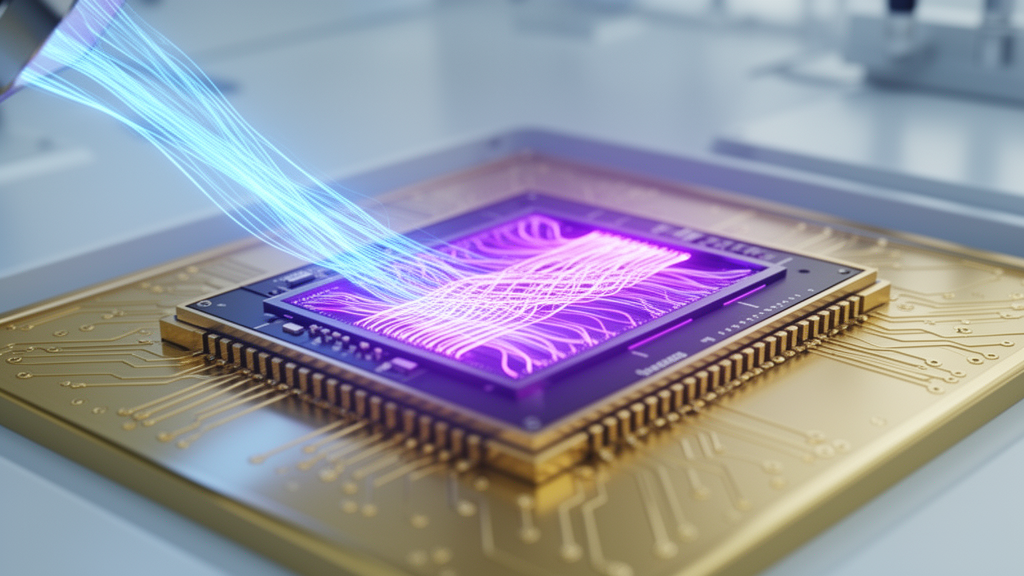
Researchers have realized the first experimental demonstration of a quantum analogue-to-digital converter tailored for quantum metrology on an integrated photonic platform. The system takes a continuous parameter, specifically an optical phase shift, and converts it into a digital bit string. In contrast to traditional quantum metrology protocols that assess precision using continuous-valued parameter estimation benchmarks, digital quantum estimation quantifies performance information-theoretically by measuring the number of significant recoverable bits. By combining an advanced reconfigurable optical circuit with deep learning algorithms to mitigate noise, the researchers demonstrated that this quantum architecture extracts more useful bits of information than classical interferometric techniques operating with identical photon and event resources.
The underlying scheme reformulates parallel quantum phase estimation algorithms into a physical device capable of acting as an analogue-to-digital converter. The theoretical protocol employs a register of probes prepared in Greenberger–Horne–Zeilinger states across different sizes. An unknown optical phase transformation is applied across each probe, followed by entangling controlled operations and an inverse quantum Fourier transform implemented without swapping gates. The measurement of the final quantum states in the computational basis directly yields the binary expansion of the optical phase parameter. In this design, the procedure is structured into three discrete sequential steps involving four-photon, two-photon, and single-photon states, respectively, which produce the corresponding bits of the phase representation.
To generate the required multi-photon quantum states, the experimental apparatus couples a high-purity semiconductor quantum dot emitter to an optical manipulation chain. The quantum dot source is excited in a resonance fluorescence regime by a pulsed laser operating at a doubled repetition rate of 158 megahertz. Emitted single photons are isolated from the excitation laser through cross-polarization filtering, yielding a source brightness parameter of approximately 14 percent. The single-photon purity is verified through second-order correlation measurements via Hanbury–Brown and Twiss interferometry, yielding values of (5.321 ± 0.001) × 10⁻³ in the two-photon configuration and (5.629 ± 0.003) × 10⁻³ in the four-photon configuration. A fast acousto-optic time-to-spatial demultiplexer redirects the sequential photon train into separate spatial paths every 180 nanoseconds, where relative polarizations and arrival delays are synchronized before chip injection.
The photonic processing core consists of a universal integrated circuit fabricated via femtosecond laser writing, spanning a footprint of 80 square millimeters and pigtailed to single-mode fiber arrays. This processor features an eight-mode rectangular mesh containing 28 reconfigurable Mach–Zehnder interferometers, each acting as a programmable beam splitter governed by two thermo-optic phase shifters. Tuning the 56 resistive heaters on the chip allows arbitrary unitary operations across the spatial modes. Following an extensive calibration procedure mapping thermal cross-talk across waveguides, the transformation fidelity of the device tested across Haar-random unitary matrices reached an average of 0.995 ± 0.002. The complete optical assembly exhibits an overall input-to-output optical transmission of approximately 50 percent, including coupling losses.
Within the integrated processor, quantum information is encoded using a dual-rail spatial convention, where each logical qubit corresponds to a single photon occupying one of two adjacent spatial waveguides. Specific sections of the processor are configured dynamically to fulfill the different stages of the estimation algorithm: state generation, phase encoding, controlled phase rotations, and Hadamard gates. In the preparation stage, the device synthesizes four-photon and two-photon entangled resource states in post-selection, alongside a deterministic single-qubit state. Quantum state tomography performed on the generated resources revealed experimental state fidelities of 0.811 ± 0.005 for the four-photon state, 0.9476 ± 0.004 for the two-photon state, and 0.9972 ± 0.0001 for the single-photon state, confirming high-fidelity state synthesis on chip despite physical losses.
Detection of the processed states is carried out using an array of superconducting nanowire single-photon detectors operating with an average detection efficiency of roughly 85 percent, connected to a time-tagging system with approximately 42-picosecond timing resolution. When factoring in the source generation rate, transmission, and detector efficiency, the integrated coincidence rates over useful configurations reached approximately 5 megahertz for single-photon events, 50 kilohertz for two-photon events, and 8 hertz for four-photon events. For experimental validation, the researchers acquired data across 99 optical phase values evenly spaced between 0 and 2π, executing up to 5,377 measurement shots per phase setting to compile reliable joint detection distributions.
Direct experimental evaluations revealed that although the quantum digital estimation protocol surpassed the classical interferometric strategy for moderate numbers of detected probes, the quantum advantage degraded as sample numbers grew. This degradation stemmed from cumulative experimental imperfections, including optical path attenuation, slight circuit programming inaccuracies, residual photon distinguishability, and drift in source multi-photon emission over extended acquisition periods. In Hong–Ou–Mandel visibility tests benchmarking mutual indistinguishability, two-photon interference visibility reached 0.938 ± 0.002, while visibilities between the six distinct photon pairs in the four-photon experiment ranged from 0.9078 ± 0.0009 to 0.940 ± 0.001, highlighting real physical constraints.
To overcome these hardware noise limitations without increasing physical resources, the team implemented a machine learning pipeline featuring a denoising autoencoder. This neural network architecture comprises an encoder that compresses 7-bit experimental outcome probabilities through dense layers of 64 and 32 neurons into a 16-neuron bottleneck latent space, followed by a symmetric decoder that reconstructs the clean probability distribution. Trained exclusively on synthetic data generated from ideal theoretical probabilities corrupted with Gaussian noise, the autoencoder isolates invariant physical characteristics and discards noise-induced variance. Evaluating the mutual information from the denoised experimental probabilities demonstrated a persistent quantum advantage over classical methods across all measurement shot regimes.
To convert the denoised probability distributions into accurate, linear phase estimates, the authors deployed a second, feed-forward neural network. This network takes 16 inputs comprising the conditional outcome probabilities alongside probabilities evaluated at a fixed shift of approximately 0.44 radians, processing them through three hidden layers of 52 neurons each before delivering a continuous phase estimate. The auxiliary shifted input enables the model to resolve periodic phase ambiguities and boundary distortions. While classical interferometric methods remain fundamentally restricted to phase discrimination within an interval of π, the neural-network-assisted quantum digital converter provided unbiased, highly accurate phase estimates across the entire 2π range, confirming the feasibility of digital quantum sensing architectures.
The progressive extraction of the bit string relies on conditional quantum operations across the multi-stage protocol. In this sequence, the bit b3 represents the highest-frequency, least significant component of the binary expansion and is extracted first from the four-photon state. Evaluating the computational parity of the first three photons, which yields one for an odd number of ones and zero for an even count, determines whether a Pauli-Z operation is applied to the fourth photon before Hadamard transformation and computational basis measurement. The resulting outcome for b3 subsequently controls an inverse rotation applied during the two-photon stage, which yields bit b2 following its own Hadamard projection. Finally, the single-photon stage applies two successive phase rotations conditioned on b2 and b3, producing the most significant bit, b1. Marginalizing the denoised distributions to these three bits yields an eight-element vector representing the observed frequencies across all computational basis states.
This protocol architecture directly resolves the systematic ambiguities present in classical interferometric estimation. In the classical benchmark, a register of 2^t − 1 unentangled probes is prepared in symmetric superposition states, each evolving under the unknown phase to produce an outcome probability of sin^2(ϕ/2). Reconstructing the optical phase from the relation 2 arcsin(N1/(2^t − 1)), where N1 represents the count of detected ones, introduces an inherent ambiguity between the intervals [0, π] and [π, 2π]. Conventional classical approaches must resolve this ambiguity by repeatedly updating reference phases across multiround measurements. In the quantum converter, however, measurement outcomes from the group of probes are analyzed jointly. This collective evaluation narrows the residual ambiguity window to the interval [7π/4, 2π] for three-qubit registers and allows the conditional gate sequence to achieve unambiguous discrimination across the entire 2π range.
Implementing the algorithm with post-selection also governs the underlying metrological resource scaling. Because the experimental setup relied on post-selection rather than active feed-forward operations, the measurement stage required repeating selections up to 2^l times for bits requiring 2^{t−l} qubits. This requirement increases physical qubit scaling from the ideal baseline of O(2 × 2^t) to O(t × 2^t), representing a moderate logarithmic overhead. At the state preparation stage, discarded events do not affect the metrological resource accounting because rejected states carry no information regarding the unknown phase parameter. Hardware-level imperfections during detection were further handled by specific network designs; the denoising autoencoder employed rectified linear unit activations within its dense layers alongside a normalized linear output layer, while the downstream estimation network utilized sigmoid and hyperbolic tangent activations optimized across 4,000 epochs with the Adam optimizer.
These findings demonstrate the broader potential of digital quantum estimation for bridging physical quantum sensors and digital signal processing architectures. Earlier theoretical proposals considered quantum analogue-to-digital converters primarily as computational subprimitives where the digitized values remained stored on quantum bits. In contrast, this experimental demonstration outputs classical bit strings directly from continuous optical parameters, yielding a higher number of useful bits than classical interferometric estimation using equivalent numbers of successfully detected events. By digitizing continuous phase inputs into binary expansions through reconfigurable integrated circuits, the demonstrated platform provides a foundation for quantum digital sensing protocols operating under real-world experimental noise.
Subject of Research: Experimental quantum analogue-to-digital converter for phase estimation
Article Title: Quantum analogue-to-digital converter for phase estimation
Article References: Caruccio, E., Roncallo, S., Cimini, V., Albiero, R., Pentangelo, C., Ceccarelli, F., Corrielli, G., Osellame, R., Spagnolo, N., Maccone, L., Macchiavello, C., & Sciarrino, F. (2026). Quantum analogue-to-digital converter for phase estimation. Nature Photonics. https://doi.org/10.1038/s41566-026-02050-7
Image Credits: AI Generated
DOI: 10.1038/s41566-026-02050-7
Keywords: quantum metrology, analogue to digital converter, phase estimation, integrated photonics, quantum dot source, denoising autoencoder, feed forward neural network, Hong Ou Mandel visibility, quantum optics, superconducting nanowire single photon detectors, entangled photons, Greenberger Horne Zeilinger state, Mach Zehnder interferometers, mutual information, quantum information
News Source: Katie Riggs. (November 20, 2026). Integrated Photonic Quantum Converter Enhances Digital Phase Estimation in Metrology. Scienmag.