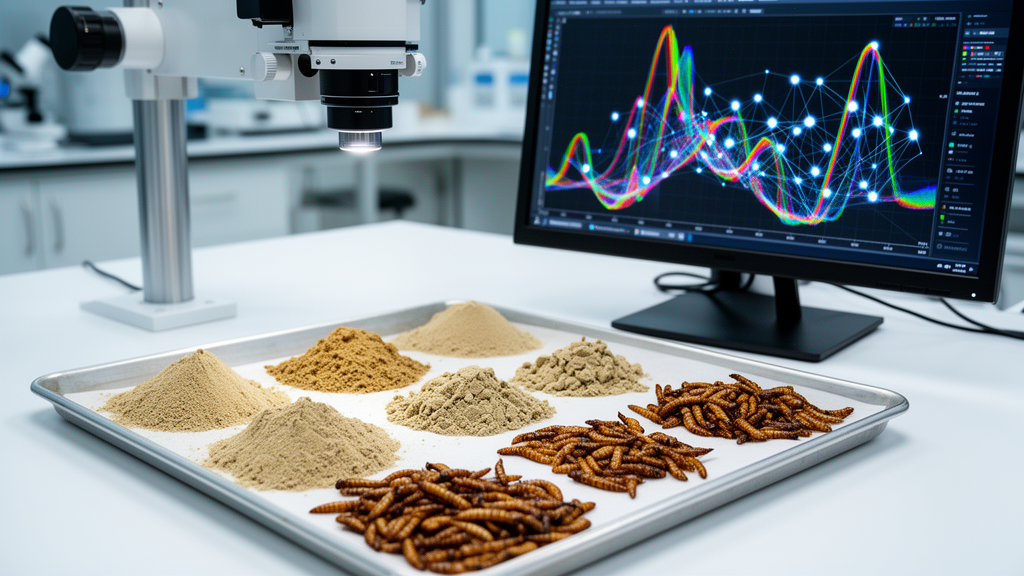
A deep-learning architecture termed the Batch-Invariant Spectral Network classified three commercially relevant edible insect species with an overall accuracy of 0.93 across independent production batches, according to research published in Results in Engineering. The study addressed a critical barrier in industrial food authentication, where physical and chemical variations between production runs often degrade the accuracy of rapid spectroscopic inspection. By coupling a learnable preprocessing convolution with an unsupervised entropy-regularised auxiliary branch, the model maintained high classification performance on milled insect slurries when evaluated under a strict leave-one-batch-out protocol, outperforming established chemometric, machine-learning, and domain-adaptation baselines.
Edible insects represent a sustainable alternative protein source capable of converting feed into biomass with lower land, water, and greenhouse gas requirements than conventional livestock. Industrial processing focuses heavily on three species approved for human or animal consumption: the house cricket Acheta domesticus, the black soldier fly Hermetia illucens, and the yellow mealworm Tenebrio molitor. These organisms exhibit distinct biochemical profiles that dictate their commercial applications and regulatory handling. Fifth-stage larvae of H. illucens contain high lipid concentrations ranging from 29 to 43 percent dry weight, dominated by medium-chain fatty acids such as lauric acid. In contrast, T. molitor larvae offer 48 to 75 percent protein dry weight, while adult A. domesticus provides 55 to 70 percent protein alongside specific components that may trigger cross-reactive allergenic responses. Rapid and non-destructive identification is essential to prevent accidental adulteration, verify raw material traceability, and protect sensitive consumers.
Near-infrared spectroscopy is particularly suited for high-throughput screening because it captures overtone and combination vibrational bands of chemical bonds, including carbon-hydrogen, nitrogen-hydrogen, and oxygen-hydrogen linkages that define lipids, proteins, and moisture. However, industrial deployment has historically been impeded by unwanted spectral variance arising from instrumental drift, fluctuating ambient moisture, sample handling, and biological batch diversity. In industrial processing, this challenge is intensified by preparatory interventions such as thermal blanching, plasma-activated water exposure, and ultrasound-assisted extraction. These techniques alter spectral absorption profiles within the exact same wavelength intervals—such as the lipid carbon-hydrogen overtone between 840 and 910 nanometres and the protein nitrogen-hydrogen combination region between 1000 and 1180 nanometres—that provide the primary biochemical cues for species discrimination.
To capture realistic production variance, the research team implemented a full factorial experimental design involving three independent commercial production batches per species acquired at 30- to 60-day intervals between November 2024 and February 2025. Whole insects were blended with water to form homogeneous slurries using an insect-to-water ratio of 1:1 for H. illucens and T. molitor, and 1:2 for A. domesticus to account for its high water-holding capacity. Samples were subjected to three primary treatments: reference tap water, thermal blanching at 70 degrees Celsius for five minutes to induce protein denaturation, and non-thermal treatment with plasma-activated water whose reactive oxygen and nitrogen species alter surface lipids and pigments. Each group was further subdivided into non-sonicated controls and ultrasound-treated samples processed at 20 kilohertz with an acoustic power density of approximately one watt per millilitre, yielding a balanced dataset of 2,700 reflectance spectra spanning 700 to 2050 nanometres across 136 wavelength variables.
Spectral sensitivity analyses revealed that treatment-induced perturbations were not uniformly distributed across the electromagnetic spectrum or among species. H. illucens demonstrated the largest spectral deviations from the untreated baseline, with major alterations observed in pigment, lipid, water, and protein absorption bands, particularly under combined ultrasound and plasma-activated water exposure. T. molitor showed intermediate sensitivity, whereas A. domesticus proved most chemically and spectrally stable. When the researchers performed multivariate analysis of variance on the first five principal components of the raw spectra, batch identity exerted a significant confounding influence, yielding a species-to-batch F-ratio of only 12 ± 6 and a linear batch-probe classification accuracy of 0.95 ± 0.01. Standard normal variate normalisation and Savitzky-Golay derivative filtering reduced batch recoverability to roughly 0.44 but suppressed species-discriminative variance, resulting in an unacceptably low species silhouette score of 0.08 to 0.20.
The Batch-Invariant Spectral Network was constructed to decouple species-discriminative spectral features from batch- and treatment-associated noise. The network architecture incorporates four jointly optimised components operating in an end-to-end framework. Raw spectra first enter an informed preprocessing module comprising a one-dimensional convolution initialised with analytic first-derivative Savitzky-Golay coefficients, followed by per-spectrum instance normalisation to eliminate baseline offsets. The resulting preprocessed representation is directed simultaneously into a sparse attentive encoder and an unsupervised batch auxiliary branch. The attentive encoder employs a feature transformer, ghost batch normalisation, and sparsemax activation to generate an adaptive wavelength-selection mask, which projects the filtered spectral inputs into an eight-dimensional latent embedding connected to a linear species classifier.
The critical mechanism enabling cross-batch generalisation is the unsupervised batch auxiliary branch. This module directs the preprocessed spectra through a gradient reversal layer into a two-layer auxiliary classification head featuring two output slots. Minimising the negative entropy loss of the auxiliary head acts to maximise the entropy of its output distribution, while the gradient reversal layer inverts this signal before it reaches the learnable convolution. Consequently, the preprocessing kernel and auxiliary head are driven in opposing entropy directions, systematically purging batch-identifying features from the preprocessed representation without requiring explicit physical batch labels during training. The entire network is trained by minimising a joint objective combining species cross-entropy, sparse-mask entropy regularisation, and the annealed auxiliary entropy loss.
Under the leave-one-batch-out evaluation protocol, where models were iteratively trained on two commercial batches and tested exclusively on the remaining independent batch, the proposed network attained a mean classification accuracy of 0.93 ± 0.04 and an identical macro-averaged F1 score of 0.93 ± 0.04. In contrast, standard baseline models evaluated on raw spectra achieved accuracies ranging from 0.66 to 0.81, with domain-adversarial neural networks scoring 0.81 ± 0.15. While classical preprocessing improved non-adversarial architectures such as TabNet and TabPFN to 0.88 and 0.87 respectively, the best-performing baseline—a domain-adversarial neural network trained on preprocessed inputs—reached 0.89 ± 0.05. Bootstrap resampling across one million iterations verified that the four-percentage-point advantage of the new network over the strongest baseline was statistically significant, with a mean accuracy difference of 0.041 and an associated p-value below 10⁻⁶.
Ablation experiments confirmed the indispensable roles of the model components in achieving cross-batch resilience. Completely removing the learnable preprocessing module and feeding raw spectra directly into the sparse encoder dropped mean classification accuracy to 0.73 ± 0.12, representing the single largest performance deficit observed. Replacing the adaptive module with static, grid-search-optimised classical preprocessing recovered accuracy to only 0.86 ± 0.01. Deactivating the auxiliary entropy regularisation branch reduced accuracy to 0.87 ± 0.09 while doubling fold-to-fold performance variance. Replacing the Savitzky-Golay convolution initialisation with random weights maintained final accuracy at 0.93 ± 0.04 but extended convergence time from 120 ± 11 epochs to 175 ± 15 epochs, demonstrating that spectroscopic prior knowledge accelerates model optimisation without constraining the final learned filter shape.
Model interpretability was evaluated using Integrated Gradients attributions and region-constrained counterfactual optimisation across eleven chemically defined spectral windows. Integrated Gradients identified lipid combination bands around 1680 to 1820 nanometres and protein nitrogen-hydrogen overtones between 1000 and 1180 nanometres as the primary drivers of model decisions, aligning with species-level biochemical disparities in fat and protein content. Counterfactual analysis on misclassified spectra revealed that targeted adjustments within mixed-organics, lipid, and protein-water absorption windows achieved label-reversal success rates exceeding 0.40 at minimal perturbation magnitudes. Error distribution analysis indicated that thermal blanching accounted for 61.0 percent of all misclassifications, primarily confusing H. illucens and T. molitor due to thermal protein denaturation and intracellular lipid release.
The authors emphasised several practical constraints inherent to the study design. Because each production batch represented a distinct commercial purchase measured on a separate date, biological lot variations were integrated with temporal instrument drift, preventing the isolation of specific hardware drift factors. Furthermore, while the surface pigment spectral region displayed high attribution in feature importance analysis, it exhibited substantial fold-to-fold variability, suggesting sensitivity to scattering phenomena that may prove less dependable than core protein and lipid absorption signatures. The researchers concluded that future evaluations must validate the framework across broader species panels, extended batch series, and real-time inline industrial conveyor systems.
Subject of Research: Near-infrared spectroscopy and deep learning for edible insect species authentication across production batches
Article Title: Batch-invariant spectral intelligence for robust and explainable insect authentication
Article References: Babor, M., Rossi, G., Altavilla, A., Schlüter, O., & Höhne, M. M. C. (2026). Batch-invariant spectral intelligence for robust and explainable insect authentication. Results in Engineering, 32, Article 114041. https://doi.org/10.1016/j.rineng.2026.114041
Image Credits: AI Generated
DOI: 10.1016/j.rineng.2026.114041
Keywords: Acheta domesticus, Hermetia illucens, Tenebrio molitor, near-infrared spectroscopy, edible insects, food authentication, deep learning, batch effect, domain adaptation, chemometrics, Savitzky-Golay, gradient reversal layer, counterfactual analysis, integrated gradients, ultrasound processing, plasma-activated water
News Source: Gavin Prescott. (November 20, 2026). Batch-Invariant Spectral Network Identifies Edible Insect Species Across Variable Processing Conditions. Scienmag.