• HOME
  • NEWS
  • EXPLORE
    • CAREER
      • Companies
      • Jobs
    • EVENTS
    • iGEM
      • News
      • Team
    • PHOTOS
    • VIDEO
    • WIKI
  • BLOG
  • COMMUNITY
    • FACEBOOK
    • INSTAGRAM
    • TWITTER
Monday, October 5, 2026
BIOENGINEER.ORG
No Result
View All Result
  • Login
  • HOME
  • NEWS
  • EXPLORE
    • CAREER
      • Companies
      • Jobs
        • Lecturer
        • PhD Studentship
        • Postdoc
        • Research Assistant
    • EVENTS
    • iGEM
      • News
      • Team
    • PHOTOS
    • VIDEO
    • WIKI
  • BLOG
  • COMMUNITY
    • FACEBOOK
    • INSTAGRAM
    • TWITTER
  • HOME
  • NEWS
  • EXPLORE
    • CAREER
      • Companies
      • Jobs
        • Lecturer
        • PhD Studentship
        • Postdoc
        • Research Assistant
    • EVENTS
    • iGEM
      • News
      • Team
    • PHOTOS
    • VIDEO
    • WIKI
  • BLOG
  • COMMUNITY
    • FACEBOOK
    • INSTAGRAM
    • TWITTER
No Result
View All Result
Bioengineer.org
No Result
View All Result
Home NEWS Science News Biology

Human textiles to repair blood vessels

Bioengineer by Bioengineer
February 10, 2020
in Biology
Reading Time: 2 mins read
0
IMAGE
Share on FacebookShare on TwitterShare on LinkedinShare on RedditShare on Telegram

IMAGE

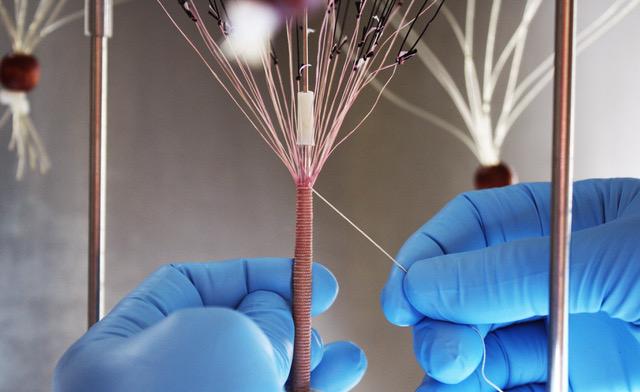
Credit: Nicolas L’Heureux


What if we could replace a patient’s damaged blood vessels with brand new ones produced in a laboratory? This is the challenge set by Inserm researcher Nicolas L’Heureux, who is working on the human extracellular matrix – the structural support of human tissues that is found around practically all of the body’s cells.

In a study published in Acta Biomaterialia, L’Heureux and his colleagues at the Tissue Bioengineering unit (Inserm/Université de Bordeaux) describe how they have cultivated human cells in the laboratory to obtain extracellular matrix deposits high in collagen – a structural protein that constitutes the mechanical scaffold of the human extracellular matrix. “We have obtained thin but highly robust extracellular matrix sheets that can be used as a construction material to replace blood vessels”, L’Heureux explains.

The researchers then cut these sheets to form yarn – a bit like that used to make fabric for clothing. “The resulting yarn can be woven, knitted or braided into various forms. Our main objective is to use this yarn to make assemblies which can replace the damaged blood vessels”, adds L’Heureux.

Made entirely from biological material, these blood vessels would also have the advantage of being well-tolerated by all patients. Given that collagen does not vary from individual to individual, it is not expected that the body will consider these vessels as foreign bodies that need to be rejected.

The researchers would now like to refine their techniques used to produce these “human textiles” before moving on to animal testing, in order to validate this last hypothesis. If these are conclusive, this could lead to clinical trials.

###

Media Contact
Inserm Press Office
[email protected]

Related Journal Article

http://dx.doi.org/10.1016/j.actbio.2020.01.037

Tags: Biomechanics/BiophysicsBiotechnologyCardiologyHealth Care Systems/ServicesMedicine/HealthMetabolism/Metabolic DiseasesPublic Health
Share12Tweet8Share2ShareShareShare2

Related Posts

Dental Students Say a Three-Phase Case Method Bridges the Preclinical-Clinical Divide

Dental Students Say a Three-Phase Case Method Bridges the Preclinical-Clinical Divide

October 5, 2026
Gut Microbes Turn Amino Acid Into Toxin That Worsens Pancreatitis in the Elderly

Gut Microbes Turn Amino Acid Into Toxin That Worsens Pancreatitis in the Elderly

October 5, 2026

Ribosomal RNA Passes Its Test as a Steady Reference in High-Throughput Plasma qPCR

October 5, 2026

GRETA: New Database Turns Mountains of Genome Sequencing Data into Searchable Science

October 5, 2026
Please login to join discussion

POPULAR NEWS

  • Alloys That Shrink Their Own Grains: New PIX Mechanism Refines Metals With Heat Alone

    Alloys That Shrink Their Own Grains: New PIX Mechanism Refines Metals With Heat Alone

    29 shares
    Share 12 Tweet 7
  • Endurance Exercise Reshapes the Liver in Males and Females Through Distinct Molecular Routes

    29 shares
    Share 12 Tweet 7
  • Single Transcription Factor PU.1 Rapidly Converts Fibroblasts into Macrophage-Lineage Cells

    29 shares
    Share 12 Tweet 7
  • New Scale Measures How Ready Nurse Educators Really Are for the AI Era

    29 shares
    Share 12 Tweet 7

About

We bring you the latest biotechnology news from best research centers and universities around the world. Check our website.

Follow us

Recent News

Alloys That Shrink Their Own Grains: New PIX Mechanism Refines Metals With Heat Alone

Endurance Exercise Reshapes the Liver in Males and Females Through Distinct Molecular Routes

Single Transcription Factor PU.1 Rapidly Converts Fibroblasts into Macrophage-Lineage Cells

Subscribe to Blog via Email

Success! An email was just sent to confirm your subscription. Please find the email now and click 'Confirm' to start subscribing.

Join 85 other subscribers
  • Contact Us

Bioengineer.org © Copyright 2023 All Rights Reserved.

Welcome Back!

Login to your account below

Forgotten Password?

Retrieve your password

Please enter your username or email address to reset your password.

Log In
No Result
View All Result
  • Homepages
    • Home Page 1
    • Home Page 2
  • News
  • National
  • Business
  • Health
  • Lifestyle
  • Science

Bioengineer.org © Copyright 2023 All Rights Reserved.