DURHAM, N.C. — A team of Duke researchers has identified a group of human DNA sequences driving changes in brain development, digestion and immunity that seem to have evolved rapidly after our family line split from that of the chimpanzees, but before we split with the Neanderthals.
Credit: Riley Mangan, Duke University
DURHAM, N.C. — A team of Duke researchers has identified a group of human DNA sequences driving changes in brain development, digestion and immunity that seem to have evolved rapidly after our family line split from that of the chimpanzees, but before we split with the Neanderthals.
Our brains are bigger, and are guts are shorter than our ape peers.
“A lot of the traits that we think of as uniquely human, and human-specific, probably appear during that time period,” in the 7.5 million years since the split with the common ancestor we share with the chimpanzee, said Craig Lowe, Ph.D., an assistant professor of molecular genetics and microbiology in the Duke School of Medicine.
Specifically, the DNA sequences in question, which the researchers have dubbed Human Ancestor Quickly Evolved Regions (HAQERS), pronounced like hackers, regulate genes. They are the switches that tell nearby genes when to turn on and off. The findings appear Nov.23 in the journal CELL.
The rapid evolution of these regions of the genome seems to have served as a fine-tuning of regulatory control, Lowe said. More switches were added to the human operating system as sequences developed into regulatory regions, and they were more finely tuned to adapt to environmental or developmental cues. By and large, those changes were advantageous to our species.
“They seem especially specific in causing genes to turn on, we think just in certain cell types at certain times of development, or even genes that turn on when the environment changes in some way,” Lowe said.
A lot of this genomic innovation was found in brain development and the GI tract. “We see lots of regulatory elements that are turning on in these tissues,” Lowe said. “These are the tissues where humans are refining which genes are expressed and at what level.”
Today, our brains are larger than other apes, and our guts are shorter. “People have hypothesized that those two are even linked, because they are two really expensive metabolic tissues to have around,” Lowe said. “I think what we’re seeing is that there wasn’t really one mutation that gave you a large brain and one mutation that really struck the gut, it was probably many of these small changes over time.”
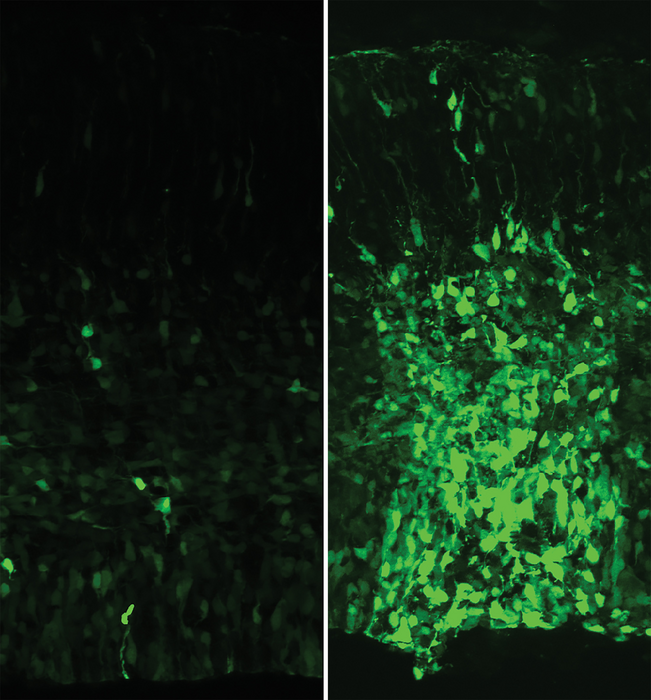
To produce the new findings, Lowe’s lab collaborated with Duke colleagues Tim Reddy, an associate professor of biostatistics and bioinformatics, and Debra Silver, an associate professor of molecular genetics and microbiology to tap their expertise. Reddy’s lab is capable of looking at millions of genetic switches at once and Silver is watching switches in action in developing mouse brains.
“Our contribution was, if we could bring both of those technologies together, then we could look at hundreds of switches in this sort of complex developing tissue, which you can’t really get from a cell line,” Lowe said.
“We wanted to identify switches that were totally new in humans,” Lowe said. Computationally, they were able to infer what the human-chimp ancestor’s DNA would have been like, as well as the extinct Neanderthal and Denisovan lineages. The researchers were able to compare the genome sequences of these other post-chimpanzee relatives thanks to databases created from the pioneering work of 2022 Nobel laureate Svante Pääbo.
“So, we know the Neanderthal sequence, but let’s test that Neanderthal sequence and see if it can really turn on genes or not,” which they did dozens of times.
“And we showed that, whoa, this really is a switch that turns on and off genes,” Lowe said. “It was really fun to see that new gene regulation came from totally new switches, rather than just sort of rewiring switches that already existed.”
Along with the positive traits that HAQERs gave humans, they can also be implicated in some diseases.
Most of us have remarkably similar HAQER sequences, but there are some variances, “and we were able to show that those variants tend to correlate with certain diseases,” Lowe said, namely hypertension, neuroblastoma, unipolar depression, bipolar depression and schizophrenia. The mechanisms of action aren’t known yet, and more research will have to be done in these areas, Lowe said.
“Maybe human-specific diseases or human-specific susceptibilities to these diseases are going to be preferentially mapped back to these new genetic switches that only exist in humans,” Lowe said.
Support for the research came from National Human Genome Research Institute – NIH (R35-HG011332), North Carolina Biotechnology Center (2016-IDG-1013, 2020-IIG-2109), Sigma Xi, The Triangle Center for Evolutionary Medicine and the Duke Whitehead Scholarship.
CITATION: “Adaptive Sequence Divergence Forged New Neurodevelopmental Enhancers in Humans,” Riley J. Mangan, Fernando C. Alsina, Federica Mosti, Jesus Emiliano Sotelo-Fonseca, Daniel A. Snellings, Eric H. Au, Juliana Carvalho, Laya Sathyan, Graham D. Johnson, Timothy E. Reddy, Debra L. Silver, Craig B. Lowe. CELL, Nov. 23, 2022. DOI: 10.1016/j.cell.2022.10.016
Journal
Cell
DOI
10.1016/j.cell.2022.10.016
Method of Research
Experimental study
Subject of Research
Animals
Article Title
Adaptive Sequence Divergence Forged New Neurodevelopmental Enhancers in Humans
Article Publication Date
23-Nov-2022