• HOME
  • NEWS
  • EXPLORE
    • CAREER
      • Companies
      • Jobs
    • EVENTS
    • iGEM
      • News
      • Team
    • PHOTOS
    • VIDEO
    • WIKI
  • BLOG
  • COMMUNITY
    • FACEBOOK
    • INSTAGRAM
    • TWITTER
Sunday, May 10, 2026
BIOENGINEER.ORG
No Result
View All Result
  • Login
  • HOME
  • NEWS
  • EXPLORE
    • CAREER
      • Companies
      • Jobs
        • Lecturer
        • PhD Studentship
        • Postdoc
        • Research Assistant
    • EVENTS
    • iGEM
      • News
      • Team
    • PHOTOS
    • VIDEO
    • WIKI
  • BLOG
  • COMMUNITY
    • FACEBOOK
    • INSTAGRAM
    • TWITTER
  • HOME
  • NEWS
  • EXPLORE
    • CAREER
      • Companies
      • Jobs
        • Lecturer
        • PhD Studentship
        • Postdoc
        • Research Assistant
    • EVENTS
    • iGEM
      • News
      • Team
    • PHOTOS
    • VIDEO
    • WIKI
  • BLOG
  • COMMUNITY
    • FACEBOOK
    • INSTAGRAM
    • TWITTER
No Result
View All Result
Bioengineer.org
No Result
View All Result
Home NEWS Science News Chemistry

Hubble peers at cosmic blue bauble

Bioengineer by Bioengineer
April 12, 2019
in Chemistry
Reading Time: 2 mins read
0
IMAGE
Share on FacebookShare on TwitterShare on LinkedinShare on RedditShare on Telegram

IMAGE

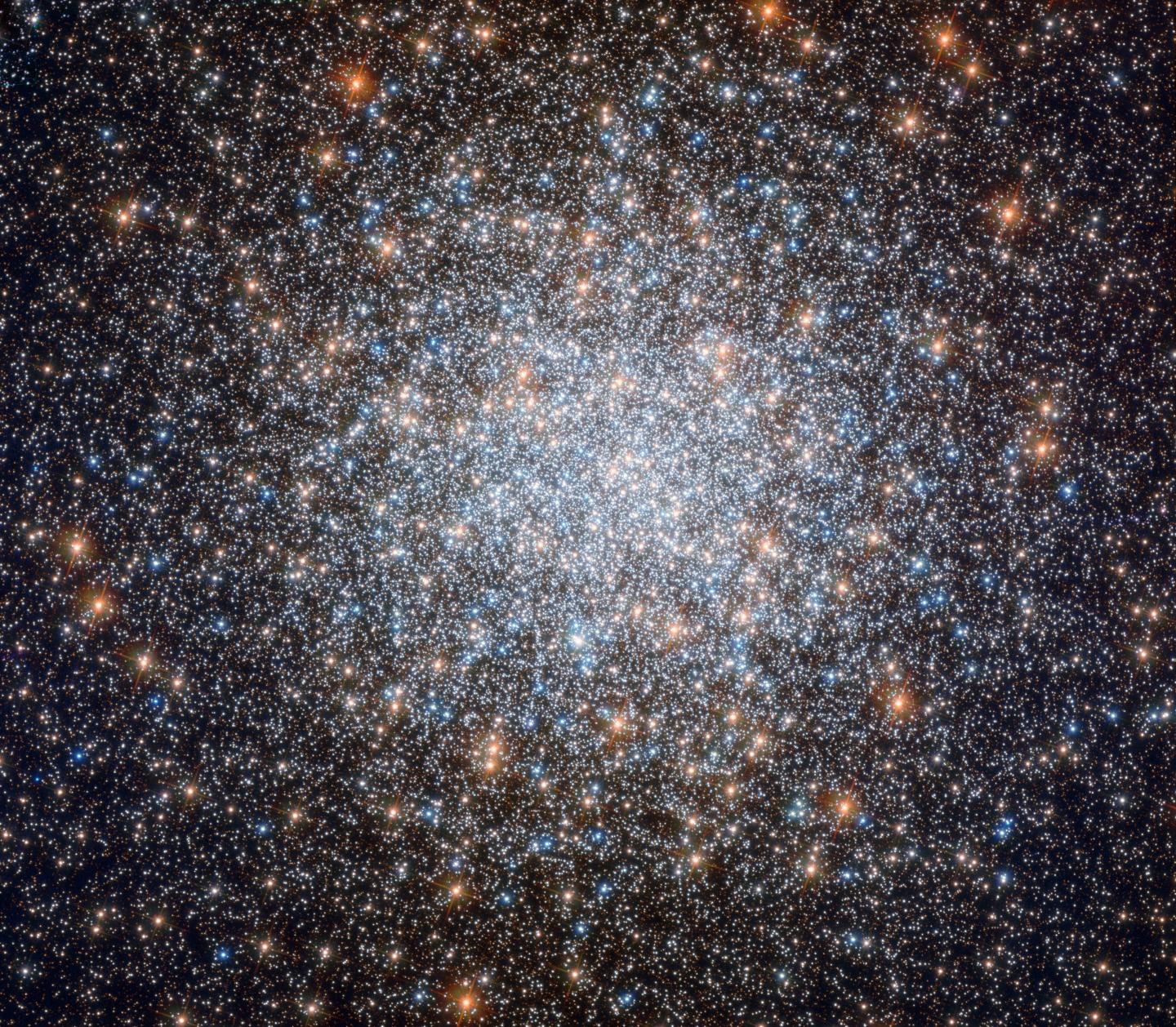
Credit: ESA/Hubble & NASA, G. Piotto et al.

Globular clusters are inherently beautiful objects, but the subject of this NASA/ESA Hubble Space Telescope image, Messier 3, is commonly acknowledged to be one of the most beautiful of them all.

Containing an incredible half-million stars, this 8-billion-year-old cosmic bauble is one of the largest and brightest globular clusters ever discovered. However, what makes Messier 3 extra special is its unusually large population of variable stars — stars that fluctuate in brightness over time. New variable stars continue to be discovered in this sparkling stellar nest to this day, but so far we know of 274, the highest number found in any globular cluster by far. At least 170 of these are of a special variety called RR Lyrae variables, which pulse with a period directly related to their intrinsic brightness. If astronomers know how bright a star truly is based on its mass and classification, and they know how bright it appears to be from our viewpoint here on Earth, they can thus work out its distance from us. For this reason, RR Lyrae stars are known as standard candles — objects of known luminosity whose distance and position can be used to help us understand more about vast celestial distances and the scale of the cosmos.

Messier 3 also contains a relatively high number of so-called blue stragglers, which are shown quite clearly in this Hubble image. These are blue main sequence stars that appear to be young because they are bluer and more luminous than other stars in the cluster. As all stars in globular clusters are believed to have formed together and thus to be roughly the same age, only a difference in mass can give these stars a different color. A red, old star can appear bluer when it acquires more mass, for instance by stripping it from a nearby star. The extra mass changes it into a bluer star, which makes us think it is younger than it really is.

###

Messier 3 is featured in Hubble’s Messier catalog, which includes some of the most fascinating objects that can be observed from Earth’s Northern Hemisphere. See the NASA-processed image and other Messier objects at: https://www.nasa.gov/content/goddard/hubble-s-messier-catalog.

Media Contact
Claire Andreoli
[email protected]

Original Source

https://www.nasa.gov/image-feature/goddard/2019/hubble-peers-at-cosmic-blue-bauble

Tags: AstronomyAstrophysicsSatellite Missions/ShuttlesSpace/Planetary ScienceStars/The Sun
Share13Tweet8Share2ShareShareShare2

Related Posts

Miniature Sensor Uses Light to Detect Touch — Chemistry

Miniature Sensor Uses Light to Detect Touch

May 8, 2026
Iron Minerals Determine Whether Dissolved Organic Matter Fuels Microbes or Becomes Long-Term Carbon Storage — Chemistry

Iron Minerals Determine Whether Dissolved Organic Matter Fuels Microbes or Becomes Long-Term Carbon Storage

May 8, 2026

Kate Evans Appointed Associate Lab Director for Biological and Environmental Systems Science at ORNL

May 8, 2026

Advancing Multiscale Modeling and Overcoming Operational Challenges in Autothermal CO₂-to-Methanol Reactors

May 8, 2026
Please login to join discussion

POPULAR NEWS

  • Research Indicates Potential Connection Between Prenatal Medication Exposure and Elevated Autism Risk

    840 shares
    Share 336 Tweet 210
  • New Study Reveals Plants Can Detect the Sound of Rain

    727 shares
    Share 290 Tweet 181
  • Scientists Investigate Possible Connection Between COVID-19 and Increased Lung Cancer Risk

    68 shares
    Share 27 Tweet 17
  • Salmonella Haem Blocks Macrophages, Boosts Infection

    61 shares
    Share 24 Tweet 15

About

We bring you the latest biotechnology news from best research centers and universities around the world. Check our website.

Follow us

Recent News

Evaluating Digoxin Use in Patients with Symptomatic Rheumatic Heart Disease

Evaluating the Effectiveness and Safety of Digitalis Glycosides in Treating Heart Failure

Urdu Fall Risk Questionnaire Adapted for Elderly

Subscribe to Blog via Email

Enter your email address to subscribe to this blog and receive notifications of new posts by email.

Join 82 other subscribers
  • Contact Us

Bioengineer.org © Copyright 2023 All Rights Reserved.

Welcome Back!

Login to your account below

Forgotten Password?

Retrieve your password

Please enter your username or email address to reset your password.

Log In
No Result
View All Result
  • Homepages
    • Home Page 1
    • Home Page 2
  • News
  • National
  • Business
  • Health
  • Lifestyle
  • Science

Bioengineer.org © Copyright 2023 All Rights Reserved.