A research team from Huaqiao University, the National University of Singapore, and collaborating institutions has developed a durable catalyst for hydrogenating carbon dioxide into methanol by embedding platinum nanoparticles directly within an indium oxide matrix. Under industrially relevant testing conditions, the synthesized catalyst achieved a carbon dioxide conversion of 10.6 percent and a methanol production rate of 0.22 grams of methanol per gram of catalyst per hour, maintaining stable operation for more than 180 hours without deactivating.
The rising concentration of atmospheric carbon dioxide, driven primarily by fossil fuel combustion, represents a significant environmental challenge. Converting carbon dioxide into methanol via catalytic hydrogenation provides a viable pathway to mitigate emissions because methanol functions as an energy carrier, a clean liquid fuel, and a fundamental chemical intermediate. However, carbon dioxide is a chemically inert and thermodynamically stable molecule, and the hydrogenation process faces severe competition from the reverse water-gas shift reaction, which generates carbon monoxide as an undesired byproduct.
While platinum supported on indium oxide has previously demonstrated capability for carbon dioxide hydrogenation, the material exhibits critical vulnerabilities during preparation and operational use. At the elevated temperatures required for catalyst activation and catalytic reaction, both the indium oxide support and the deposited platinum nanoparticles undergo severe thermal sintering. This sintering causes nanoparticle agglomeration and particle growth, which diminishes active catalytic surface area and inadvertently accelerates the competing reverse water-gas shift reaction.
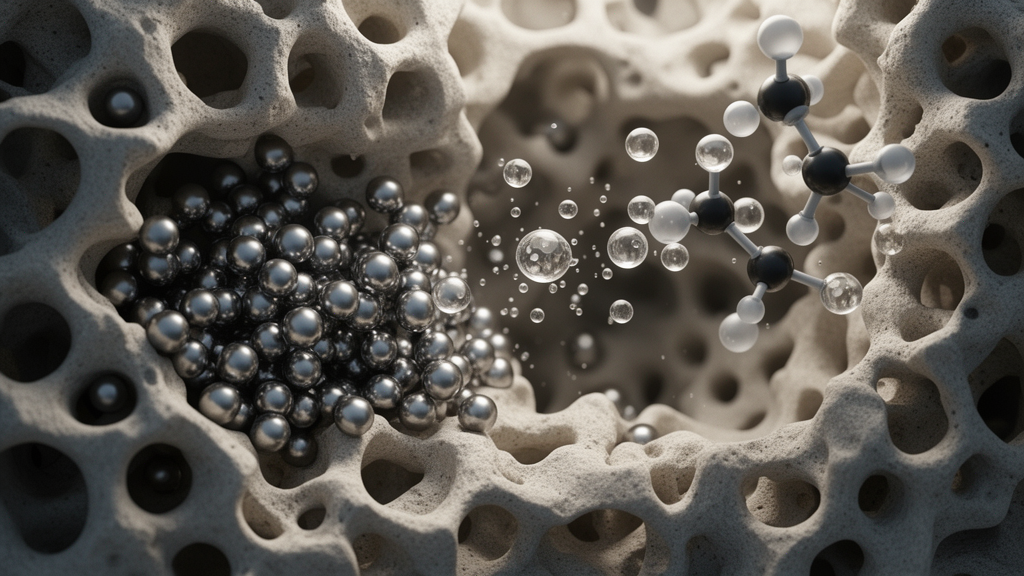
To overcome particle agglomeration, the researchers designed an in situ growth and confinement approach utilizing metal-organic framework precursors. The team selected MIL-68(In) nanorods as the starting template and grew platinum nanoparticles on the metal-organic framework prior to thermal treatment. During subsequent calcination, the metal-organic framework decomposed to yield indium oxide, effectively trapping and embedding the growing platinum nanoparticles within the forming oxide matrix.
Structural and spectroscopic analyses confirmed that the resulting catalyst contains ultrasmall indium oxide crystallites measuring 11.8 nanometers and possesses a specific surface area of 48.3 square meters per gram. Detailed spectroscopic investigations also revealed pronounced electronic interactions across the platinum-oxygen-indium interface. These interactions produced a 41 percent surface oxygen vacancy density across the material while substantially restricting the presence of fully exposed metallic platinum sites.
The catalytic performance was evaluated under conditions of 3 megapascals of pressure, a temperature of 300 degrees Celsius, and a gas hourly space velocity of 12,000 milliliters per gram of catalyst per hour. Beyond achieving high conversion and production metrics, the embedded platinum structure substantially lowered the apparent activation energy for methanol formation to 62.2 kilojoules per mole, compared to 122.8 kilojoules per mole observed on pure indium oxide.
Extended catalytic testing confirmed that the composite material operated continuously for over 180 hours without notable activity loss, outperforming conventional platinum on indium oxide systems prepared by traditional post-impregnation techniques. The investigators conclude that this metal-organic framework-mediated embedding methodology represents a versatile strategy for engineering stable, sintering-resistant metal-oxide catalysts for sustainable chemical production.
Subject of Research: Catalytic conversion of carbon dioxide to methanol using embedded platinum nanoparticles in indium oxide
Article Title: Embedded platinum nanoparticles prevent sintering and boost CO₂-to-methanol conversion
Article References: Embedded platinum nanoparticles prevent sintering and boost CO₂-to-methanol conversion. Original publication (Bibliographic details unavailable.)
Image Credits: AI Generated
DOI: Not provided
Keywords: Carbon dioxide conversion, Methanol synthesis, Platinum nanoparticles, Indium oxide, Heterogeneous catalysis, Metal-organic frameworks, MIL-68(In), In situ embedding, Catalyst sintering, Reverse water-gas shift reaction, Oxygen vacancies, Chemical engineering, Nanocrystallites, Huaqiao University, National University of Singapore, Electronic interactions, Activation energy
News Source: Bethany Barker. (November 13, 2026). Embedded Platinum Nanoparticles Boost Carbon Dioxide Conversion into Methanol. Scienmag.