A comprehensive cradle-to-gate life cycle assessment and techno-economic evaluation has revealed that single-cell protein synthesized by methane-oxidizing bacteria reduces overall ecosystem damage by 88 percent compared to agricultural soybean meal and lowers human health burdens by 41 percent relative to marine fish meal. Investigating scalable substitutes for environmentally taxing protein commodities, researchers modeled mass and energy balances across three distinct production routes designed to yield a functional unit of 1000 kilograms of crude protein. The evaluated systems comprised conventional crop-based soybean meal, wild-caught marine fish meal, and bacterial biomass cultivated on purified biomethane. Across broad endpoint indicators, the bacterial production pathway delivered the lowest cumulative environmental footprint, recording a normalized damage score of 0.348, which stood significantly below conventional livestock and aquaculture feed benchmarks while achieving robust economic returns.
The study addressed escalating global protein demands driven by population growth, economic expansion, and expanding livestock and aquaculture sectors that rely heavily on concentrated feedstuffs. Conventional feed supply chains impose severe ecological tolls that threaten terrestrial and marine stability. Agricultural soybean meal production drives extensive land-use conversion, tropical deforestation, biodiversity decline, and greenhouse gas releases across primary exporting regions such as Brazil and Argentina. Concurrently, industrial fish meal extraction accelerates marine resource depletion through overfishing and ecosystem disturbance. To assess whether gas-fermenting microorganisms can decouple dietary protein generation from arable land and ocean harvesting, the investigative team deployed the ReCiPe 2016 Hierarchical impact framework in accordance with ISO 14040 and ISO 14044 standards, quantifying environmental impacts across eighteen midpoint categories alongside three aggregate endpoint damage domains encompassing human health, ecosystems, and natural resource scarcity.
System boundaries for all three pathways followed a cradle-to-gate inventory structure drawing on published literature, industrial operational disclosures, experimental yields, and global Ecoinvent datasets. For System 1, producing 1000 kilograms of crude protein required cultivating approximately 2552 kilograms of soybean meal containing an average crude protein content of 45 percent, after incorporating typical extraction and refinement losses of 8 percent. The cultivation inventory accounted for mechanical soil preparation, chemical seed fungicide treatments, synthetic fertilizer and pesticide applications, supplemental irrigation beyond natural rainfall, and diesel transport to processing plants where seeds underwent crushing and natural gas heating. For System 2, producing the functional unit required capturing and refining 1667 kilograms of fish meal possessing a 60 percent protein concentration, taking into account processing mass losses of roughly 67 percent during multi-stage vessel chilling, cooking at 85 degrees Celsius, mechanical pressing, phase separation, stickwater treatment, and high-temperature rotary drying.
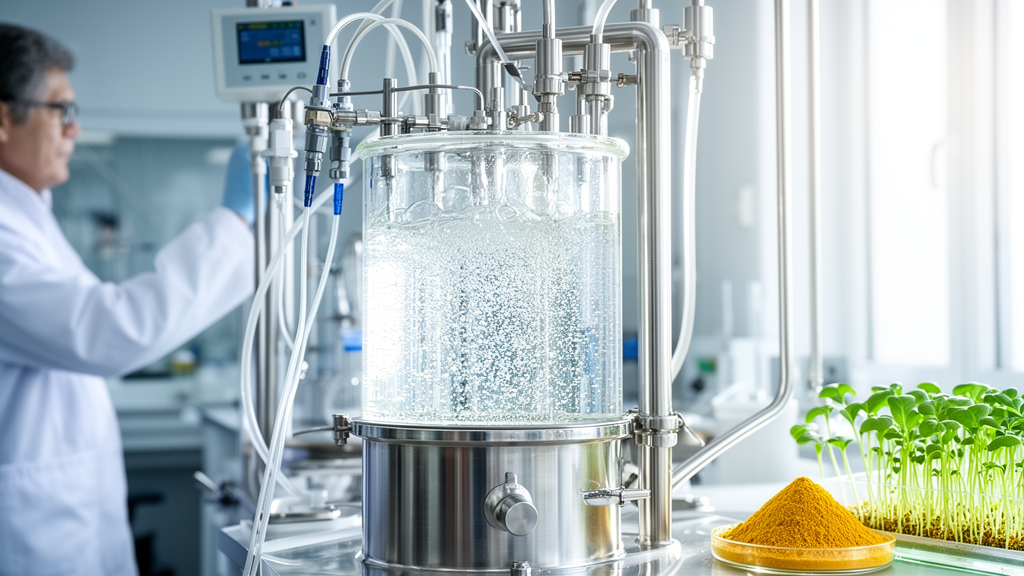
For System 3, microbial biomass synthesis centered on cultivating methane-oxidizing bacteria within controlled bioreactor vessels where methane served as the sole carbon and energy substrate. Inside the bacterial cells, dissolved methane undergoes initial oxidation to methanol and formaldehyde before assimilating through ribulose monophosphate or serine biochemical pathways into functional cellular components. Experimental laboratory cultures operated under aerobic parameters at 28 degrees Celsius, utilizing a methane-to-oxygen volumetric gas ratio of 2 to 3 and a neutral pH of 7.0. The lab reactors documented a steady methane uptake rate of 9.32 liters per liter per day, generating a cell dry weight concentration of 0.834 grams per liter with a crude protein content of 59 percent. To satisfy the functional unit of 1000 kilograms of crude protein, the system required synthesizing approximately 1693 kilograms of dry bacterial biomass, requiring downstream cell pasteurization, centrifugation, and spray drying modeled through proportional linear engineering scale-up.
Comparative midpoint analysis demonstrated that methane-oxidizing bacteria drastically reduce direct spatial footprints while altering pollution profiles. Soybean meal accounted for 98.47 percent of cumulative land use across the three systems, requiring 9927.45 square meter equivalents per functional unit, and generated 66.45 percent of stratospheric ozone depletion potential through intensive field management and agrochemical inputs. In contrast, the bacterial protein process accounted for only 0.65 percent of total land use impact, while also recording the lowest relative contributions to human carcinogenic toxicity at 20.26 percent, mineral resource scarcity at 14.08 percent, and terrestrial ozone formation at 25.75 percent. Marine fish meal dominated marine ecotoxicity potential, generating 255.9 kilograms of 1,4-dichlorobenzene equivalents, or 41.41 percent of the total, driven by open-ocean trawler diesel combustion and associated particulate matter, ionizing radiation, and marine disturbance.
Despite distinct land and biodiversity advantages, bacterial protein synthesis proved highly energy-intensive, generating notable trade-offs in resource consumption and electrical grid dependency. Microbial protein exhibited the highest fossil resource scarcity and freshwater ecotoxicity values among the evaluated systems, which were slightly higher than competing options due to upstream substrate synthesis and steady reactor agitation. In endpoint evaluations, microbial protein accounted for 38 percent of total resource depletion, compared to relative resource contributions of 94.3 percent for soybean meal and 66.1 percent for fish meal when referenced against the bacterial system. Process stage contribution breakdowns pinpointed the microbial fermentation phase as the overwhelming environmental hotspot, contributing more than 50 percent of impacts across fifteen midpoint categories, including 88.38 percent of mineral resource scarcity, 83.33 percent of human carcinogenic toxicity, 82.39 percent of global warming, and 81.28 percent of land use impacts.
The ecological burden of the microbial system was heavily influenced by methane generation and feedstock purification routes. Operating the synthesis loop required 3602 cubic meters of methane alongside continuous chemical nutrient dosing, including ammonium chloride, magnesium sulfate, calcium chloride, and sodium phosphate. To resolve how gas-processing infrastructure governs environmental performance, the investigators conducted a comparative sensitivity analysis evaluating three biogas purification technologies: Ammonia Washing, Membrane Technique, and Pressure Swing Adsorption. Biomethane derived from anaerobic digestion of organic wastes represented the baseline sustainable feedstock. When assessed across midpoint and endpoint criteria, Pressure Swing Adsorption proved the most efficient and robust purification method, exhibiting the lowest energy requirements, minimizing chemical solvent contamination risks, and achieving methane purity exceeding 96 percent via selective molecular sieve beds under alternating pressure cycles.
The sensitivity analysis indicated that Pressure Swing Adsorption achieved minimal endpoint damage values of 0.008 disability-adjusted life years for human health, 1.69 times ten to the fifth species-years for ecosystem quality, and 87.388 United States dollars for resource depletion. In sharp contrast, Membrane Technique produced the highest environmental footprint across all categories, exhibiting an environmental resource depletion burden over 140 percent higher than Pressure Swing Adsorption and a 13.7 percent higher global warming potential. Furthermore, when subjecting operational parameters to a 10 percent perturbation in input volumes, Pressure Swing Adsorption exhibited the lowest sensitivity coefficients, retaining steady performance in marine eutrophication and water consumption, whereas Membrane Technique displayed sensitivity coefficients 2.3 times higher in resource depletion, showing that operational fluctuations in membrane separation severely amplify system-wide life cycle burdens.
The study also analyzed the direct environmental leverage of clean electricity, given the substantial electrical loads required to power bioreactor mechanical stirring, constant aeration, temperature regulation, cell separation, and thermal drying. When comparing background electricity sources for the microbial system, drawing power from coal-fired generation produced approximately six times the human health impact and twice the ecosystem damage of renewable power derived from wind and hydrogen energy systems. Normalized results indicated that coal-fired electricity contributed 75 percent of human health damage, 56 percent of ecosystem degradation, and 42 percent of resource depletion within the energetic subsystems. Transitioning microbial protein bioreactors to dedicated renewable electricity grids consequently eliminates the primary driver of operational emissions, substantially widening the ecological advantage of bacterial protein over crop cultivation and marine harvesting.
Alongside environmental metrics, the authors conducted a rigorous cost-benefit economic analysis modeled over a ten-year facility operating lifetime in an industrially developed region of China, using 2023 pricing baselines and an 8 percent discount rate. The microbial facility was parameterized at an annual capacity of 800 metric tons of crude protein utilizing two industrial production trains. Capital equipment expenditure was scaled from baseline data using the six-tenths engineering rule, covering activated seed tanks, industrial fermenters, steam sterilization equipment, filter presses, and freeze-drying units totaling approximately 70,000 dollars in core machinery alongside an upfront baseline of 107.36 dollars per 1000 kilograms of capacity. Operating expenses integrated labor for ten plant operators, facility maintenance, process water, electricity, wastewater treatment at 0.47 dollars per ton, and shadow-priced pollutant discharge mitigation.
Financial accounting demonstrated that all three protein production models attained positive net present values, validating their baseline commercial viability. However, microbial protein production achieved the highest financial return, delivering a net present value of 3.40 million dollars and an estimated return on investment of 51 percent, compared to 47 percent for the soybean meal facility. Assuming equivalent nutritional parity with high-grade marine ingredients, microbial protein was priced at 1740 dollars per ton, identical to market fish meal. At this price point, the unit production cost of bacterial protein was 111.3 dollars per ton lower than the production cost of fish meal. Feedstock and utility consumption constituted the dominant operational expense for the microbial facility, representing 78 percent of running costs due to methane and electricity inputs, whereas labor represented 38 percent of expenses in soybean farming.
While confirming the technical feasibility of methane-based protein, the authors highlighted clear analytical boundaries and engineering challenges. Because full-scale commercial installations for gas-fermenting bacteria remain limited, the life cycle inventories relied on linear scaling from 150-milliliter bench reactors and literature proxies, introducing empirical uncertainties regarding large-scale gas-liquid mass transfer rates, exothermic heat integration, and parasitic electricity loads. Furthermore, revenue models assumed static commodity prices and full market price equivalence with marine fish meal without accounting for consumer acceptance, safety certifications, or valorized secondary by-products, which bolster fish meal economics through fish oil sales. The researchers concluded that transitioning methane-oxidizing bacteria to industrial reality requires supportive regulatory frameworks, targeted process engineering to enhance fermentation gas-transfer efficiency, and direct integration with low-carbon biomethane and renewable energy supplies.
Subject of Research: Comparative life cycle and techno-economic assessment of microbial protein from methane-oxidizing bacteria versus soybean and fish meal
Article Title: Sustainable protein production from methane-oxidizing bacteria: environmental and economic comparison with conventional protein sources
Article References: Ma, C., Jiang, T., Sun, Q., Xiao, X., Shi, L., Ai, X., Liu, Y., & Yang, Z. (2026). Sustainable protein production from methane-oxidizing bacteria: environmental and economic comparison with conventional protein sources. Carbon Research, 5(1), Article 19. https://doi.org/10.1007/s44246-025-00256-y
Image Credits: AI Generated
DOI: 10.1007/s44246-025-00256-y
Keywords: methane-oxidizing bacteria, microbial protein, life cycle assessment, techno-economic evaluation, soybean meal, fish meal, pressure swing adsorption, ecosystem damage, human health impact, resource depletion, net present value, return on investment, anaerobic digestion, biomethane purification, fermentation emissions, alternative proteins, feed sustainability, cradle-to-gate
News Source: Gavin Prescott. (November 13, 2026). Methane-Fed Bacterial Protein Cuts Ecosystem Harm Eighty-Eight Percent Compared to Soy. Scienmag.