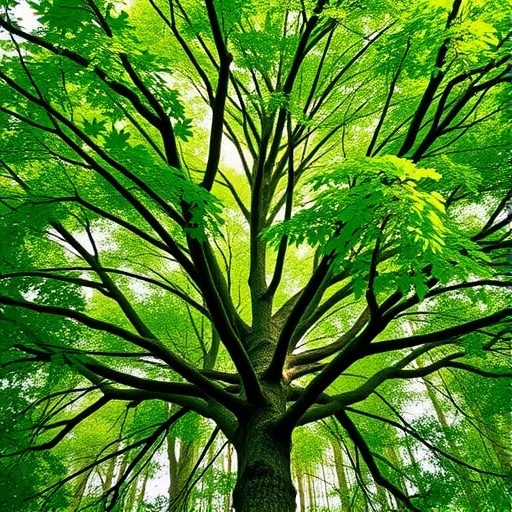
In the intricate dance of forest life, trees stand as silent competitors vying for one of the most critical resources: light. While it is well acknowledged that trees engage in fierce competition for sunlight, the specific role that their physical crown structures play in mediating these interactions has remained elusive. For decades, ecological research has primarily focused on simple metrics such as tree height to approximate competitive ability, often overlooking the complex, multidimensional architecture of tree crowns. This simplification has limited our understanding of how variations in crown shape affect forest dynamics and species coexistence.
A groundbreaking study led by Dr. Yunquan Wang and colleagues at Zhejiang Normal University, in collaboration with the Zhuji Natural Resources and Planning Bureau, Zhejiang University, and Jiulongshan National Nature Reserve, ventures into this uncharted territory. Published in the prestigious journal Plant Diversity, this research rigorously analyzed 3,589 individual trees spanning 31 species within a subtropical forest plot. The work aims to integrate multidimensional measures of crown architecture with shade tolerance, moving beyond traditional height-based assessments, thereby providing a mechanistic framework to enhance forest dynamic models.
The researchers meticulously measured not only total tree height but also crown base height—the vertical position where the live crown begins—and crown width across individual trees. From these raw measurements, they derived six detailed crown architecture traits to capture the geometric complexity of tree crowns. Tracking the growth of these trees over a five-year longitudinal study allowed the team to evaluate how differences in these crown traits between neighboring trees influenced their annual growth rates, with a special emphasis on the differing ecological strategies of light-demanding versus shade-tolerant species.
Light-demanding species typically invest in rapid vertical growth, exhibiting pronounced apical dominance where the main stem directs energy upwards to outcompete neighbors for sunlight. Dr. Qi Wu, the study’s lead author, explains that for these species, having neighbors with very different crown architectures tended to diminish their growth. This phenomenon aligns with the concept of environmental filtering, where coexisting trees with similar crown shapes and competitive strategies are favored because they segregate light resources in comparable ways. The interference caused by crown dissimilarity reflects a competitive disadvantage in the race for light among fast-growing species.
In contrast, the researchers found an intriguing nuance in the relationship between horizontal crown projection area and growth rates among light-demanding trees. When neighboring trees exhibited large differences in their crown projection areas, effectively minimizing crown overlap at the canopy level, the growth rates of these trees improved. This suggests that spatial complementarity in horizontal crown expansion allows efficient partitioning of light resources, enabling trees to optimize photosynthetic intake without direct shading competition. This finding emphasizes the importance of three-dimensional crown geometry in understanding light competition dynamics.
Shade-tolerant species followed a markedly different ecological script. These species displayed greater flexibility in crown morphology, which likely enhances their survival under low-light conditions typical of understory environments. Remarkably, the study noted that differences in crown architecture among neighboring shade-tolerant trees did not significantly impact their growth rates. Instead, their growth was chiefly constrained by the density of conspecific neighbors—trees of the same species—surrounding them. This density-dependent growth limitation highlights the role of biotic factors beyond light competition in shaping shade-tolerant species demographics.
This density effect observed in shade-tolerant species elegantly supports the Janzen-Connell hypothesis, a foundational theory in tropical ecology. The hypothesis posits that host-specific natural enemies, such as pathogens and herbivorous insects, accumulate preferentially around adults of a species, creating a hostile local environment for their offspring and inhibiting their establishment nearby. Therefore, for shade-tolerant trees, biotic pressures from natural enemies rather than light competition predominantly influence their growth and survival patterns.
The study underscores how shade tolerance emerges as a pivotal trait structuring neighborhood interactions and the mediating role of crown traits in these processes. Ignoring the shade tolerance axis would mask important, species-specific variations in individual-level growth responses, thereby limiting the predictive accuracy of forest coexistence models. By incorporating crown architecture and shade tolerance, the research offers a refined lens to examine the ecological mechanisms driving species assembly and forest dynamics.
Importantly, this work pushes the frontier of forest ecology by illuminating the nuanced trade-offs and complex interactions emanating from physical crown traits—elements often overlooked in classic models. Trees are not merely height competitors but orchestrate their crown shapes in three-dimensional space, influencing both competitive and facilitative interactions within diverse forest communities. This nuanced understanding is particularly crucial in subtropical forests, where biodiversity and structural complexity are high.
Looking ahead, the authors advocate for further research that couples crown traits with organ-level physiological traits such as leaf economic spectrum parameters and hydraulic properties. Such integrative trait-based approaches, especially when tested across varied climatic gradients, hold the promise of uncovering generalized patterns shaping forest ecosystems globally. Given the accelerating impacts of climate change on forest composition and function, these insights are timely and essential for crafting more robust predictive models.
This pioneering study not only changes textbook assumptions about forest competition but also offers a scalable framework that can be fundamental for forest management and conservation strategies worldwide. Understanding the interplay of crown architecture and shade tolerance in mediating tree growth and neighborhood interactions allows scientists and forest managers to better anticipate species trajectories under environmental change, optimize reforestation efforts, and preserve biodiversity.
Ultimately, the intricate crown shapes of trees are more than aesthetic variations —they are key functional traits that structure life in the forest canopy and understory. As this study reveals, configurations of tree crowns dictate competitive outcomes in subtle, shade tolerance-dependent ways, shaping the composition, resilience, and future of forested ecosystems in an ever-changing world.
Subject of Research: Not applicable
Article Title: Crown architecture traits mediate shade tolerance-dependent trade-offs and neighborhood interactions in a subtropical forest
Web References: http://dx.doi.org/10.1016/j.pld.2026.02.004
Image Credits: WU and WANG, 2026, Plant Diversity
Keywords: Biodiversity, Ecology, Plant sciences, Forestry
Tags: crown base height measurementecological significance of crown shapeforest dynamic modeling improvementsforest species coexistence mechanismsJiulongshan National Nature Reserve biodiversitylight competition among treesmultidimensional crown structure analysisPlant Diversity journal studiesshade tolerance and tree competitionsubtropical forest tree diversitytree crown architecture in forest ecologyZhejiang Normal University forest research