

• HOME
  • NEWS
  • EXPLORE
    • CAREER
      • Companies
      • Jobs
    • EVENTS
    • iGEM
      • News
      • Team
    • PHOTOS
    • VIDEO
    • WIKI
  • BLOG
  • COMMUNITY
    • FACEBOOK
    • INSTAGRAM
    • TWITTER
Saturday, June 27, 2026
BIOENGINEER.ORG
No Result
View All Result
  • Login
  • HOME
  • NEWS
  • EXPLORE
    • CAREER
      • Companies
      • Jobs
        • Lecturer
        • PhD Studentship
        • Postdoc
        • Research Assistant
    • EVENTS
    • iGEM
      • News
      • Team
    • PHOTOS
    • VIDEO
    • WIKI
  • BLOG
  • COMMUNITY
    • FACEBOOK
    • INSTAGRAM
    • TWITTER
  • HOME
  • NEWS
  • EXPLORE
    • CAREER
      • Companies
      • Jobs
        • Lecturer
        • PhD Studentship
        • Postdoc
        • Research Assistant
    • EVENTS
    • iGEM
      • News
      • Team
    • PHOTOS
    • VIDEO
    • WIKI
  • BLOG
  • COMMUNITY
    • FACEBOOK
    • INSTAGRAM
    • TWITTER
No Result
View All Result
Bioengineer.org
No Result
View All Result
Home NEWS Science News

How reef-building corals got their bones

Bioengineer by Bioengineer
April 29, 2021
in Science News
Reading Time: 2 mins read
0
IMAGE
Share on FacebookShare on TwitterShare on LinkedinShare on RedditShare on Telegram

IMAGE

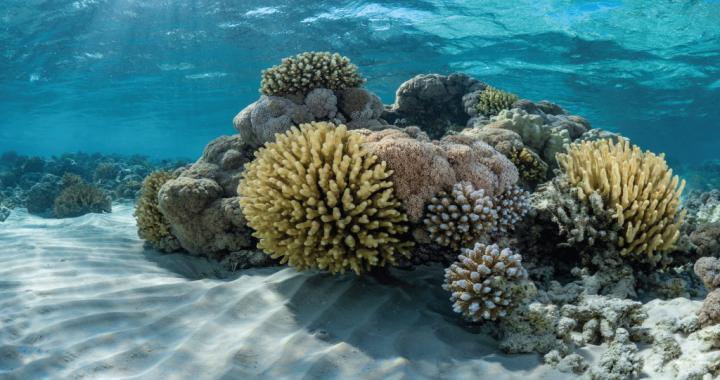
Credit: © 2021 Morgan Bennett Smith

Coral reefs provide shelter, sustenance and stability to a range of organisms, but these vital ecosystems would not exist if not for the skeletal structure created by stony corals. Now, KAUST scientists together with an international team have revealed the underlying genetic story of how corals evolved from soft-bodied organisms to build the myriad calcified structures we see today.

“While the processes involved in coral calcification are well understood, it is less clear how corals’ ability to grow calcium carbonate skeletons actually evolved,” says Xin Wang, a former KAUST Ph.D. student who worked on the project under the supervision of Manual Aranda.

“How did a squishy anemone-like organism begin to build reefs?” asks Aranda. “Did the ‘tools’ already exist in their genetic code?”

There is a debate surrounding when calcified corals first began to emerge; the earliest fossils found to date are around 265 million years old, but their evolution began far earlier.

“We conducted a genomic search for conserved genes that might be involved in calcification,” says Wang. “Our findings suggest that corals evolved to calcify somewhere between 308 and 265 million years ago.”

The team compared the genomes of six different related species — two evolutionary divergent reef-building corals, two of their closest noncalcifying relatives and two sea anemones. The complex analysis took two years using the KAUST supercomputer.

“We found that the necessary proteins to make coral skeletons were already present in the soft-bodied ancestor and that various existing proteins were recruited to boost the calcifying process. Essentially, we believe we’ve found the genetic toolkit for coral skeleton creation,” says Wang.

To calcify, corals must draw in positively charged calcium ions from seawater. To make this process as efficient as possible, the coral proteins that help the calcium precipitate should be negatively charged and the pH balance of the calcifying fluid must be just right.

The team pinpointed the genes responsible for transporting calcium and removing protons in the soft-bodied organisms, and they showed that two of the three gene copies found in corals have been recruited to the calcifying tissue. The researchers then identified a gene encoding an acid-rich protein that was duplicated in corals twice and then recruited to precipitate and stabilize calcium carbonate in the initial stage of skeleton building. They also highlighted transmembrane proteins involved in bone matrix adhesion.

“This is a great example of how latent traits can evolve to become dominant given certain environmental pressures,” says Aranda. “Next we hope to verify which of these components is critical to calcification and investigate how coral reefs might be influenced by the changing pH of future oceans.”

###

Media Contact
Michael Cusack
[email protected]

Original Source

https://discovery.kaust.edu.sa/en/article/1130/how-reef-building-corals-got-their-bones

Related Journal Article

http://dx.doi.org/10.1093/molbev/msab103

Tags: BiodiversityBiologyEcology/EnvironmentEvolutionFisheries/AquacultureGeneticsMarine/Freshwater BiologyZoology/Veterinary Science
Share12Tweet8Share2ShareShareShare2

Related Posts

Tracking Lanthanide-Labeled Microplastics in Plants

June 25, 2026

POSTECH Researchers Slash Cost of Reconstituted Cell-Free Systems by 95%

June 25, 2026

AI and Physics Collaborate to Design Advanced Hydrogen Storage Materials

June 25, 2026

Natural Hallucinogens: Evolution’s Ecological Tools, Not Mere Chemical Byproducts

June 25, 2026
Please login to join discussion

POPULAR NEWS

  • Saying Goodbye to PGY-6: Pediatric Fellowship Realities

    103 shares
    Share 41 Tweet 26
  • Multi-Hospital Study Reveals Long Covid Burden Is Twice as High as Current Estimates

    92 shares
    Share 36 Tweet 23
  • Detection of EDCs in Breast Milk and Infant Urine Up to Six Months Highlights Early Exposure Risks

    77 shares
    Share 31 Tweet 19
  • New Drug Candidate Developed at McMaster Shows Potential for Treating Brain Cancer

    58 shares
    Share 23 Tweet 15

About

We bring you the latest biotechnology news from best research centers and universities around the world. Check our website.

Follow us

Recent News

Tracking Lanthanide-Labeled Microplastics in Plants

POSTECH Researchers Slash Cost of Reconstituted Cell-Free Systems by 95%

AI and Physics Collaborate to Design Advanced Hydrogen Storage Materials

Subscribe to Blog via Email

Success! An email was just sent to confirm your subscription. Please find the email now and click 'Confirm' to start subscribing.

Join 82 other subscribers
  • Contact Us

Bioengineer.org © Copyright 2023 All Rights Reserved.

Welcome Back!

Login to your account below

Forgotten Password?

Retrieve your password

Please enter your username or email address to reset your password.

Log In
No Result
View All Result
  • Homepages
    • Home Page 1
    • Home Page 2
  • News
  • National
  • Business
  • Health
  • Lifestyle
  • Science

Bioengineer.org © Copyright 2023 All Rights Reserved.

