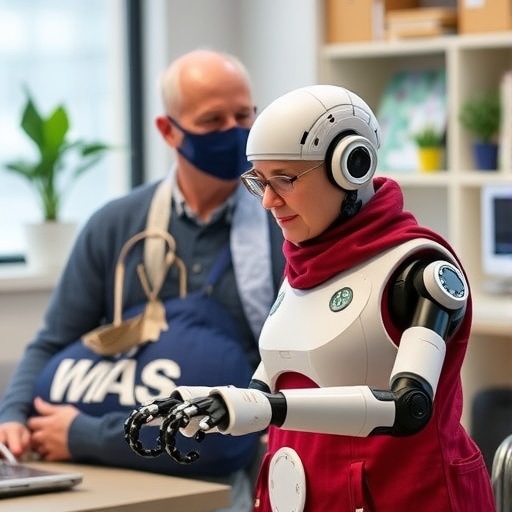
In the rapidly evolving landscape of eldercare, robots designed to assist the aging population are becoming increasingly prevalent. As technological advancements continue to blend artificial intelligence with robotics, the challenge lies not only in the technical capabilities of these machines but also in their social and psychological acceptance among older adults. A recent hermeneutic phenomenological study delves deep into how elderly individuals perceive and integrate care robots into their daily lives, focusing on the complex interplay between anthropomorphic perception, role identity, and functional needs.
The study, conducted by Zhou, Shu, Deng, and colleagues, investigates an often-overlooked aspect of robotic eldercare: the negotiation process that older adults undergo when interacting with robots that mimic human characteristics. Anthropomorphism, the tendency to attribute human traits to non-human entities, is a critical factor influencing whether older users find such robots approachable or unsettling. The research examines how these perceptions align or conflict with elderly individuals’ self-concept and expectations from caregiving relationships.
Central to the inquiry is the concept of role identity, which refers to the social roles and self-definitions individuals hold. For older adults, maintaining a sense of autonomy and dignity is paramount. The study reveals that when robots are perceived as overly human-like, they can inadvertently challenge these identities by blurring the lines between human care and mechanized assistance. Conversely, robots that are too mechanical might fail to engage users emotionally, leading to underutilization and rejection.
Functionality remains a core consideration, as the practical benefits of eldercare robots must meet the diverse and evolving needs of their users. The research underscores the importance of matching robotic capabilities with the specific requirements of elderly individuals, ranging from physical support to companionship. Importantly, the study highlights that functional adequacy alone does not guarantee acceptance; emotional and psychological factors play equally vital roles.
Technological design emerges as a pivotal element influencing these human-robot interactions. The researchers advocate for a nuanced approach where robotic features are tailored carefully to balance anthropomorphic cues without overstepping psychological comfort zones. This includes calibrations in appearance, voice modulation, and behavioral responsiveness to ensure robots feel supportive yet respectful of human boundaries.
Through qualitative interviews and immersive observational methods, the authors gather rich, experiential data demonstrating how older adults articulate their preferences and concerns regarding eldercare robots. Participants frequently expressed ambivalence, appreciating the robots’ assistance but remaining wary of potential depersonalization in caregiving. This tension reveals a critical challenge in robotics: fostering empathy and trust in machines programmed to emulate human caregivers.
Additionally, the study touches upon the ethical dimensions surrounding the deployment of care robots. Issues such as dependency, privacy, and consent come to the forefront, reminding stakeholders that technical innovation must be coupled with ethical responsibility. The researchers call for ongoing dialogue among developers, users, caregivers, and policymakers to navigate these complexities thoughtfully.
From a broader societal perspective, this investigation contributes to understanding how aging populations can be better supported through technology without diminishing human interaction’s irreplaceable value. It underscores the potential of care robots to enhance quality of life while cautioning against a one-size-fits-all approach. The findings emphasize the necessity of customizable solutions that honor individual identities and needs.
The implications extend to future design principles in assistive robotics. For instance, adaptive learning algorithms might enable robots to modify their behaviors based on continuous feedback from users, dynamically aligning with changing preferences and emotional states. Such responsiveness could revolutionize the caregiving landscape, making eldercare more personalized and humane.
Moreover, this research sheds light on the psychological mechanisms underlying trust formation between humans and machines. Understanding how older adults internalize robotic assistants’ presence informs not just eldercare robotics but also broader domains like social robotics and human-computer interaction. Perhaps most compellingly, it challenges designers to rethink what it means to create “social” robots in contexts where vulnerability and identity are deeply intertwined.
While technological hurdles remain—such as enhancing mobility, sensor accuracy, and natural language processing—the social acceptance of robots hinges on more subtle qualitative factors illuminated by this study. Consequently, interdisciplinary collaboration involving gerontology, psychology, engineering, and ethics will be essential to drive forward innovations that are both effective and embraced by end-users.
The study’s contribution is particularly timely given the demographic shifts toward aging societies globally. With healthcare systems under strain and caregiver shortages becoming more acute, eldercare robots offer a promising supplement—provided they are developed and implemented in ways that resonate meaningfully with older adults’ lived experiences.
In conclusion, the hermeneutic phenomenological analysis by Zhou and colleagues provides a critical lens through which to evaluate the multifaceted dimensions of eldercare robotics. By foregrounding the subjective narratives of older adults negotiating the roles and perceptions of their robotic companions, the research advocates for a human-centered design paradigm. This approach not only bridges technological innovation with empathetic caregiving but also charts a path forward for integrating robots into the social fabric of aging with dignity and respect.
Subject of Research: The study explores the interaction dynamics between older adults and eldercare robots, focusing on how anthropomorphic perceptions, role identity, and functional needs influence the acceptance and use of robotic caregivers.
Article Title: Seeking the right match: a hermeneutic phenomenological study of how older adults negotiate anthropomorphic perceptions, role identity and functional needs in elderly care robots.
Article References:
Zhou, Y., Shu, W., Deng, L. et al. Seeking the right match: a hermeneutic phenomenological study of how older adults negotiate anthropomorphic perceptions, role identity and functional needs in elderly care robots. BMC Geriatr (2026). https://doi.org/10.1186/s12877-026-07565-w
Image Credits: AI Generated
Tags: AI in aging population supportanthropomorphism in eldercare technologyautonomy and dignity in eldercareelder care robots acceptancefunctional needs of older adultshuman-robot interaction for seniorsnegotiation process in robotic caregivingolder adults and robotics interactionphenomenological study on eldercare robotspsychological impact of care robotsrole identity in elderly caresocial perceptions of care robots