• HOME
  • NEWS
  • EXPLORE
    • CAREER
      • Companies
      • Jobs
    • EVENTS
    • iGEM
      • News
      • Team
    • PHOTOS
    • VIDEO
    • WIKI
  • BLOG
  • COMMUNITY
    • FACEBOOK
    • INSTAGRAM
    • TWITTER
Monday, July 6, 2026
BIOENGINEER.ORG
No Result
View All Result
  • Login
  • HOME
  • NEWS
  • EXPLORE
    • CAREER
      • Companies
      • Jobs
        • Lecturer
        • PhD Studentship
        • Postdoc
        • Research Assistant
    • EVENTS
    • iGEM
      • News
      • Team
    • PHOTOS
    • VIDEO
    • WIKI
  • BLOG
  • COMMUNITY
    • FACEBOOK
    • INSTAGRAM
    • TWITTER
  • HOME
  • NEWS
  • EXPLORE
    • CAREER
      • Companies
      • Jobs
        • Lecturer
        • PhD Studentship
        • Postdoc
        • Research Assistant
    • EVENTS
    • iGEM
      • News
      • Team
    • PHOTOS
    • VIDEO
    • WIKI
  • BLOG
  • COMMUNITY
    • FACEBOOK
    • INSTAGRAM
    • TWITTER
No Result
View All Result
Bioengineer.org
No Result
View All Result
Home NEWS Science News Chemistry

How neuromuscular connections are maintained after nerve lesions

Bioengineer by Bioengineer
July 25, 2019
in Chemistry
Reading Time: 3 mins read
0
IMAGE
Share on FacebookShare on TwitterShare on LinkedinShare on RedditShare on Telegram

IMAGE

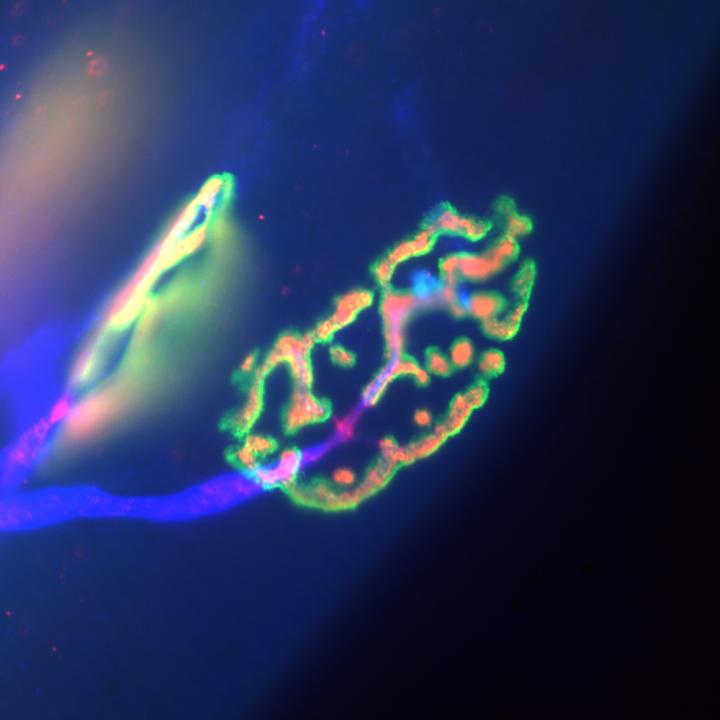
Credit: (Image: University of Basel, Biozentrum)

After nerve injury, the protein complex mTORC1 takes over an important function in skeletal muscle to maintain the neuromuscular junction, the synapse between the nerve and muscle fiber. Researchers at the University of Basel’s Biozentrum have now shown that the activation of mTORC1 must be tightly balanced for a proper response of the muscle to nerve injury. The study published in Nature Communications opens new insights into muscle weakness related to neuromuscular diseases or caused by ageing.

The protein complex mTORC1 promotes muscle growth and is important for the self-cleaning process of the muscle cells. The role of mTORC1 in skeletal muscle fibers in response to nerve injury has so far not been studied in detail. New insights have been provided by the research team led by Markus Rüegg at the Biozentrum of the University of Basel.

Function of mTORC1

Nerves and muscles in our body are connected by specialized synapses, called neuromuscular junctions, which transmit signals from the nerve to muscle fibers. If innervation is lost or interrupted by the injury of the nerve, muscles cannot contract anymore. However, to prepare the muscle for re-innervation by the nerve, the muscle component of the neuromuscular junction, the motor endplate, is maintained. Rüegg’s research team has now more closely studied the function of mTORC1 and its upstream kinase PKB/Akt in the maintenance of the motor endplate after nerve injury using different mouse models.

The best known function of the PKB/Akt – mTORC1 signaling pathway is to promote muscle growth and the cellular self-cleaning process. &laquoWe have now been able to show that PKB/Akt and mTORC1 also play an important role in the maintenance of the neuromuscular endplate», explains Perrine Castets, first author of the study.

PKB/Akt – mTORC1 tightly balanced

After nerve damage, both PKB/Akt and mTORC1 get activated in muscle fibers. Rüegg’s study demonstrates that mTORC1 should not be activated too strongly nor too little to ensure a proper response of the muscle. The underlying mechanism involves an mTORC1-dependent feedback onto the kinase PKB/Akt: &laquoShould mTORC1 be too strongly activated, PKB/Akt is inhibited, resulting in the loss of the neuromuscular endplate. Balanced activation of both PKB/Akt and mTORC1 is required for the proper response of the muscle fiber», says Castets.

The newly described function of PKB/Akt and mTORC1 opens new perspective on how age-related muscle atrophy develops in humans. This is, likewise, induced through an alteration of neuromuscular endplates and possibly by over-activation of mTORC1. &laquoThrough this study, we now better understand the molecular mechanisms contributing to the maintenance of the neuromuscular junctions. Based on our results, we may be able to develop new approaches to potentially counteract age-related deficits and structural changes in order to better preserve the performance and functional capabilities of the muscles during ageing», says Rüegg.

###

Media Contact
Reto Caluori
[email protected]

Original Source

https://www.unibas.ch/en/News-Events/News/Uni-Research/How-neuromuscular-connections-are-maintained-after-nerve-lesions.html

Related Journal Article

http://dx.doi.org/10.1038/s41467-019-11227-4

Tags: BiochemistryBiologyMedicine/HealthMolecular Biologyneurobiology
Share12Tweet8Share2ShareShareShare2

Related Posts

Salt adaptation linked to higher disease risk, Mizzou study finds

Salt adaptation linked to higher disease risk, Mizzou study finds

July 6, 2026
Intelligent Microgrid Management Promises Lower Household Energy Bills and Reduced Diesel Emissions — Chemistry

Intelligent Microgrid Management Promises Lower Household Energy Bills and Reduced Diesel Emissions

July 4, 2026

Graz University of Technology Deciphers the Structural Secrets of MOF Thin Films

July 2, 2026

Breaking Thermodynamic Limits: Wavelength-Driven Catalysis Advances Ammonia Synthesis

July 2, 2026
Please login to join discussion

POPULAR NEWS

  • Detection of EDCs in Breast Milk and Infant Urine Up to Six Months Highlights Early Exposure Risks

    77 shares
    Share 31 Tweet 19
  • New Drug Candidate Developed at McMaster Shows Potential for Treating Brain Cancer

    58 shares
    Share 23 Tweet 15
  • Saying Goodbye to PGY-6: Pediatric Fellowship Realities

    103 shares
    Share 41 Tweet 26
  • KTU Researchers Explore Ultrasound’s Role in Enhancing Blood Flow Beyond Diagnostics

    53 shares
    Share 21 Tweet 13

About

We bring you the latest biotechnology news from best research centers and universities around the world. Check our website.

Follow us

Recent News

Flame retardant BDE-209 targets molecularly linked to ulcerative colitis

Ultra-high frequency particle impacts mimic rockbursts to shatter hard rock

Kidney transplant outcomes in older adults studied by German researchers

Subscribe to Blog via Email

Enter your email address to subscribe to this blog and receive notifications of new posts by email.

Join 83 other subscribers
  • Contact Us

Bioengineer.org © Copyright 2023 All Rights Reserved.

Welcome Back!

Login to your account below

Forgotten Password?

Retrieve your password

Please enter your username or email address to reset your password.

Log In
No Result
View All Result
  • Homepages
    • Home Page 1
    • Home Page 2
  • News
  • National
  • Business
  • Health
  • Lifestyle
  • Science

Bioengineer.org © Copyright 2023 All Rights Reserved.