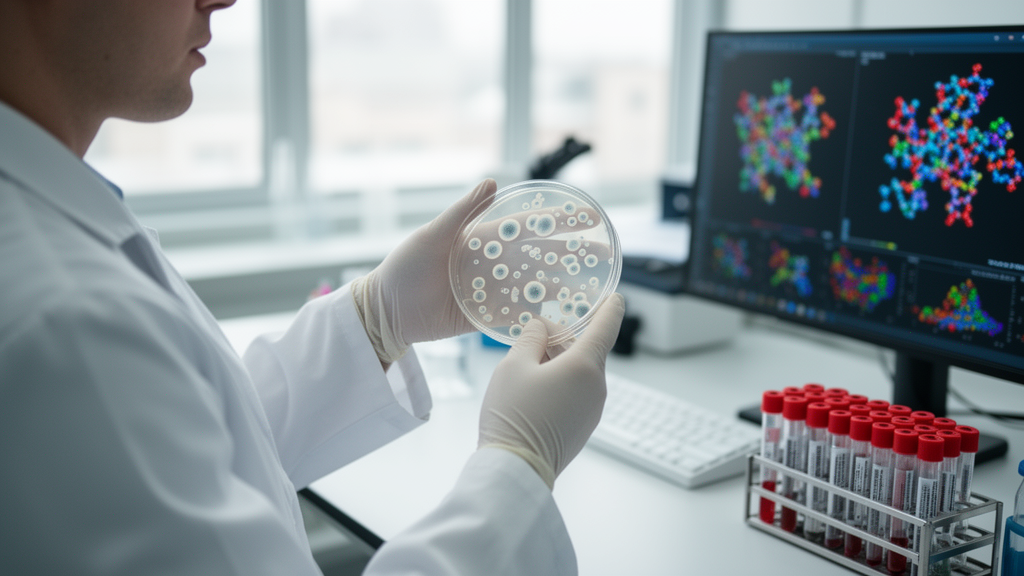
Antimicrobial resistance has quietly become one of the most consequential threats to modern medicine, eroding the clinical value of antibiotics that once seemed inexhaustible. As resistant pathogens spread across hospitals, farms, and communities, the pharmaceutical pipeline has struggled to keep pace, largely because the traditional method of discovering antibiotics—growing microorganisms in the laboratory and screening their chemical products—has hit a wall. Scientists now estimate that the vast majority of environmental microbes cannot be cultured with standard techniques, which means most of the biosynthetic diversity on Earth has remained invisible to drug hunters. A new review published in Frontiers in Chemical Biology argues that the way out of this impasse lies in combining two complementary omics technologies: metagenomics, which reads the collective genetic material of entire microbial communities, and metabolomics, which catalogs the small molecules those communities actually produce. By linking genomes to metabolites, researchers can finally connect the blueprint of a potential drug to the molecule itself and to the biological activity that makes it worth pursuing.
The core problem with culture-dependent discovery is straightforward: only a small fraction of microorganisms in soil, ocean sediment, or the human body will grow on an agar plate. Everything else—potentially rich sources of novel antimicrobial compounds—has been locked away. Metagenomics bypasses this bottleneck entirely by extracting and sequencing DNA directly from environmental samples, without any need to cultivate the organisms first. Within these sequencing data, computational tools can identify biosynthetic gene clusters, the coordinated sets of genes that encode the enzymes responsible for assembling complex natural products such as polyketides, ribosomal and non-ribosomal peptides, and other secondary metabolites. Many of these clusters are cryptic, meaning they are silent under laboratory conditions and never produce detectable compounds when the organism is grown in isolation. Metagenomics brings them into view, allowing researchers to catalog antimicrobial pathways from organisms they have never seen, including microbes adapted to extreme ecological niches where unique selective pressures have shaped unusual chemistry.
Extreme environments—deep-sea hydrothermal vents, hypersaline lakes, arid deserts, and permafrost—have emerged as particularly promising hunting grounds. The harsh conditions in these habitats drive intense chemical warfare among microorganisms, favoring the evolution of biosynthetic machinery that produces molecules with structures and modes of action absent from more temperate ecosystems. Metagenomic surveys of such sites have revealed biosynthetic gene clusters with little or no similarity to known pathways, suggesting the potential for genuinely new chemical scaffolds rather than modified versions of existing antibiotic classes. This matters enormously for the resistance crisis, because new scaffolds with novel mechanisms of action are far less likely to be defeated by resistance determinants that pathogens have already acquired.
Metabolomics addresses the other half of the discovery equation. While metagenomics reveals what organisms are genetically capable of producing, metabolomics profiles what is actually being made. Using mass spectrometry and nuclear magnetic resonance spectroscopy, researchers can detect, annotate, and quantify thousands of small molecules in a single sample, including those produced by medicinal plants and the microbiomes associated with their roots, leaves, and rhizospheres. Plant-associated environments are a second major focus of the review, since the chemical dialogue between plants and their microbial partners generates a remarkable diversity of bioactive metabolites, many with antimicrobial properties. Functional evaluation—testing these metabolites against resistant pathogens—then connects chemical profiles to biological activity, closing the loop between molecule and phenotype.
Applied independently, each technology has already expanded the repertoire of antimicrobial candidates. Metagenomic studies have uncovered novel enzyme families and gene clusters from uncultured organisms, while metabolomic profiling of plant extracts and microbial cultures has identified compounds active against drug-resistant bacteria and fungi. But the review’s central argument is that the true potential emerges only when the two approaches are integrated. A metagenomic dataset on its own can identify thousands of gene clusters, yet most will never be linked to a molecule or an activity. A metabolomic dataset on its own can catalog hundreds of compounds, yet assigning them to the genes that produce them is often impossible. Integration solves both problems simultaneously: genomic information predicts which biosynthetic pathways are present, metabolomic data confirm which molecules are actually produced, and bioactivity testing reveals which of those molecules matter against resistant pathogens. This resistance-aware, integrative framework bridges genomes, metabolites, and antimicrobial phenotypes in a single pipeline.
Representative case studies highlighted in the review illustrate the power of this approach. In one strategy, researchers sequence the metagenome of an extreme or plant-associated environment, use bioinformatic tools to prioritize biosynthetic gene clusters likely to encode novel compounds, and then either express those clusters in heterologous hosts or correlate their presence with metabolomic features detected in the same samples. Statistical methods such as molecular networking and correlation analysis can match mass spectrometric signals to predicted gene clusters, dramatically narrowing the search space. In other cases, activation of silent gene clusters—through changes in culture conditions, co-cultivation of competing microbes, or genetic manipulation—reveals metabolites that were previously hidden, which metabolomics then captures and characterizes. These workflows have already yielded candidate molecules with activity against clinically relevant resistant pathogens, demonstrating that the integrated approach is not merely theoretical.
Methodological innovation is advancing on several fronts simultaneously. Long-read sequencing technologies now allow near-complete assembly of biosynthetic gene clusters from metagenomic samples, resolving the fragmented contigs that once made pathway reconstruction difficult. Improved bioinformatic tools can predict the chemical structures encoded by gene clusters with increasing accuracy, guiding researchers toward the most promising targets before any laboratory work begins. On the metabolomics side, advances in mass spectrometry sensitivity, chromatographic separation, and computational annotation have made it possible to profile complex microbial communities and plant microbiomes with unprecedented depth. Molecular networking platforms organize mass spectra into families of related compounds, enabling researchers to recognize known molecules quickly and focus attention on the novel chemistry that surrounds them.
Computational tools and data-driven frameworks are increasingly the connective tissue of the entire pipeline. Machine learning models trained on known biosynthetic gene clusters can predict the products of uncharacterized ones, while integrative algorithms correlate genomic features with metabolomic profiles across many samples to identify gene-molecule-activity triads. Multi-omics integration—combining metagenomics, metatranscriptomics, metabolomics, and even proteomics—adds layers of functional context, showing not just which pathways exist but which are actively expressed under specific conditions. These data-driven approaches are shaping future discovery pipelines in which the decision to invest laboratory effort in a particular gene cluster or molecule is guided by quantitative evidence rather than chance, dramatically improving the efficiency of a process that has historically been slow and serendipitous.
Significant analytical challenges remain. The sheer volume of metagenomic data generated by modern sequencing platforms can overwhelm existing computational infrastructure, and the annotation of biosynthetic gene clusters is still imperfect, with many clusters resistant to functional prediction. Metabolomic profiles are similarly complex, and distinguishing genuinely novel compounds from known ones requires careful curation of reference databases. Linking a specific gene cluster to a specific metabolite remains one of the hardest problems in the field, particularly in communities containing hundreds of interacting species. Heterologous expression of gene clusters from uncultured organisms can fail for reasons of codon usage, missing regulatory elements, or the absence of necessary cofactors. The review emphasizes that overcoming these obstacles will require continued development of computational tools, standardized data formats, and collaborative frameworks that allow laboratories to share and compare results across environments and platforms.
The stakes of this work could hardly be higher. Antimicrobial resistance is escalating, and each year that passes without new classes of antibiotics narrows the options available to clinicians treating infections that were once routine. By opening up the biosynthetic potential of uncultured microorganisms in extreme environments and the chemical richness of medicinal plant-associated microbiomes, integrative metagenomic and metabolomic approaches access chemical space that traditional methods simply cannot reach. The review’s authors argue that these integrated omics strategies, combined with resistance-aware screening and multi-omics data frameworks, represent the most credible path toward identifying novel antimicrobial agents, new drug targets, and previously unknown mechanisms of action. As computational tools mature and sequencing and spectrometry costs continue to fall, the pipeline from environmental DNA to clinical candidate is becoming faster, more systematic, and more predictive—offering a genuine reason for optimism in the fight against one of medicine’s most stubborn adversaries.
Subject of Research: Integrative metagenomic and metabolomic approaches for antimicrobial discovery to combat antimicrobial resistance
Article Title: Linking genomes to metabolites in antimicrobial discovery: integrative metagenomic and metabolomic approaches to combat antimicrobial resistance
Article References: Kailoo, S., Bhardwaj, M., & Rasool, S. (2026). Linking genomes to metabolites in antimicrobial discovery: integrative metagenomic and metabolomic approaches to combat antimicrobial resistance. Frontiers in Chemical Biology, 5, Article 1840907. https://doi.org/10.3389/fchbi.2026.1840907
Image Credits: AI Generated
DOI: 10.3389/fchbi.2026.1840907
Keywords: antimicrobial resistance, metagenomics, metabolomics, biosynthetic gene clusters, natural products, drug discovery, multi-omics integration, medicinal plants, extreme environments, chemical biology, Linking, genomes
News Source: Alexandra Wallace. (October 17, 2026). How Metagenomics and Metabolomics Are Joining Forces to Find New Antibiotics. Scienmag.