
In a groundbreaking study unveiled in the journal Science, researchers from the University of Pittsburgh and the University of California San Diego reveal unprecedented insights into the dynamic behavior of lysosomes under cellular stress. Lysosomes, the critical cellular organelles responsible for the degradation and recycling of biomolecules, have been known to alter their morphology in response to various pathological stimuli, a phenomenon termed lysosomal vacuolation. This latest research elucidates the molecular mechanism behind lysosomal vacuolation, uncovering a sophisticated regulatory system that not only mediates but controls this process with remarkable precision.
Lysosomes are fundamentally indispensable to cellular homeostasis, functioning as the cell’s waste disposal system by digesting damaged proteins, organelles, pathogens, and other macromolecules. These organelles maintain cellular integrity and promote longevity by orchestrating the clearance of molecular debris. Yet, under conditions of cellular stress or disease, lysosomes can become abnormally enlarged, forming conspicuous vacuoles filled with solutes and water, akin to plant cell vacuoles. Despite widespread observation of these lysosomal vacuoles in diseases ranging from neurodegeneration to toxic exposures, the underlying mechanics and physiologic consequences of this process remained largely obscure—until now.
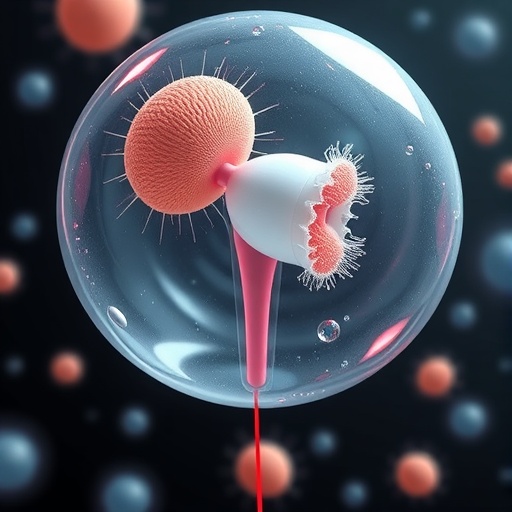
The research team, led by Dr. Jay Xiaojun Tan, Ph.D., has identified a pivotal protein they named LYVAC (lysosomal vacuolator), which orchestrates the lysosomal vacuolation response. Their findings indicate that in response to a broad spectrum of cellular insults, lysosomes accumulate an osmotic load, causing them to swell. Rather than a passive collapse or pathological failure, the lysosomal membrane expansion is actively managed by LYVAC. This protein localizes selectively to stressed lysosomes, delivering lipid molecules that serve as membrane building blocks, thereby enabling controlled membrane extension and vacuole formation.
.adsslot_uU5KJYcz9D{width:728px !important;height:90px !important;}
@media(max-width:1199px){ .adsslot_uU5KJYcz9D{width:468px !important;height:60px !important;}
}
@media(max-width:767px){ .adsslot_uU5KJYcz9D{width:320px !important;height:50px !important;}
}
ADVERTISEMENT
This newly characterized regulatory axis challenges previous assumptions that lysosomal enlargements were solely detrimental byproducts of cellular dysfunction. Instead, the LYVAC-mediated vacuolation represents an adaptive, highly regulated cellular response designed to maintain lysosomal integrity and avert rupture in the face of osmotic and metabolic stress. The dual-signal mechanisms that govern LYVAC’s recruitment ensure that membrane remodeling occurs selectively and precisely, safeguarding healthy lysosomes from inadvertent modification.
The mechanistic details uncovered in this study revolve around LYVAC’s ability to interpret distinct signals emanating from damaged lysosomal membranes. Binding is meticulously regulated, and upon localization, LYVAC facilitates lipid transfer from endoplasmic reticulum contacts or other intracellular reservoirs to the lysosomal membrane. This lipid delivery is hypothesized to provide the structural flexibility required for the bulbous expansion of lysosomes, preserving their functional capacity even when challenged by pathological stimuli.
Remarkably, lysosomal vacuolation has clinical correlates in a variety of human diseases. Conditions such as Parkinson’s disease, Alzheimer’s disease, certain lysosomal storage disorders, and even cataract formation display pathological lysosomal swelling. The elucidation of LYVAC’s role provides a concrete molecular target to investigate whether vacuolation contributes causally to disease progression or represents a protective cellular adaptation.
Importantly, the discovery that cells employ not just one, but multiple lipid-driven mechanisms to maintain lysosomal stability dovetails with previous work by Dr. Tan’s laboratory, which described the PITT (phosphoinositide-initiated membrane tethering and lipid transport) pathway. Together, these findings portray a sophisticated cellular lipid transport network fine-tuned to respond to diverse forms of lysosomal stress, balancing repair, expansion, and quality control.
The revelation of LYVAC’s function offers promising therapeutic avenues. Modulating LYVAC activity could allow researchers to selectively manipulate lysosomal vacuolation, potentially reducing harmful swelling in pathological contexts or enhancing lysosomal function in aging cells. Given the centrality of lysosomal integrity to cellular health and longevity, such strategies could translate into treatments for neurodegenerative diseases, toxin-induced cellular damage, and age-associated declines in cellular maintenance systems.
As the research progresses, one key objective is to decode the upstream signals that “switch on” LYVAC and to unravel the molecular cues by which cells pinpoint exactly which lysosomes require vacuolation. Understanding these signals will be crucial for harnessing this pathway therapeutically. The research team is actively exploring these signaling cascades, coupled with genetic models of neurodegeneration where extensive lysosomal vacuolation naturally occurs.
Dr. Tan emphasizes the importance of distinguishing between beneficial and deleterious roles of lysosomal vacuolation, a question that has long perplexed biologists. This study lays a vital foundation by furnishing a molecular handle on vacuolation, enabling precise experimental dissection of its physiological and pathological roles.
The field now stands on the cusp of a paradigm shift in lysosomal biology, opening new frontiers in the understanding of cellular resilience and failure under stress. Lyso-somal vacuolation, once a morphological curiosity, emerges as an orchestrated cellular strategy with wide-reaching implications for health, disease, and aging.
By shedding light on this elaborate membrane remodeling machinery, the researchers provide the scientific community with critical insights to decode lysosomal adaptations and their impacts on cellular fate. These breakthroughs are anticipated to galvanize efforts to develop novel interventions aimed at enhancing lysosomal robustness, thereby promoting healthy aging and combating lysosome-related diseases.
This collaborative endeavor, involving researchers Haoxiang Yang, Jinrui Xun, Awishi Mondal, Bo Lv, Simon Watkins, Yajuan Li, and Lingyan Shi, underscores the power of interdisciplinary approaches combining cell biology, molecular biochemistry, and disease modeling to unravel complex cellular processes.
Supported by robust funding from the NIH, the Aging Institute, and UPMC’s Competitive Medical Research Fund, the study heralds a new era in targeted lysosomal research—one that may well change how we understand and treat a spectrum of human illnesses.
Subject of Research: Cells
Article Title: LYVAC/PDZD8 Is a Lysosomal Vacuolator
News Publication Date: 21-Aug-2025
Web References: https://doi.org/10.1126/science.adz0972
Image Credits: Jay Xiaojun Tan Lab
Keywords: Cell biology
Tags: biomolecule recycling in lysosomescellular integrity and longevitycellular stress responseimpact of stress on lysosomesimplications of lysosomal dysfunctionlysosomal morphology changeslysosomal vacuolation mechanismlysosome function in homeostasismolecular debris clearance in cellsneurodegenerative disease and lysosomesrole of LYVAC proteinwaste disposal systems in cells