


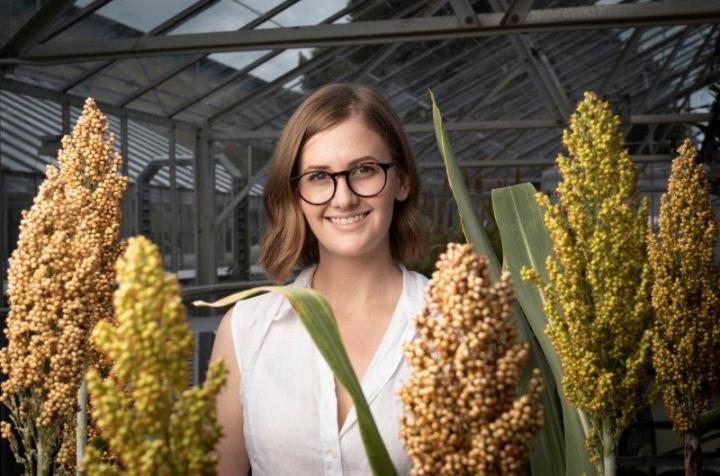
Credit: The University of Queensland
Gene editing technology will play a vital role in climate-proofing future crops to protect global food supplies, according to scientists at The University of Queensland.
Biotechnologist Dr Karen Massel from UQ’s Centre for Crop Science has published a review of gene editing technologies such as CRISPR-Cas9 to safeguard food security in farming systems under stress from extreme and variable climate conditions.
“Farmers have been manipulating the DNA of plants using conventional breeding technologies for millennia, and now with new gene-editing technologies, we can do this with unprecedented safety, precision and speed,” Dr Massel said.
“This type of gene editing mimics the way cells repair in nature.”
Her review recommended integrating CRISPR-Cas9 genome editing into modern breeding programs for crop improvement in cereals.
Energy-rich cereal crops such as wheat, rice, maize and sorghum provide two-thirds of the world’s food energy intake.
“Just 15 plant crops provide 90 per cent of the world’s food calories,” Dr Massel said.
“It’s a race between a changing climate and plant breeders’ ability to produce crops with genetic resilience that grow well in adverse conditions and have enriched nutritional qualities.
“The problem is that it takes too long for breeders to detect and make that genetic diversity available to farmers, with a breeding cycle averaging about 15 years for cereal crops.
“Plus CRISPR allows us to do things we can’t do through conventional breeding in terms of generating novel diversity and improving breeding for desirable traits.”
In proof-of-concept studies, Dr Massel and colleagues at the Queensland Alliance for Agriculture and Food Innovation (QAAFI) applied gene editing technology to sorghum and barley pre-breeding programs.
“In sorghum, we edited the plant’s genes to unlock the digestibility level of the available protein and to boost its nutritional value for humans and livestock,” she said.
“We’ve also used gene-editing to modify the canopy architecture and root architecture of both sorghum and barley, to improve water use efficiency.”
Dr Massel’s research also compared the different genome sequences of cereals – including wild variants and ancestors of modern cereals – to differences in crop performance in different climates and under different kinds of stresses.
“Wild varieties of production crops serve as a reservoir of genetic diversity, which is especially valuable when it comes to climate resilience,” she said.
“We are looking for genes or gene networks that will improve resilience in adverse growing climates.
“Once a viable gene variant is identified, the trick is to re-create it directly in high-performing cultivated crops without disrupting the delicate balance of genetics related to production traits.
“These kinds of changes can be so subtle that they are indistinguishable from the naturally occurring variants that inspired them.”
In 2019, Australia’s Office of the Gene Technology Regulator deregulated gene-editing, differentiating it from genetically modified organism (GMO) technology.
Gene edited crops are not yet grown in Australia, but biosecurity and safety risk assessments of the technology are currently being undertaken.
###
This research is funded by an Australian Research Council Discovery grant with support from the Queensland Department of Agriculture and Fisheries and The University of Queensland.
This research is published in Theoretical and Applied Genetics (DOI: 10.1007/s00122-020-03764-0).
Media Contact
Margaret Puls
[email protected]
Original Source
https:/
Related Journal Article
http://dx.



