• HOME
  • NEWS
  • EXPLORE
    • CAREER
      • Companies
      • Jobs
    • EVENTS
    • iGEM
      • News
      • Team
    • PHOTOS
    • VIDEO
    • WIKI
  • BLOG
  • COMMUNITY
    • FACEBOOK
    • INSTAGRAM
    • TWITTER
Wednesday, October 7, 2026
BIOENGINEER.ORG
No Result
View All Result
  • Login
  • HOME
  • NEWS
  • EXPLORE
    • CAREER
      • Companies
      • Jobs
        • Lecturer
        • PhD Studentship
        • Postdoc
        • Research Assistant
    • EVENTS
    • iGEM
      • News
      • Team
    • PHOTOS
    • VIDEO
    • WIKI
  • BLOG
  • COMMUNITY
    • FACEBOOK
    • INSTAGRAM
    • TWITTER
  • HOME
  • NEWS
  • EXPLORE
    • CAREER
      • Companies
      • Jobs
        • Lecturer
        • PhD Studentship
        • Postdoc
        • Research Assistant
    • EVENTS
    • iGEM
      • News
      • Team
    • PHOTOS
    • VIDEO
    • WIKI
  • BLOG
  • COMMUNITY
    • FACEBOOK
    • INSTAGRAM
    • TWITTER
No Result
View All Result
Bioengineer.org
No Result
View All Result
Home NEWS Science News Health

Host cell fusion in bacteria infection alarms immune system, causing host cell destruction

Bioengineer by Bioengineer
July 8, 2020
in Health
Reading Time: 3 mins read
0
IMAGE
Share on FacebookShare on TwitterShare on LinkedinShare on RedditShare on Telegram

IMAGE

Credit: Dr Gan Yunn Hwen

Burkholderia pseudomallei is a bacterium in the soil that causes melioidosis, a tropical disease with high morbidity and mortality. Recently, researchers at the NUS Yong Loo Lin School of Medicine discovered that Burkholderia infection sets off a series of events that provoke the host’s immune system and cause the infected cells to self-destruct. The work was published on 22 June in the prestigious journal Proceedings of the National Academy of Sciences U.S.A.

When Burkholderia pseudomallei infects cells, it can cause the infected cells to fuse with other cells around them, forming giant cells with many nuclei. Dr Joanne Wei-Kay Ku and Associate Professor Gan Yunn Hwen, both from the Department of Biochemistry and the NUSMed Infectious Disease Programme, as well as their co-authors found that this cell fusion event stimulated the type 1 interferon (IFN) signaling pathway, which modulates the immune system to fight against invading pathogens such as bacteria and viruses.

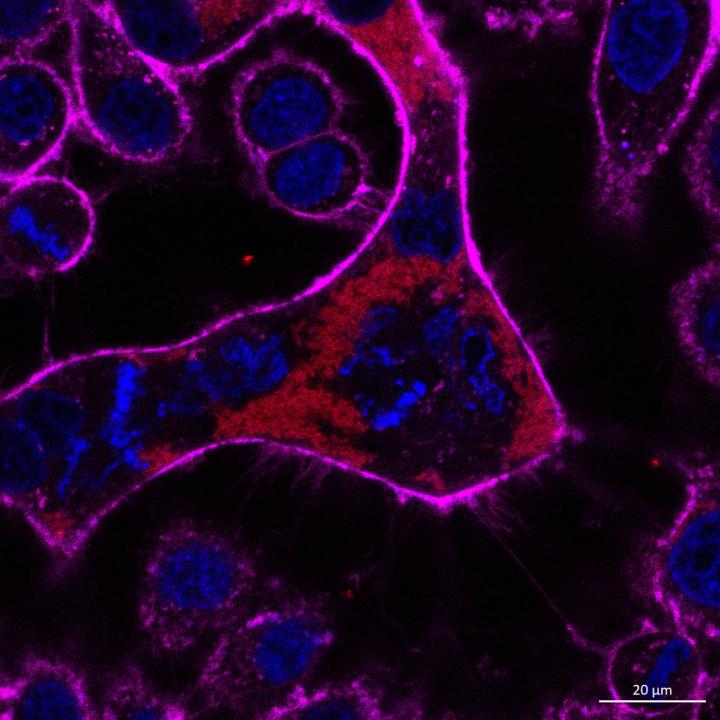
Interestingly, the act of the cells fusing, rather than the bacterial infection, was the trigger to the immune system because the type 1 IFN signaling pathway was also stimulated when cell fusion was induced by the addition of a chemical. The researchers found that the giant cells did not behave like normal cells. Firstly, they started to divide but could not complete the process (Images 1 and 2; Video). Secondly, the DNA in the giant cells was damaged, making it more unstable (prone to changes such as mutations). These are ripe conditions for the cells to transform into cancer cells.

One of the hallmarks of damaged, unstable DNA is the presence of micronuclei, which form when bits of DNA fail to segregate properly during cell division. When these micronuclei rupture (which they are prone to do), the DNA is made accessible to factors in the cytosol. A/Prof Gan and team observed micronuclei in the giant cells and a corresponding activation of the cGAS-STING pathway of the immune system, which senses the out-of-place DNA and is known to lead to type 1 IFN signaling.

However, under the onslaught of extensive cell fusion, the activated cGAS-STING pathway turns on an unusual death program known as autophagy instead of producing type 1 IFN. This causes these abnormal giant cells to self-destruct. Since unnatural cell fusion is often accompanied with DNA damage and instability, the killing mechanism could be a powerful way to destroy cells before they become cancerous.

The ability of our immune system to “sense” different forms of danger such as viral or bacterial invaders is well known. However, it took an unusual pathogen like Burkholderia bacteria for researchers to discover that abnormal cell fusion is a novel danger signal sensed by the immune system. These findings add to our understanding of how the immune system resists abnormally fused cells, whether a result of infections or through exposure to chemicals, from turning into cancer cells.

A/Prof Gan further explained the importance of knowing your enemy, “Our microbial adversaries are often our best teachers. Learning how to cure and control infections are critically important. However, understanding the interactions between pathogen and host is equally important, because it allows us to discover what our immune system is capable or incapable of, and these fundamental discoveries can give us new perspectives in maintaining health and treating disease.”

###

Media Contact
Gwen Khoo
[email protected]

Related Journal Article

http://dx.doi.org/10.1073/pnas.2006908117

Tags: BacteriologyBiologycancerImmunology/Allergies/AsthmaInfectious/Emerging DiseasesMedicine/HealthMicrobiology
Share12Tweet8Share2ShareShareShare2

Related Posts

Doctors Know Stigmatizing Words Harm Patients, Yet Most Cannot Spot Them in Charts

Doctors Know Stigmatizing Words Harm Patients, Yet Most Cannot Spot Them in Charts

October 7, 2026
Transplant Drug Rewires Prostate Tissue in Two Distinct Phases, Rat Study Finds

Transplant Drug Rewires Prostate Tissue in Two Distinct Phases, Rat Study Finds

October 7, 2026

Liver Metastases Shorten Survival on Chemotherapy but Not Immunotherapy in Pancreatic Cancer

October 7, 2026

A Simple Electrical Measure May Predict Who Develops Sarcopenia

October 7, 2026
Please login to join discussion

POPULAR NEWS

  • Alloys That Shrink Their Own Grains: New PIX Mechanism Refines Metals With Heat Alone

    Alloys That Shrink Their Own Grains: New PIX Mechanism Refines Metals With Heat Alone

    29 shares
    Share 12 Tweet 7
  • Endurance Exercise Reshapes the Liver in Males and Females Through Distinct Molecular Routes

    29 shares
    Share 12 Tweet 7
  • Single Transcription Factor PU.1 Rapidly Converts Fibroblasts into Macrophage-Lineage Cells

    29 shares
    Share 12 Tweet 7
  • New Scale Measures How Ready Nurse Educators Really Are for the AI Era

    29 shares
    Share 12 Tweet 7

About

We bring you the latest biotechnology news from best research centers and universities around the world. Check our website.

Follow us

Recent News

Alloys That Shrink Their Own Grains: New PIX Mechanism Refines Metals With Heat Alone

Endurance Exercise Reshapes the Liver in Males and Females Through Distinct Molecular Routes

Single Transcription Factor PU.1 Rapidly Converts Fibroblasts into Macrophage-Lineage Cells

Subscribe to Blog via Email

Success! An email was just sent to confirm your subscription. Please find the email now and click 'Confirm' to start subscribing.

Join 85 other subscribers
  • Contact Us

Bioengineer.org © Copyright 2023 All Rights Reserved.

Welcome Back!

Login to your account below

Forgotten Password?

Retrieve your password

Please enter your username or email address to reset your password.

Log In
No Result
View All Result
  • Homepages
    • Home Page 1
    • Home Page 2
  • News
  • National
  • Business
  • Health
  • Lifestyle
  • Science

Bioengineer.org © Copyright 2023 All Rights Reserved.